

7 Studies on, the Use and Protection of Springs in Poland
125
a contact area for groundwater, surface water, terrestrial, and soil fauna. In Poland,
a share of crenobionts in the spring niche fauna is usually small, when compared
to crenophiles and crenoxenes. All the same, a significant individualism in fauna is
observed at individual locations [105].
Components of a natural landscape. Springs, as the points of groundwater outflow,
play an important role in shaping the structure of natural and transformed landscapes
of Poland. When they are present, they usually have a significant share in their
shaping. The groundwater outflow points and their niches can be found at different
altitudes and different morphological locations. They also differ in the forms and
dynamics of water outflow, as well as in water quality and temperature, and in the
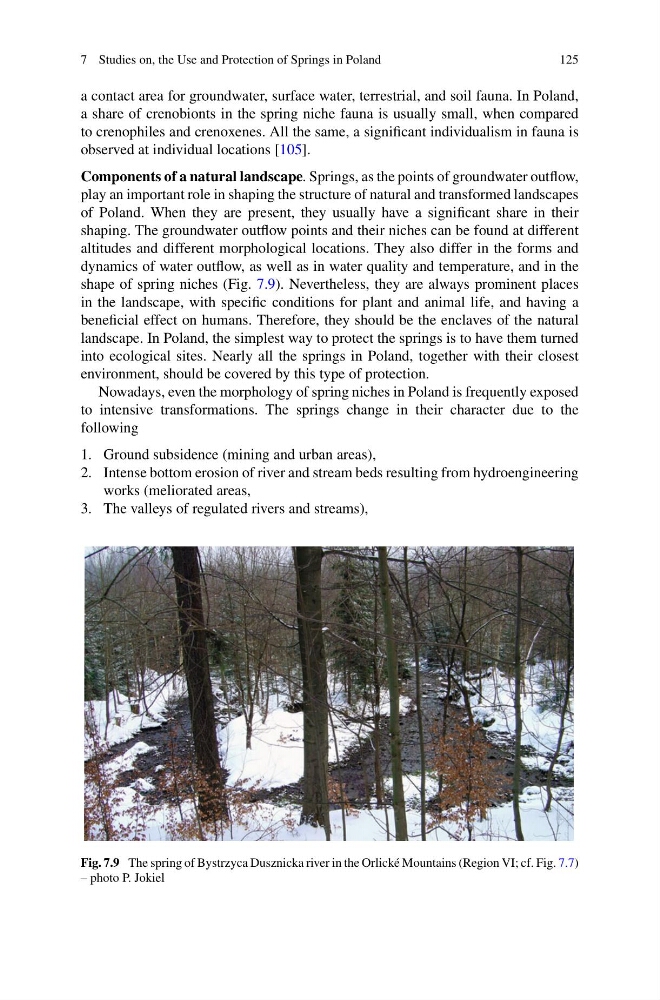
shape of spring niches (Fig. 7.9). Nevertheless, they are always prominent places
in the landscape, with specific conditions for plant and animal life, and having a
beneficial effect on humans. Therefore, they should be the enclaves of the natural
landscape. In Poland, the simplest way to protect the springs is to have them turned
into ecological sites. Nearly all the springs in Poland, together with their closest
environment, should be covered by this type of protection.
Nowadays, even the morphology of spring niches in Poland is frequently exposed
to intensive transformations. The springs change in their character due to the
following
1. Ground subsidence (mining and urban areas),
2. Intense bottom erosion of river and stream beds resulting from hydroengineering
works (meliorated areas,
3. The valleys of regulated rivers and streams),
Fig. 7.9 The spring of Bystrzyca Dusznicka river in the Orlické Mountains (Region VI; cf. Fig. 7.7)
– photo P. Jokiel
125
a contact area for groundwater, surface water, terrestrial, and soil fauna. In Poland,
a share of crenobionts in the spring niche fauna is usually small, when compared
to crenophiles and crenoxenes. All the same, a significant individualism in fauna is
observed at individual locations [105].
Components of a natural landscape. Springs, as the points of groundwater outflow,
play an important role in shaping the structure of natural and transformed landscapes
of Poland. When they are present, they usually have a significant share in their
shaping. The groundwater outflow points and their niches can be found at different
altitudes and different morphological locations. They also differ in the forms and
dynamics of water outflow, as well as in water quality and temperature, and in the
shape of spring niches (Fig. 7.9). Nevertheless, they are always prominent places
in the landscape, with specific conditions for plant and animal life, and having a
beneficial effect on humans. Therefore, they should be the enclaves of the natural
landscape. In Poland, the simplest way to protect the springs is to have them turned
into ecological sites. Nearly all the springs in Poland, together with their closest
environment, should be covered by this type of protection.
Nowadays, even the morphology of spring niches in Poland is frequently exposed
to intensive transformations. The springs change in their character due to the
following
1. Ground subsidence (mining and urban areas),
2. Intense bottom erosion of river and stream beds resulting from hydroengineering
works (meliorated areas,
3. The valleys of regulated rivers and streams),
Fig. 7.9 The spring of Bystrzyca Dusznicka river in the Orlické Mountains (Region VI; cf. Fig. 7.7)
– photo P. Jokiel