

124
P. Jokiel and Z. Michalczyk
discharge, hydrological conditions, and the physico-chemical parameters of water,
as well as, increasingly often, various hydrobiological properties of spring waters
and niches. Recently, the geomorphological aspect, seepage erosion, in particular,
has also been noted with its significant contribution to the development of the relief
and a fluvial system. It was documented that, in Poland, the groundwater outflows
initiate the formation of new watercourses and they also extend the existing courses
by stimulating headward erosion. They may also lead to the branching of a local
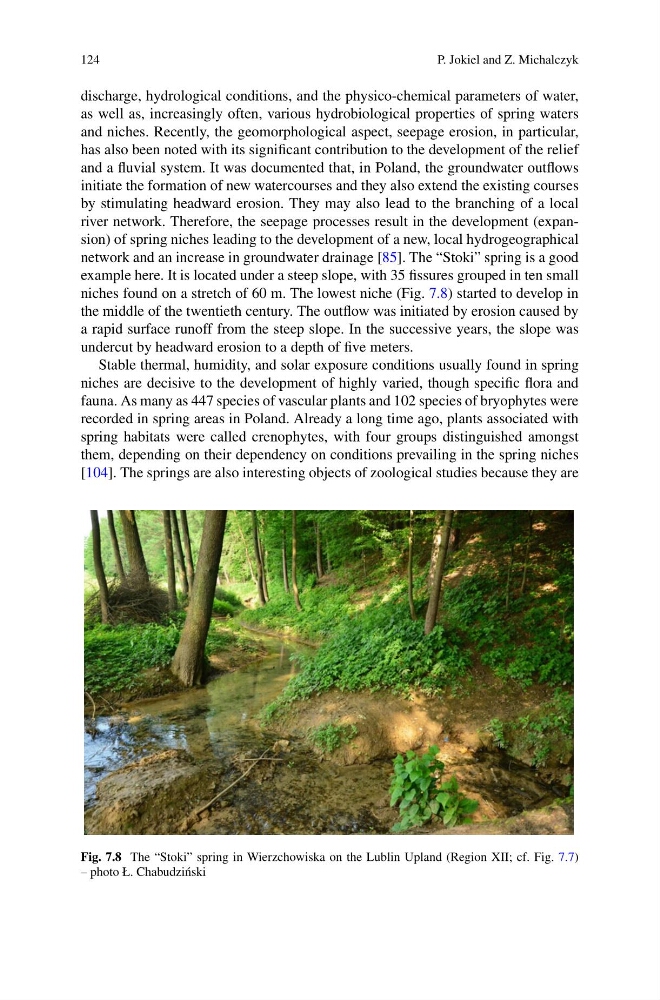
river network. Therefore, the seepage processes result in the development (expansion) of spring niches leading to the development of a new, local hydrogeographical
network and an increase in groundwater drainage [85]. The “Stoki” spring is a good
example here. It is located under a steep slope, with 35 fissures grouped in ten small
niches found on a stretch of 60 m. The lowest niche (Fig. 7.8) started to develop in
the middle of the twentieth century. The outflow was initiated by erosion caused by
a rapid surface runoff from the steep slope. In the successive years, the slope was
undercut by headward erosion to a depth of five meters.
Stable thermal, humidity, and solar exposure conditions usually found in spring
niches are decisive to the development of highly varied, though specific flora and
fauna. As many as 447 species of vascular plants and 102 species of bryophytes were
recorded in spring areas in Poland. Already a long time ago, plants associated with
spring habitats were called crenophytes, with four groups distinguished amongst
them, depending on their dependency on conditions prevailing in the spring niches
[104]. The springs are also interesting objects of zoological studies because they are
Fig. 7.8 The “Stoki” spring in Wierzchowiska on the Lublin Upland (Region XII; cf. Fig. 7.7)
– photo Ł. Chabudzi´ nski
P. Jokiel and Z. Michalczyk
discharge, hydrological conditions, and the physico-chemical parameters of water,
as well as, increasingly often, various hydrobiological properties of spring waters
and niches. Recently, the geomorphological aspect, seepage erosion, in particular,
has also been noted with its significant contribution to the development of the relief
and a fluvial system. It was documented that, in Poland, the groundwater outflows
initiate the formation of new watercourses and they also extend the existing courses
by stimulating headward erosion. They may also lead to the branching of a local
river network. Therefore, the seepage processes result in the development (expansion) of spring niches leading to the development of a new, local hydrogeographical
network and an increase in groundwater drainage [85]. The “Stoki” spring is a good
example here. It is located under a steep slope, with 35 fissures grouped in ten small
niches found on a stretch of 60 m. The lowest niche (Fig. 7.8) started to develop in
the middle of the twentieth century. The outflow was initiated by erosion caused by
a rapid surface runoff from the steep slope. In the successive years, the slope was
undercut by headward erosion to a depth of five meters.
Stable thermal, humidity, and solar exposure conditions usually found in spring
niches are decisive to the development of highly varied, though specific flora and
fauna. As many as 447 species of vascular plants and 102 species of bryophytes were
recorded in spring areas in Poland. Already a long time ago, plants associated with
spring habitats were called crenophytes, with four groups distinguished amongst
them, depending on their dependency on conditions prevailing in the spring niches
[104]. The springs are also interesting objects of zoological studies because they are
Fig. 7.8 The “Stoki” spring in Wierzchowiska on the Lublin Upland (Region XII; cf. Fig. 7.7)
– photo Ł. Chabudzi´ nski