

7 Studies on, the Use and Protection of Springs in Poland
123
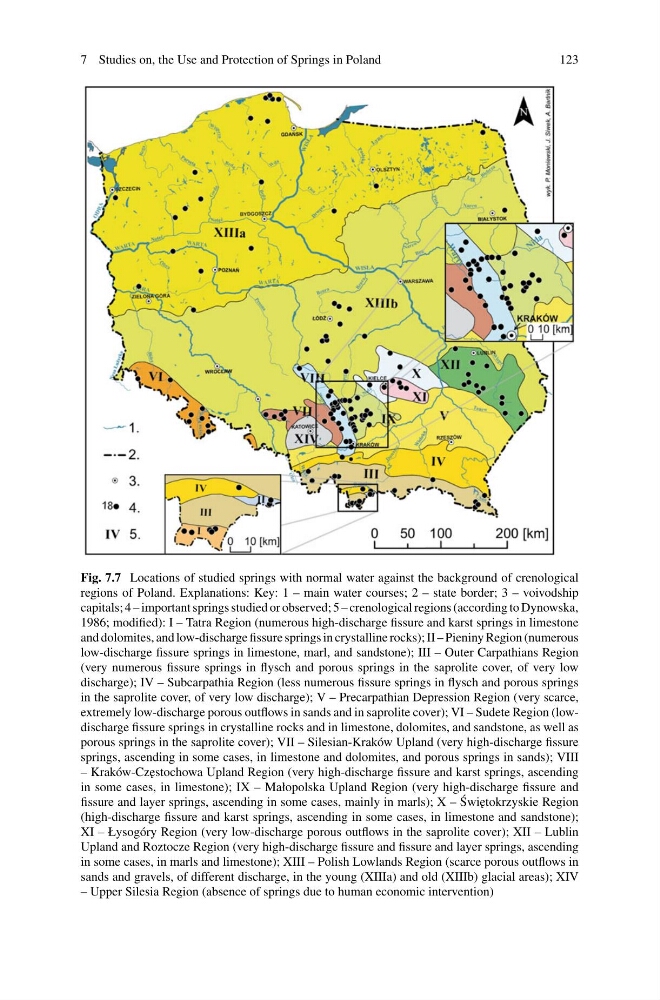
Fig. 7.7 Locations of studied springs with normal water against the background of crenological
regions of Poland. Explanations: Key: 1 – main water courses; 2 – state border; 3 – voivodship
capitals; 4 – important springs studied or observed; 5 – crenological regions (according to Dynowska,
1986; modified): I – Tatra Region (numerous high-discharge fissure and karst springs in limestone
and dolomites, and low-discharge fissure springs in crystalline rocks); II – Pieniny Region (numerous
low-discharge fissure springs in limestone, marl, and sandstone); III – Outer Carpathians Region
(very numerous fissure springs in flysch and porous springs in the saprolite cover, of very low
discharge); IV – Subcarpathia Region (less numerous fissure springs in flysch and porous springs
in the saprolite cover, of very low discharge); V – Precarpathian Depression Region (very scarce,
extremely low-discharge porous outflows in sands and in saprolite cover); VI – Sudete Region (lowdischarge fissure springs in crystalline rocks and in limestone, dolomites, and sandstone, as well as
porous springs in the saprolite cover); VII – Silesian-Kraków Upland (very high-discharge fissure
springs, ascending in some cases, in limestone and dolomites, and porous springs in sands); VIII
– Kraków-Cz˛ estochowa Upland Region (very high-discharge fissure and karst springs, ascending
in some cases, in limestone); IX – Małopolska Upland Region (very high-discharge fissure and
fissure and layer springs, ascending in some cases, mainly in marls); X – ´
Swi˛ etokrzyskie Region
(high-discharge fissure and karst springs, ascending in some cases, in limestone and sandstone);
XI – Łysogóry Region (very low-discharge porous outflows in the saprolite cover); XII – Lublin
Upland and Roztocze Region (very high-discharge fissure and fissure and layer springs, ascending
in some cases, in marls and limestone); XIII – Polish Lowlands Region (scarce porous outflows in
sands and gravels, of different discharge, in the young (XIIIa) and old (XIIIb) glacial areas); XIV
– Upper Silesia Region (absence of springs due to human economic intervention)
123
Fig. 7.7 Locations of studied springs with normal water against the background of crenological
regions of Poland. Explanations: Key: 1 – main water courses; 2 – state border; 3 – voivodship
capitals; 4 – important springs studied or observed; 5 – crenological regions (according to Dynowska,
1986; modified): I – Tatra Region (numerous high-discharge fissure and karst springs in limestone
and dolomites, and low-discharge fissure springs in crystalline rocks); II – Pieniny Region (numerous
low-discharge fissure springs in limestone, marl, and sandstone); III – Outer Carpathians Region
(very numerous fissure springs in flysch and porous springs in the saprolite cover, of very low
discharge); IV – Subcarpathia Region (less numerous fissure springs in flysch and porous springs
in the saprolite cover, of very low discharge); V – Precarpathian Depression Region (very scarce,
extremely low-discharge porous outflows in sands and in saprolite cover); VI – Sudete Region (lowdischarge fissure springs in crystalline rocks and in limestone, dolomites, and sandstone, as well as
porous springs in the saprolite cover); VII – Silesian-Kraków Upland (very high-discharge fissure
springs, ascending in some cases, in limestone and dolomites, and porous springs in sands); VIII
– Kraków-Cz˛ estochowa Upland Region (very high-discharge fissure and karst springs, ascending
in some cases, in limestone); IX – Małopolska Upland Region (very high-discharge fissure and
fissure and layer springs, ascending in some cases, mainly in marls); X – ´
Swi˛ etokrzyskie Region
(high-discharge fissure and karst springs, ascending in some cases, in limestone and sandstone);
XI – Łysogóry Region (very low-discharge porous outflows in the saprolite cover); XII – Lublin
Upland and Roztocze Region (very high-discharge fissure and fissure and layer springs, ascending
in some cases, in marls and limestone); XIII – Polish Lowlands Region (scarce porous outflows in
sands and gravels, of different discharge, in the young (XIIIa) and old (XIIIb) glacial areas); XIV
– Upper Silesia Region (absence of springs due to human economic intervention)