

126
P. Jokiel and Z. Michalczyk
4. Development of local and regional depression zones in groundwater’s (opencast
areas, urban areas, zones affected by water intakes),
5. Ground leveling and backfilling of niche hollows, frequently with waste
(suburban forests, areas of new districts, industrial and road investment areas),
and
6. Many other factors related to the wide notion of urbanization and industrialization.
At the same time, concentrated outflows of leachate waters appear at the edges
of many coal waste heaps in Silesia, forming specific “anthropogenic springs.” In
some of them, the discharge can even exceed 10 dm
3
× s
−1 . In most cases, they
are descending outflows. In some cases, (e.g., the heap in Skrzyszów near Jastrz˛ ebie
Zdrój), such “spring” can be of an ascending type, due to colmatation of some heap
material layers [106]. Also, the construction of artificial water reservoirs supports the
formation of anthropogenic springs. An example here is the dam and the reservoir
on the Czarna Przemsza in Przeczyce, where the river water damming resulted in
the water inflow to fissure systems located higher and what was called “vampires”
by local people appeared below the dam. A horror of horrors, one of them was even
found in the cellar of the dam management building [107].
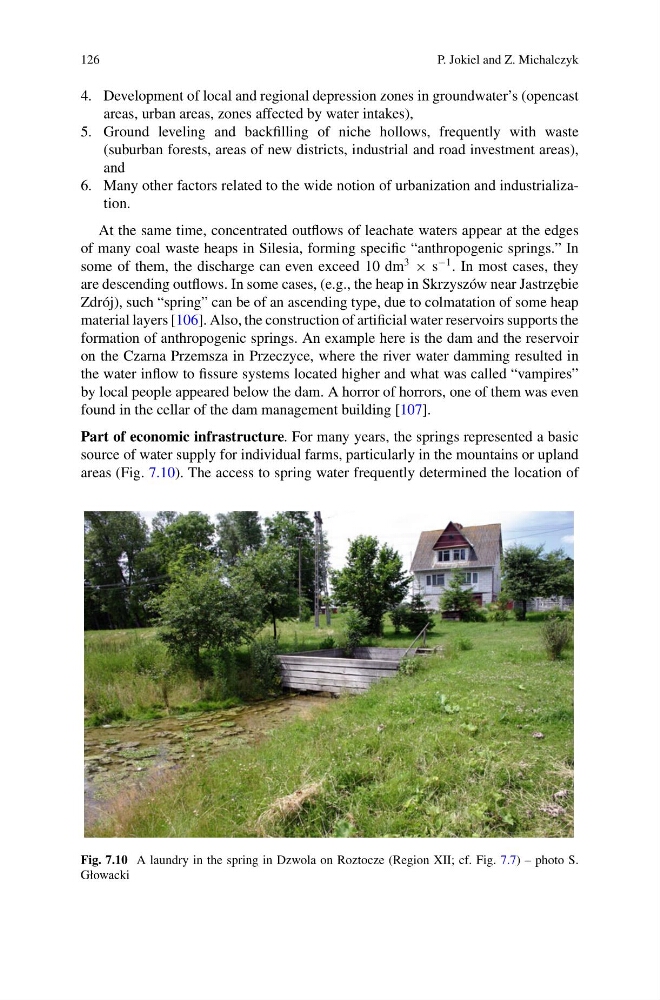
Part of economic infrastructure. For many years, the springs represented a basic
source of water supply for individual farms, particularly in the mountains or upland
areas (Fig. 7.10). The access to spring water frequently determined the location of
Fig. 7.10 A laundry in the spring in Dzwola on Roztocze (Region XII; cf. Fig. 7.7) – photo S.
Głowacki
P. Jokiel and Z. Michalczyk
4. Development of local and regional depression zones in groundwater’s (opencast
areas, urban areas, zones affected by water intakes),
5. Ground leveling and backfilling of niche hollows, frequently with waste
(suburban forests, areas of new districts, industrial and road investment areas),
and
6. Many other factors related to the wide notion of urbanization and industrialization.
At the same time, concentrated outflows of leachate waters appear at the edges
of many coal waste heaps in Silesia, forming specific “anthropogenic springs.” In
some of them, the discharge can even exceed 10 dm
3
× s
−1 . In most cases, they
are descending outflows. In some cases, (e.g., the heap in Skrzyszów near Jastrz˛ ebie
Zdrój), such “spring” can be of an ascending type, due to colmatation of some heap
material layers [106]. Also, the construction of artificial water reservoirs supports the
formation of anthropogenic springs. An example here is the dam and the reservoir
on the Czarna Przemsza in Przeczyce, where the river water damming resulted in
the water inflow to fissure systems located higher and what was called “vampires”
by local people appeared below the dam. A horror of horrors, one of them was even
found in the cellar of the dam management building [107].
Part of economic infrastructure. For many years, the springs represented a basic
source of water supply for individual farms, particularly in the mountains or upland
areas (Fig. 7.10). The access to spring water frequently determined the location of
Fig. 7.10 A laundry in the spring in Dzwola on Roztocze (Region XII; cf. Fig. 7.7) – photo S.
Głowacki