

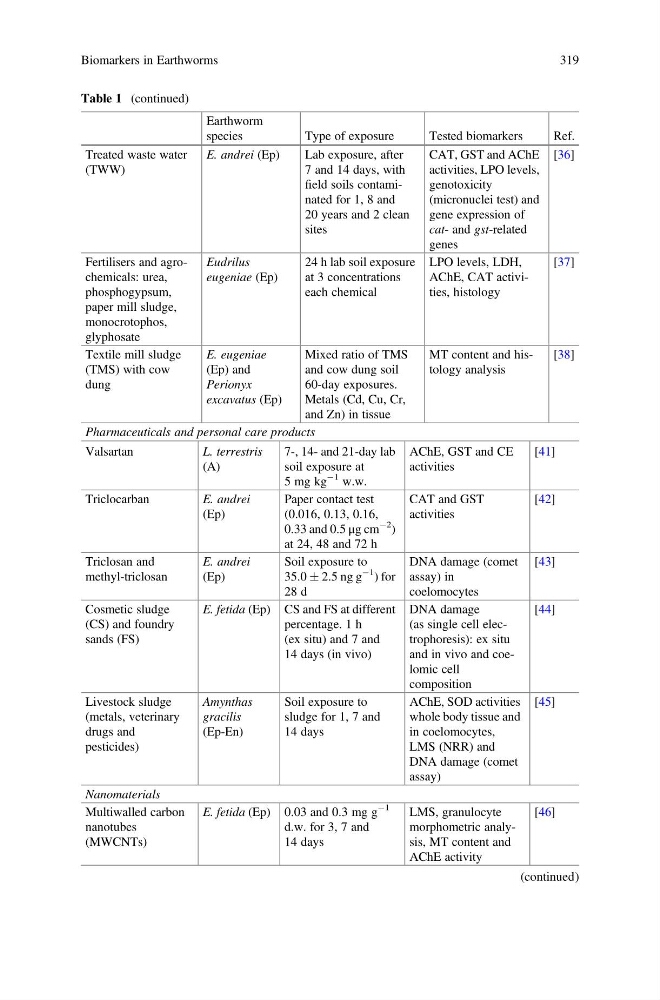
Table 1 (continued)
Earthworm
species
Type of exposure
Tested biomarkers
Ref.
Treated waste water
(TWW)
E. andrei (Ep)
Lab exposure, after
7 and 14 days, with
field soils contaminated for 1, 8 and
20 years and 2 clean
sites
CAT, GST and AChE
activities, LPO levels,
genotoxicity
(micronuclei test) and
gene expression of
cat- and gst-related
genes
[36]
Fertilisers and agrochemicals: urea,
phosphogypsum,
paper mill sludge,
monocrotophos,
glyphosate
Eudrilus
eugeniae (Ep)
24 h lab soil exposure
at 3 concentrations
each chemical
LPO levels, LDH,
AChE, CAT activities, histology
[37]
Textile mill sludge
(TMS) with cow
dung
E. eugeniae
(Ep) and
Perionyx
excavatus (Ep)
Mixed ratio of TMS
and cow dung soil
60-day exposures.
Metals (Cd, Cu, Cr,
and Zn) in tissue
MT content and histology analysis
[38]
Pharmaceuticals and personal care products
Valsartan
L. terrestris
(A)
7-, 14- and 21-day lab
soil exposure at
5 mg kg
À1 w.w.
AChE, GST and CE
activities
[41]
Triclocarban
E. andrei
(Ep)
Paper contact test
(0.016, 0.13, 0.16,
0.33 and 0.5 μg cm
À2
)
at 24, 48 and 72 h
CAT and GST
activities
[42]
Triclosan and
methyl-triclosan
E. andrei
(Ep)
Soil exposure to
35.0 Æ 2.5 ng g
À1
) for
28 d
DNA damage (comet
assay) in
coelomocytes
[43]
Cosmetic sludge
(CS) and foundry
sands (FS)
E. fetida (Ep) CS and FS at different
percentage. 1 h
(ex situ) and 7 and
14 days (in vivo)
DNA damage
(as single cell electrophoresis): ex situ
and in vivo and coelomic cell
composition
[44]
Livestock sludge
(metals, veterinary
drugs and
pesticides)
Amynthas
gracilis
(Ep-En)
Soil exposure to
sludge for 1, 7 and
14 days
AChE, SOD activities
whole body tissue and
in coelomocytes,
LMS (NRR) and
DNA damage (comet
assay)
[45]
Nanomaterials
Multiwalled carbon
nanotubes
(MWCNTs)
E. fetida (Ep) 0.03 and 0.3 mg g
À1
d.w. for 3, 7 and
14 days
LMS, granulocyte
morphometric analysis, MT content and
AChE activity
[46]
(continued)
Biomarkers in Earthworms
319
Earthworm
species
Type of exposure
Tested biomarkers
Ref.
Treated waste water
(TWW)
E. andrei (Ep)
Lab exposure, after
7 and 14 days, with
field soils contaminated for 1, 8 and
20 years and 2 clean
sites
CAT, GST and AChE
activities, LPO levels,
genotoxicity
(micronuclei test) and
gene expression of
cat- and gst-related
genes
[36]
Fertilisers and agrochemicals: urea,
phosphogypsum,
paper mill sludge,
monocrotophos,
glyphosate
Eudrilus
eugeniae (Ep)
24 h lab soil exposure
at 3 concentrations
each chemical
LPO levels, LDH,
AChE, CAT activities, histology
[37]
Textile mill sludge
(TMS) with cow
dung
E. eugeniae
(Ep) and
Perionyx
excavatus (Ep)
Mixed ratio of TMS
and cow dung soil
60-day exposures.
Metals (Cd, Cu, Cr,
and Zn) in tissue
MT content and histology analysis
[38]
Pharmaceuticals and personal care products
Valsartan
L. terrestris
(A)
7-, 14- and 21-day lab
soil exposure at
5 mg kg
À1 w.w.
AChE, GST and CE
activities
[41]
Triclocarban
E. andrei
(Ep)
Paper contact test
(0.016, 0.13, 0.16,
0.33 and 0.5 μg cm
À2
)
at 24, 48 and 72 h
CAT and GST
activities
[42]
Triclosan and
methyl-triclosan
E. andrei
(Ep)
Soil exposure to
35.0 Æ 2.5 ng g
À1
) for
28 d
DNA damage (comet
assay) in
coelomocytes
[43]
Cosmetic sludge
(CS) and foundry
sands (FS)
E. fetida (Ep) CS and FS at different
percentage. 1 h
(ex situ) and 7 and
14 days (in vivo)
DNA damage
(as single cell electrophoresis): ex situ
and in vivo and coelomic cell
composition
[44]
Livestock sludge
(metals, veterinary
drugs and
pesticides)
Amynthas
gracilis
(Ep-En)
Soil exposure to
sludge for 1, 7 and
14 days
AChE, SOD activities
whole body tissue and
in coelomocytes,
LMS (NRR) and
DNA damage (comet
assay)
[45]
Nanomaterials
Multiwalled carbon
nanotubes
(MWCNTs)
E. fetida (Ep) 0.03 and 0.3 mg g
À1
d.w. for 3, 7 and
14 days
LMS, granulocyte
morphometric analysis, MT content and
AChE activity
[46]
(continued)
Biomarkers in Earthworms
319