

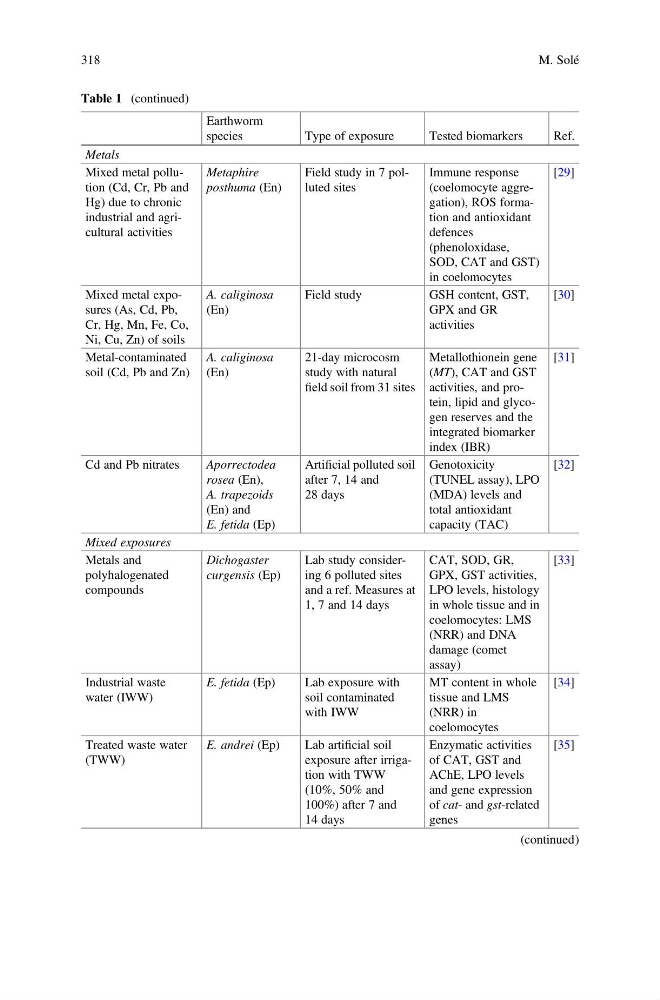
Table 1 (continued)
Earthworm
species
Type of exposure
Tested biomarkers
Ref.
Metals
Mixed metal pollution (Cd, Cr, Pb and
Hg) due to chronic
industrial and agricultural activities
Metaphire
posthuma (En)
Field study in 7 polluted sites
Immune response
(coelomocyte aggregation), ROS formation and antioxidant
defences
(phenoloxidase,
SOD, CAT and GST)
in coelomocytes
[29]
Mixed metal exposures (As, Cd, Pb,
Cr, Hg, Mn, Fe, Co,
Ni, Cu, Zn) of soils
A. caliginosa
(En)
Field study
GSH content, GST,
GPX and GR
activities
[30]
Metal-contaminated
soil (Cd, Pb and Zn)
A. caliginosa
(En)
21-day microcosm
study with natural
field soil from 31 sites
Metallothionein gene
(MT), CAT and GST
activities, and protein, lipid and glycogen reserves and the
integrated biomarker
index (IBR)
[31]
Cd and Pb nitrates
Aporrectodea
rosea (En),
A. trapezoids
(En) and
E. fetida (Ep)
Artificial polluted soil
after 7, 14 and
28 days
Genotoxicity
(TUNEL assay), LPO
(MDA) levels and
total antioxidant
capacity (TAC)
[32]
Mixed exposures
Metals and
polyhalogenated
compounds
Dichogaster
curgensis (Ep)
Lab study considering 6 polluted sites
and a ref. Measures at
1, 7 and 14 days
CAT, SOD, GR,
GPX, GST activities,
LPO levels, histology
in whole tissue and in
coelomocytes: LMS
(NRR) and DNA
damage (comet
assay)
[33]
Industrial waste
water (IWW)
E. fetida (Ep)
Lab exposure with
soil contaminated
with IWW
MT content in whole
tissue and LMS
(NRR) in
coelomocytes
[34]
Treated waste water
(TWW)
E. andrei (Ep)
Lab artificial soil
exposure after irrigation with TWW
(10%, 50% and
100%) after 7 and
14 days
Enzymatic activities
of CAT, GST and
AChE, LPO levels
and gene expression
of cat- and gst-related
genes
[35]
(continued)
318
M. Solé
Earthworm
species
Type of exposure
Tested biomarkers
Ref.
Metals
Mixed metal pollution (Cd, Cr, Pb and
Hg) due to chronic
industrial and agricultural activities
Metaphire
posthuma (En)
Field study in 7 polluted sites
Immune response
(coelomocyte aggregation), ROS formation and antioxidant
defences
(phenoloxidase,
SOD, CAT and GST)
in coelomocytes
[29]
Mixed metal exposures (As, Cd, Pb,
Cr, Hg, Mn, Fe, Co,
Ni, Cu, Zn) of soils
A. caliginosa
(En)
Field study
GSH content, GST,
GPX and GR
activities
[30]
Metal-contaminated
soil (Cd, Pb and Zn)
A. caliginosa
(En)
21-day microcosm
study with natural
field soil from 31 sites
Metallothionein gene
(MT), CAT and GST
activities, and protein, lipid and glycogen reserves and the
integrated biomarker
index (IBR)
[31]
Cd and Pb nitrates
Aporrectodea
rosea (En),
A. trapezoids
(En) and
E. fetida (Ep)
Artificial polluted soil
after 7, 14 and
28 days
Genotoxicity
(TUNEL assay), LPO
(MDA) levels and
total antioxidant
capacity (TAC)
[32]
Mixed exposures
Metals and
polyhalogenated
compounds
Dichogaster
curgensis (Ep)
Lab study considering 6 polluted sites
and a ref. Measures at
1, 7 and 14 days
CAT, SOD, GR,
GPX, GST activities,
LPO levels, histology
in whole tissue and in
coelomocytes: LMS
(NRR) and DNA
damage (comet
assay)
[33]
Industrial waste
water (IWW)
E. fetida (Ep)
Lab exposure with
soil contaminated
with IWW
MT content in whole
tissue and LMS
(NRR) in
coelomocytes
[34]
Treated waste water
(TWW)
E. andrei (Ep)
Lab artificial soil
exposure after irrigation with TWW
(10%, 50% and
100%) after 7 and
14 days
Enzymatic activities
of CAT, GST and
AChE, LPO levels
and gene expression
of cat- and gst-related
genes
[35]
(continued)
318
M. Solé