

74
some cases, a portion of the straight-run gas oil was included in the catalytic cracker
feed [30].
The hydrocarbons injected into the FCC as feedstock come from a vacuum distillation tower and boil in the gas oil range of 350–550 °C+. FCC is flexible enough to
process gas oils from other secondary units such as delayed coker and hydrocracker.
The feed is preheated to 260–370 °C. The FCC products drawn off from a fractionator are generally used to heat this [31]. The degree of preheat can influence the
reactor temperature and catalyst circulation, thereby affecting product yields to
some extent.
The main feedstocks for FCC units are as follows:
• Straight-run feedstocks.
– Flashed distillate (~370–580 °C) from high vacuum units.
– Short residue from high vacuum units.
– Light long residue (~370+) from crude distillation units.
• Hydrogenated feedstocks.
– Hydrotreated flashed distillate.
– Hydrowax from hydrocracker bottom.
– Hydrogenated cycle oils.
• Miscellaneous.
– Heavy gas oil.
– Coker gas oil.
Besides the above-mentioned sources of hydrocarbon feedstock, refiners often
recycle some portion of the streams from the fractionator. These streams like heavy
cycle oil (HCO) and clarified oil (CLO) are heavy and aromatic rich mixtures,
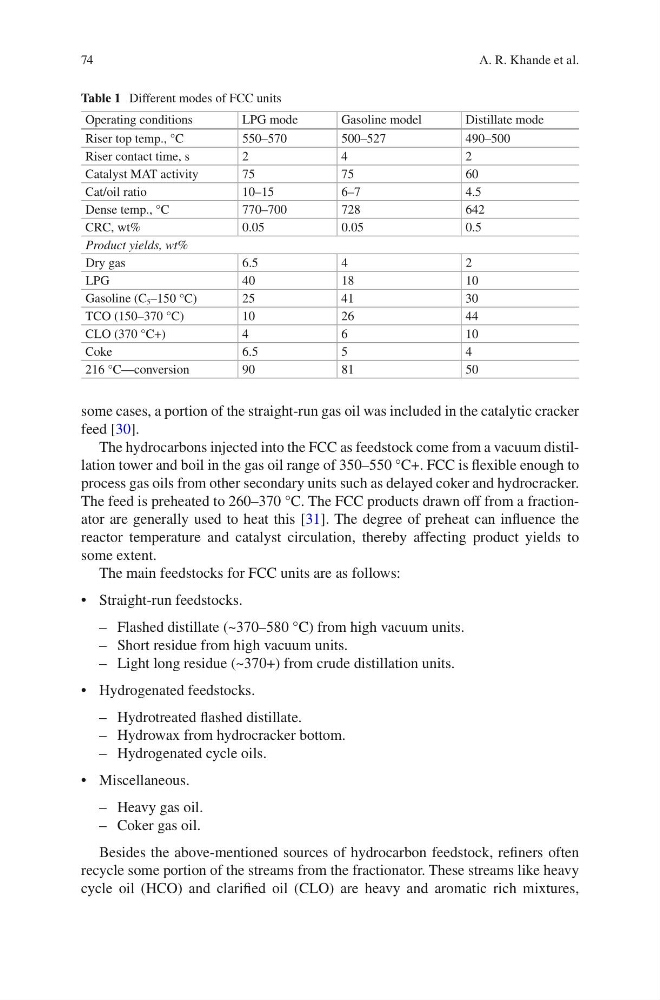
Table 1 Different modes of FCC units
Operating conditions
LPG mode
Gasoline model
Distillate mode
Riser top temp., °C
550–570
500–527
490–500
Riser contact time, s
2
4
2
Catalyst MAT activity
75
75
60
Cat/oil ratio
10–15
6–7
4.5
Dense temp., °C
770–700
728
642
CRC, wt%
0.05
0.05
0.5
Product yields, wt%
Dry gas
6.5
4
2
LPG
40
18
10
Gasoline (C 5 –150 °C)
25
41
30
TCO (150–370 °C)
10
26
44
CLO (370 °C+)
4
6
10
Coke
6.5
5
4
216 °C—conversion
90
81
50
A. R. Khande et al.
some cases, a portion of the straight-run gas oil was included in the catalytic cracker
feed [30].
The hydrocarbons injected into the FCC as feedstock come from a vacuum distillation tower and boil in the gas oil range of 350–550 °C+. FCC is flexible enough to
process gas oils from other secondary units such as delayed coker and hydrocracker.
The feed is preheated to 260–370 °C. The FCC products drawn off from a fractionator are generally used to heat this [31]. The degree of preheat can influence the
reactor temperature and catalyst circulation, thereby affecting product yields to
some extent.
The main feedstocks for FCC units are as follows:
• Straight-run feedstocks.
– Flashed distillate (~370–580 °C) from high vacuum units.
– Short residue from high vacuum units.
– Light long residue (~370+) from crude distillation units.
• Hydrogenated feedstocks.
– Hydrotreated flashed distillate.
– Hydrowax from hydrocracker bottom.
– Hydrogenated cycle oils.
• Miscellaneous.
– Heavy gas oil.
– Coker gas oil.
Besides the above-mentioned sources of hydrocarbon feedstock, refiners often
recycle some portion of the streams from the fractionator. These streams like heavy
cycle oil (HCO) and clarified oil (CLO) are heavy and aromatic rich mixtures,
Table 1 Different modes of FCC units
Operating conditions
LPG mode
Gasoline model
Distillate mode
Riser top temp., °C
550–570
500–527
490–500
Riser contact time, s
2
4
2
Catalyst MAT activity
75
75
60
Cat/oil ratio
10–15
6–7
4.5
Dense temp., °C
770–700
728
642
CRC, wt%
0.05
0.05
0.5
Product yields, wt%
Dry gas
6.5
4
2
LPG
40
18
10
Gasoline (C 5 –150 °C)
25
41
30
TCO (150–370 °C)
10
26
44
CLO (370 °C+)
4
6
10
Coke
6.5
5
4
216 °C—conversion
90
81
50
A. R. Khande et al.