

73
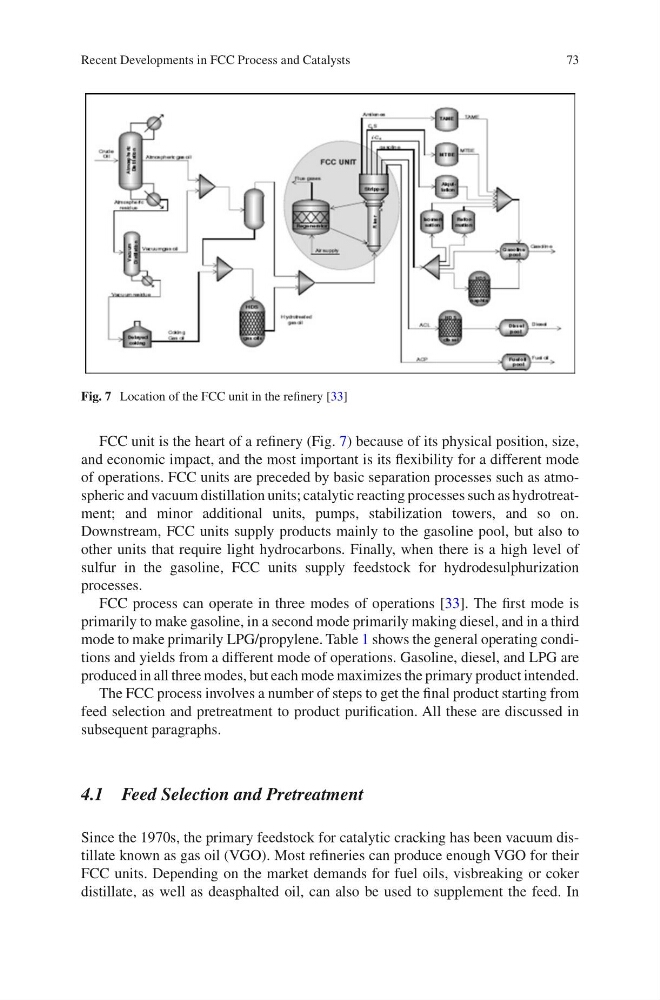
FCC unit is the heart of a refinery (Fig. 7) because of its physical position, size,
and economic impact, and the most important is its flexibility for a different mode
of operations. FCC units are preceded by basic separation processes such as atmospheric and vacuum distillation units; catalytic reacting processes such as hydrotreatment; and minor additional units, pumps, stabilization towers, and so on.
Downstream, FCC units supply products mainly to the gasoline pool, but also to
other units that require light hydrocarbons. Finally, when there is a high level of
sulfur in the gasoline, FCC units supply feedstock for hydrodesulphurization
processes.
FCC process can operate in three modes of operations [33]. The first mode is
primarily to make gasoline, in a second mode primarily making diesel, and in a third
mode to make primarily LPG/propylene. Table 1 shows the general operating conditions and yields from a different mode of operations. Gasoline, diesel, and LPG are
produced in all three modes, but each mode maximizes the primary product intended.
The FCC process involves a number of steps to get the final product starting from
feed selection and pretreatment to product purification. All these are discussed in
subsequent paragraphs.
4.1 Feed Selection and Pretreatment
Since the 1970s, the primary feedstock for catalytic cracking has been vacuum distillate known as gas oil (VGO). Most refineries can produce enough VGO for their
FCC units. Depending on the market demands for fuel oils, visbreaking or coker
distillate, as well as deasphalted oil, can also be used to supplement the feed. In
Fig. 7 Location of the FCC unit in the refinery [33]
Recent Developments in FCC Process and Catalysts
FCC unit is the heart of a refinery (Fig. 7) because of its physical position, size,
and economic impact, and the most important is its flexibility for a different mode
of operations. FCC units are preceded by basic separation processes such as atmospheric and vacuum distillation units; catalytic reacting processes such as hydrotreatment; and minor additional units, pumps, stabilization towers, and so on.
Downstream, FCC units supply products mainly to the gasoline pool, but also to
other units that require light hydrocarbons. Finally, when there is a high level of
sulfur in the gasoline, FCC units supply feedstock for hydrodesulphurization
processes.
FCC process can operate in three modes of operations [33]. The first mode is
primarily to make gasoline, in a second mode primarily making diesel, and in a third
mode to make primarily LPG/propylene. Table 1 shows the general operating conditions and yields from a different mode of operations. Gasoline, diesel, and LPG are
produced in all three modes, but each mode maximizes the primary product intended.
The FCC process involves a number of steps to get the final product starting from
feed selection and pretreatment to product purification. All these are discussed in
subsequent paragraphs.
4.1 Feed Selection and Pretreatment
Since the 1970s, the primary feedstock for catalytic cracking has been vacuum distillate known as gas oil (VGO). Most refineries can produce enough VGO for their
FCC units. Depending on the market demands for fuel oils, visbreaking or coker
distillate, as well as deasphalted oil, can also be used to supplement the feed. In
Fig. 7 Location of the FCC unit in the refinery [33]
Recent Developments in FCC Process and Catalysts