

72
4 The FCC Process
Fluid catalytic cracking (FCC) is a secondary refining process for conversion of
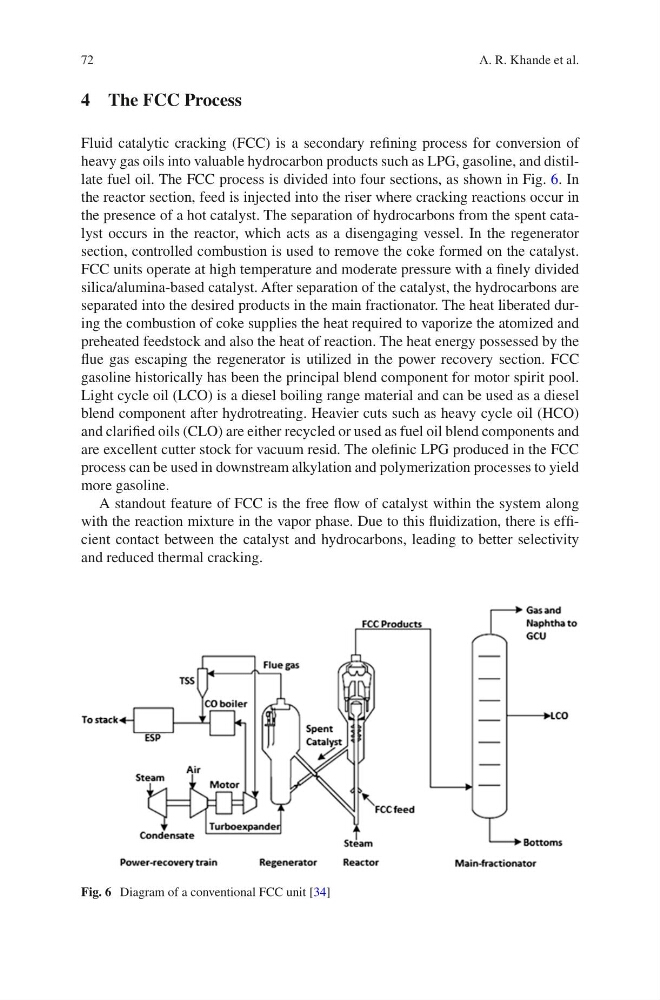
heavy gas oils into valuable hydrocarbon products such as LPG, gasoline, and distillate fuel oil. The FCC process is divided into four sections, as shown in Fig. 6. In
the reactor section, feed is injected into the riser where cracking reactions occur in
the presence of a hot catalyst. The separation of hydrocarbons from the spent catalyst occurs in the reactor, which acts as a disengaging vessel. In the regenerator
section, controlled combustion is used to remove the coke formed on the catalyst.
FCC units operate at high temperature and moderate pressure with a finely divided
silica/alumina-based catalyst. After separation of the catalyst, the hydrocarbons are
separated into the desired products in the main fractionator. The heat liberated during the combustion of coke supplies the heat required to vaporize the atomized and
preheated feedstock and also the heat of reaction. The heat energy possessed by the
flue gas escaping the regenerator is utilized in the power recovery section. FCC
gasoline historically has been the principal blend component for motor spirit pool.
Light cycle oil (LCO) is a diesel boiling range material and can be used as a diesel
blend component after hydrotreating. Heavier cuts such as heavy cycle oil (HCO)
and clarified oils (CLO) are either recycled or used as fuel oil blend components and
are excellent cutter stock for vacuum resid. The olefinic LPG produced in the FCC
process can be used in downstream alkylation and polymerization processes to yield
more gasoline.
A standout feature of FCC is the free flow of catalyst within the system along
with the reaction mixture in the vapor phase. Due to this fluidization, there is efficient contact between the catalyst and hydrocarbons, leading to better selectivity
and reduced thermal cracking.
Fig. 6 Diagram of a conventional FCC unit [34]
A. R. Khande et al.
4 The FCC Process
Fluid catalytic cracking (FCC) is a secondary refining process for conversion of
heavy gas oils into valuable hydrocarbon products such as LPG, gasoline, and distillate fuel oil. The FCC process is divided into four sections, as shown in Fig. 6. In
the reactor section, feed is injected into the riser where cracking reactions occur in
the presence of a hot catalyst. The separation of hydrocarbons from the spent catalyst occurs in the reactor, which acts as a disengaging vessel. In the regenerator
section, controlled combustion is used to remove the coke formed on the catalyst.
FCC units operate at high temperature and moderate pressure with a finely divided
silica/alumina-based catalyst. After separation of the catalyst, the hydrocarbons are
separated into the desired products in the main fractionator. The heat liberated during the combustion of coke supplies the heat required to vaporize the atomized and
preheated feedstock and also the heat of reaction. The heat energy possessed by the
flue gas escaping the regenerator is utilized in the power recovery section. FCC
gasoline historically has been the principal blend component for motor spirit pool.
Light cycle oil (LCO) is a diesel boiling range material and can be used as a diesel
blend component after hydrotreating. Heavier cuts such as heavy cycle oil (HCO)
and clarified oils (CLO) are either recycled or used as fuel oil blend components and
are excellent cutter stock for vacuum resid. The olefinic LPG produced in the FCC
process can be used in downstream alkylation and polymerization processes to yield
more gasoline.
A standout feature of FCC is the free flow of catalyst within the system along
with the reaction mixture in the vapor phase. Due to this fluidization, there is efficient contact between the catalyst and hydrocarbons, leading to better selectivity
and reduced thermal cracking.
Fig. 6 Diagram of a conventional FCC unit [34]
A. R. Khande et al.