

75
which can be further cracked in the FCC. The remaining portion is blended and sold
as fuel oil.
FCC can process hydrocarbons having a wide tolerance of density, volatility, and
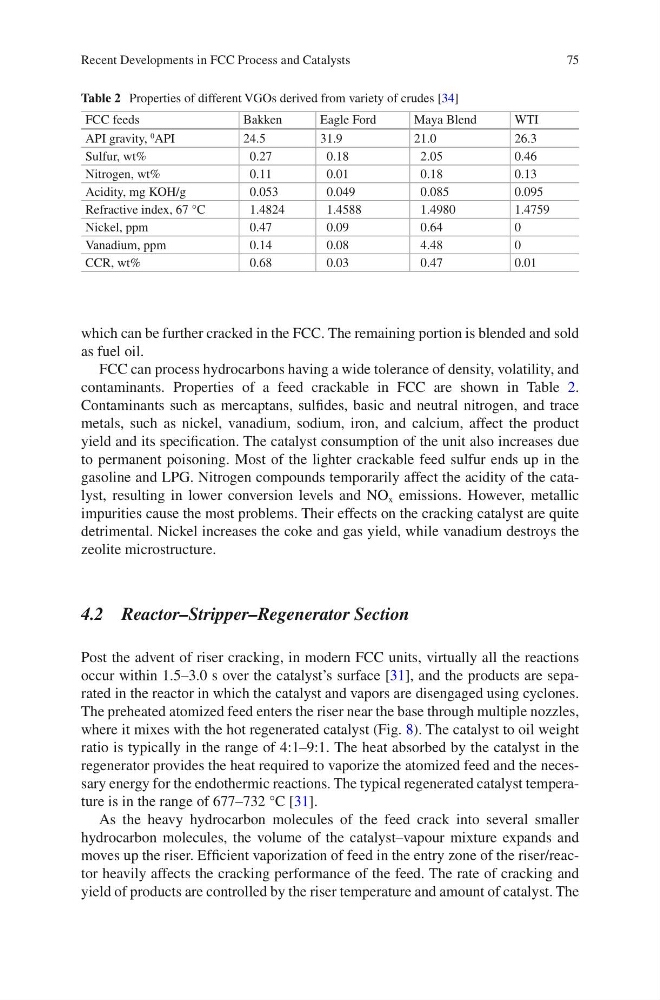
contaminants. Properties of a feed crackable in FCC are shown in Table 2.
Contaminants such as mercaptans, sulfides, basic and neutral nitrogen, and trace
metals, such as nickel, vanadium, sodium, iron, and calcium, affect the product
yield and its specification. The catalyst consumption of the unit also increases due
to permanent poisoning. Most of the lighter crackable feed sulfur ends up in the
gasoline and LPG. Nitrogen compounds temporarily affect the acidity of the catalyst, resulting in lower conversion levels and NO x emissions. However, metallic
impurities cause the most problems. Their effects on the cracking catalyst are quite
detrimental. Nickel increases the coke and gas yield, while vanadium destroys the
zeolite microstructure.
4.2 Reactor–Stripper–Regenerator Section
Post the advent of riser cracking, in modern FCC units, virtually all the reactions
occur within 1.5–3.0 s over the catalyst’s surface [31], and the products are separated in the reactor in which the catalyst and vapors are disengaged using cyclones.
The preheated atomized feed enters the riser near the base through multiple nozzles,
where it mixes with the hot regenerated catalyst (Fig. 8). The catalyst to oil weight
ratio is typically in the range of 4:1–9:1. The heat absorbed by the catalyst in the
regenerator provides the heat required to vaporize the atomized feed and the necessary energy for the endothermic reactions. The typical regenerated catalyst temperature is in the range of 677–732 °C [31].
As the heavy hydrocarbon molecules of the feed crack into several smaller
hydrocarbon molecules, the volume of the catalyst–vapour mixture expands and
moves up the riser. Efficient vaporization of feed in the entry zone of the riser/reactor heavily affects the cracking performance of the feed. The rate of cracking and
yield of products are controlled by the riser temperature and amount of catalyst. The
Table 2 Properties of different VGOs derived from variety of crudes [34]
FCC feeds
Bakken
Eagle Ford
Maya Blend
WTI
API gravity,
0
API
24.5
31.9
21.0
26.3
Sulfur, wt%
0.27
0.18
2.05
0.46
Nitrogen, wt%
0.11
0.01
0.18
0.13
Acidity, mg KOH/g
0.053
0.049
0.085
0.095
Refractive index, 67 °C
1.4824
1.4588
1.4980
1.4759
Nickel, ppm
0.47
0.09
0.64
0
Vanadium, ppm
0.14
0.08
4.48
0
CCR, wt%
0.68
0.03
0.47
0.01
Recent Developments in FCC Process and Catalysts
which can be further cracked in the FCC. The remaining portion is blended and sold
as fuel oil.
FCC can process hydrocarbons having a wide tolerance of density, volatility, and
contaminants. Properties of a feed crackable in FCC are shown in Table 2.
Contaminants such as mercaptans, sulfides, basic and neutral nitrogen, and trace
metals, such as nickel, vanadium, sodium, iron, and calcium, affect the product
yield and its specification. The catalyst consumption of the unit also increases due
to permanent poisoning. Most of the lighter crackable feed sulfur ends up in the
gasoline and LPG. Nitrogen compounds temporarily affect the acidity of the catalyst, resulting in lower conversion levels and NO x emissions. However, metallic
impurities cause the most problems. Their effects on the cracking catalyst are quite
detrimental. Nickel increases the coke and gas yield, while vanadium destroys the
zeolite microstructure.
4.2 Reactor–Stripper–Regenerator Section
Post the advent of riser cracking, in modern FCC units, virtually all the reactions
occur within 1.5–3.0 s over the catalyst’s surface [31], and the products are separated in the reactor in which the catalyst and vapors are disengaged using cyclones.
The preheated atomized feed enters the riser near the base through multiple nozzles,
where it mixes with the hot regenerated catalyst (Fig. 8). The catalyst to oil weight
ratio is typically in the range of 4:1–9:1. The heat absorbed by the catalyst in the
regenerator provides the heat required to vaporize the atomized feed and the necessary energy for the endothermic reactions. The typical regenerated catalyst temperature is in the range of 677–732 °C [31].
As the heavy hydrocarbon molecules of the feed crack into several smaller
hydrocarbon molecules, the volume of the catalyst–vapour mixture expands and
moves up the riser. Efficient vaporization of feed in the entry zone of the riser/reactor heavily affects the cracking performance of the feed. The rate of cracking and
yield of products are controlled by the riser temperature and amount of catalyst. The
Table 2 Properties of different VGOs derived from variety of crudes [34]
FCC feeds
Bakken
Eagle Ford
Maya Blend
WTI
API gravity,
0
API
24.5
31.9
21.0
26.3
Sulfur, wt%
0.27
0.18
2.05
0.46
Nitrogen, wt%
0.11
0.01
0.18
0.13
Acidity, mg KOH/g
0.053
0.049
0.085
0.095
Refractive index, 67 °C
1.4824
1.4588
1.4980
1.4759
Nickel, ppm
0.47
0.09
0.64
0
Vanadium, ppm
0.14
0.08
4.48
0
CCR, wt%
0.68
0.03
0.47
0.01
Recent Developments in FCC Process and Catalysts