

688
radical conditions. Recently, efforts were made to develop Ziegler-Natta catalysts
for polymerization of these monomers. However, early transition metals were oxophilic, and the titanium-, zirconium-, and chromium-based catalysts were easily
poisoned by these functional olefins possessing oxygen-based functional groups.
Late transition metals though less oxophilic possess weak catalytic efficiency and
produce oligomers of olefin. One of the approaches to circumvent this issue was to
protect the polar functional group present in the monomer during polymerization.
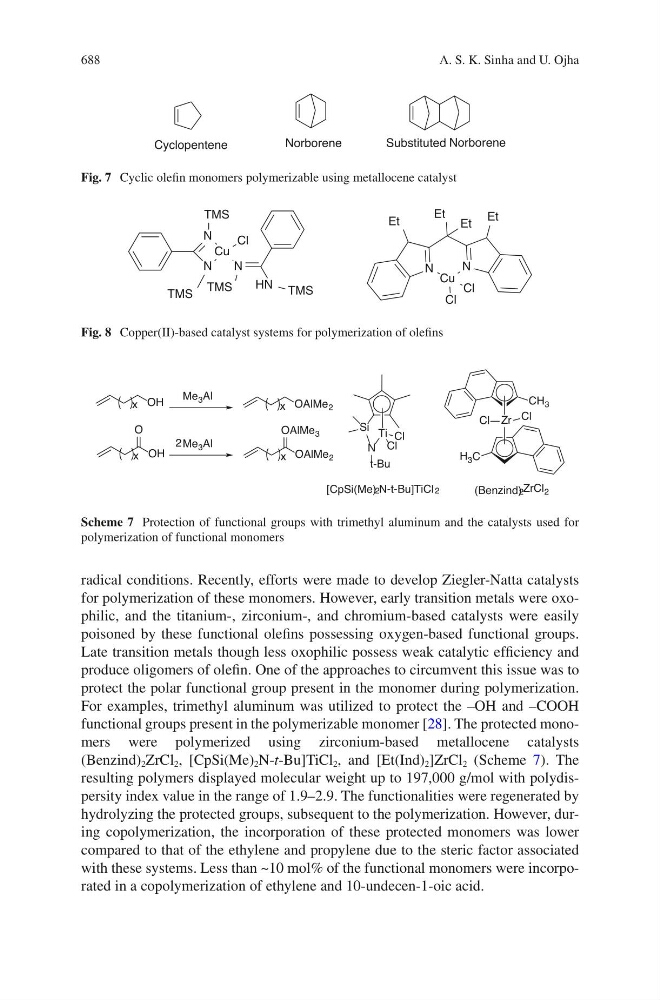
For examples, trimethyl aluminum was utilized to protect the –OH and –COOH
functional groups present in the polymerizable monomer [28]. The protected monomers were polymerized using zirconium-based metallocene catalysts
(Benzind) 2 ZrCl 2 , [CpSi(Me) 2 N-t-Bu]TiCl 2 , and [Et(Ind) 2 ]ZrCl 2 (Scheme 7). The
resulting polymers displayed molecular weight up to 197,000 g/mol with polydispersity index value in the range of 1.9–2.9. The functionalities were regenerated by
hydrolyzing the protected groups, subsequent to the polymerization. However, during copolymerization, the incorporation of these protected monomers was lower
compared to that of the ethylene and propylene due to the steric factor associated
with these systems. Less than ~10 mol% of the functional monomers were incorporated in a copolymerization of ethylene and 10-undecen-1-oic acid.
N
Cu
N
TMS
TMS
N
Cl
HN
TMS
TMS
N Cu
N
Et
Et Et
Et
Cl
Cl
Fig. 8 Copper(II)-based catalyst systems for polymerization of olefins
Cyclopentene
Norborene
Substituted Norborene
Fig. 7 Cyclic olefin monomers polymerizable using metallocene catalyst
OH
x
Me 3 Al
OAlMe 2
x
OH
x
O
OAlMe 2
x
Me 3 Al
OAlMe 3
2
Si Ti
N
t-Bu
Cl
Cl
CH 3
H 3 C
Zr
Cl
Cl
(Benzind) 2 ZrCl 2
[CpSi(Me)2N-t-Bu]TiCl2
Scheme 7 Protection of functional groups with trimethyl aluminum and the catalysts used for
polymerization of functional monomers
A. S. K. Sinha and U. Ojha