

687
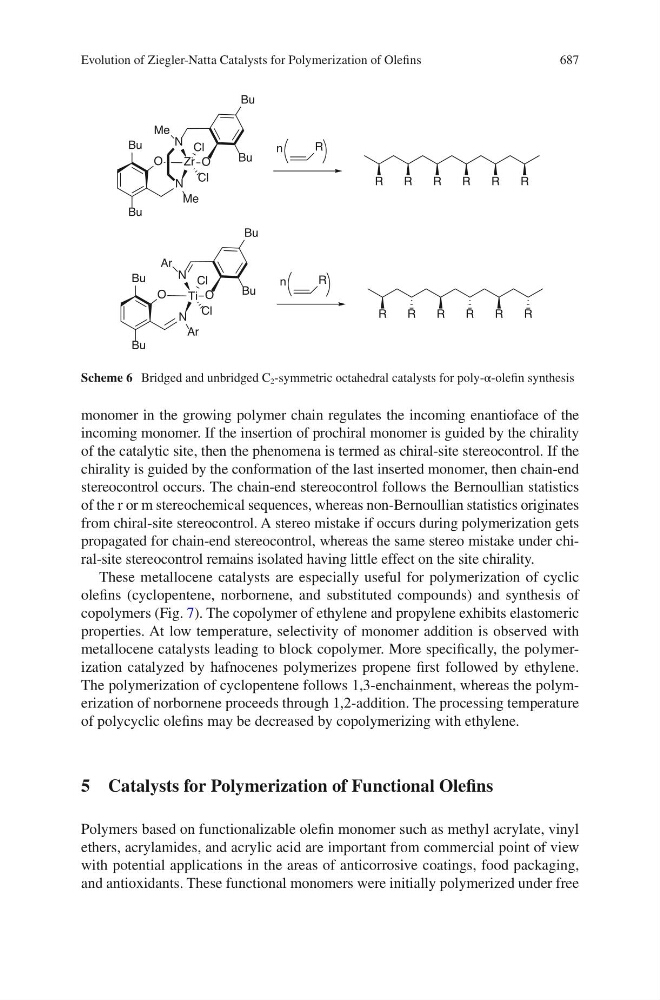
monomer in the growing polymer chain regulates the incoming enantioface of the
incoming monomer. If the insertion of prochiral monomer is guided by the chirality
of the catalytic site, then the phenomena is termed as chiral-site stereocontrol. If the
chirality is guided by the conformation of the last inserted monomer, then chain-end
stereocontrol occurs. The chain-end stereocontrol follows the Bernoullian statistics
of the r or m stereochemical sequences, whereas non-Bernoullian statistics originates
from chiral-site stereocontrol. A stereo mistake if occurs during polymerization gets
propagated for chain-end stereocontrol, whereas the same stereo mistake under chiral-site stereocontrol remains isolated having little effect on the site chirality.
These metallocene catalysts are especially useful for polymerization of cyclic
olefins (cyclopentene, norbornene, and substituted compounds) and synthesis of
copolymers (Fig. 7). The copolymer of ethylene and propylene exhibits elastomeric
properties. At low temperature, selectivity of monomer addition is observed with
metallocene catalysts leading to block copolymer. More specifically, the polymerization catalyzed by hafnocenes polymerizes propene first followed by ethylene.
The polymerization of cyclopentene follows 1,3-enchainment, whereas the polymerization of norbornene proceeds through 1,2-addition. The processing temperature
of polycyclic olefins may be decreased by copolymerizing with ethylene.
5 Catalysts for Polymerization of Functional Olefins
Polymers based on functionalizable olefin monomer such as methyl acrylate, vinyl
ethers, acrylamides, and acrylic acid are important from commercial point of view
with potential applications in the areas of anticorrosive coatings, food packaging,
and antioxidants. These functional monomers were initially polymerized under free
O
N
Bu
Bu
Me
Zr
N
Cl
Cl
O
Me
Bu
Bu
R
n
R
R
R
R
R
O
N
Bu
Bu
Ar
Ti
N
Cl
Cl
O
Ar
Bu
Bu
R
n
R
R
R
R
R
R
R
Scheme 6 Bridged and unbridged C 2 -symmetric octahedral catalysts for poly-α-olefin synthesis
Evolution of Ziegler-Natta Catalysts for Polymerization of Olefins