

689
5.1 Palladium- and Nickel-Based Catalyst Systems
With the evolution of cationic Pd(II) and Ni(II) α-diimine catalysts, the olefin
polymerization received a further boost. DuPont also commercialized this catalyst
with trade name Versipol. These catalyst systems polymerized olefin and α-olefin
and also copolymerized olefin with a range of functional olefins. The important
features of these catalyst systems were the highly electrophilic and cationic Ni or Pd
metal centers, use of bulky α-diimine ligands, and non-coordinating counterions.
The electrophilicity of the metal centers improved the rate of olefin insertion,
whereas the bulkiness of the ligands facilitated insertion in comparison with chain
transfer. The non-coordinating counterions provided site for the olefin coordination.
Easy and high-yield synthetic routes to α-diimine ligands allowed development a
range of catalyst based on Ni(II) and Pd(II). The cationic form of the catalyst is
essential for the catalytic activity. The catalyst precursor possessing a halide group
was treated with salts of non-coordinating anions to synthesize the cationic species.
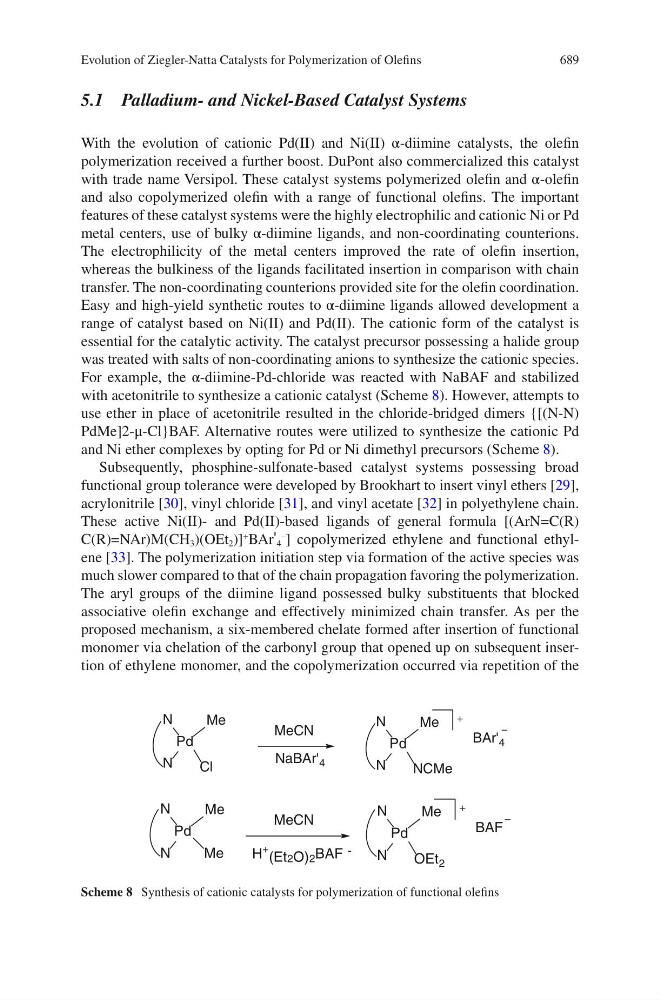
For example, the α-diimine-Pd-chloride was reacted with NaBAF and stabilized
with acetonitrile to synthesize a cationic catalyst (Scheme 8). However, attempts to
use ether in place of acetonitrile resulted in the chloride-bridged dimers {[(N-N)
PdMe]2-μ-Cl}BAF. Alternative routes were utilized to synthesize the cationic Pd
and Ni ether complexes by opting for Pd or Ni dimethyl precursors (Scheme 8).
Subsequently, phosphine-sulfonate-based catalyst systems possessing broad
functional group tolerance were developed by Brookhart to insert vinyl ethers [29],
acrylonitrile [30], vinyl chloride [31], and vinyl acetate [32] in polyethylene chain.
These active Ni(II)- and Pd(II)-based ligands of general formula [(ArN=C(R)
C(R)=NAr)M(CH 3 )(OEt 2 )]
+
BAr' 4
–
] copolymerized ethylene and functional ethylene [33]. The polymerization initiation step via formation of the active species was
much slower compared to that of the chain propagation favoring the polymerization.
The aryl groups of the diimine ligand possessed bulky substituents that blocked
associative olefin exchange and effectively minimized chain transfer. As per the
proposed mechanism, a six-membered chelate formed after insertion of functional
monomer via chelation of the carbonyl group that opened up on subsequent insertion of ethylene monomer, and the copolymerization occurred via repetition of the
N
Pd
N
Me
Cl
MeCN
NaBAr' 4
N
Pd
N
Me
NCMe
BAr' 4
N
Pd
N
Me
Me
MeCN
N
Pd
N
Me
OEt 2
BAF
H
+ (Et2O)2 BAF -
Scheme 8 Synthesis of cationic catalysts for polymerization of functional olefins
Evolution of Ziegler-Natta Catalysts for Polymerization of Olefins