

681
Bis(cyclopentadienyl)titanium chloride and trialkyl aluminum-based catalyst compositions were studied as possible homogeneous system for polymerization of
ethylene.
The catalytic activity of these systems was dependent on the chloride content of
these catalysts [13]. Interestingly, Vollmer and coworkers showed that in presence
of trace amount of water, these catalyst systems even in absence of chloride content
efficiently polymerized ethylene [14]. Furthermore, the molecular weight of resulting polymer was dependent on the polymerization temperature. For example, a
tri(cyclopentadienyl)zirconium- and trialkylaluminum-based catalyst system effectively polymerized ethylene, and the molecular weight increased from 40,000 to
1.5 × 10
6
g/mol on decreasing the temperature from 90 to 50 °C. Controlled synthesis of methylalumoxanes from trialkylaluminum in presence of water was proposed
to be the key factor in improving the efficiency of these systems [15]. Soon the
potential of Cp 2 MX 2 -AlR 3 systems as efficient polymerization catalyst was realized,
and systems based on other group 4 metals such as Zr or Hf were studied. However,
the polymerization of propylene in presence of bis(cyclopentadienyl)M(IV), where
M is Ti or Zr, and methylalumoxanes produced atactic structures (Fig. 4) [16].
Catalysts and conditions were optimized to produce isotactic and syndiotactic
polypropylene. Ewen synthesized a polypropylene with mmmmmrmmmmmr stereo sequence using bis(cyclopentadienyl)bis(phenyl)titanium catalyst system
(Fig. 5) [17]. Two successive methyl groups on same plane were assigned as a meso
(m)-diad, whereas two successive methyl groups in opposite plane are assigned as
racemic (r)-diad.
Nuclear magnetic resonance (NMR) spectroscopy was utilized to estimate the
population of stereospecific segments and corresponding configuration in the polypropylene samples. The relative intensities of pentads mostly followed a Bernoullian
statistical distribution of a chain-end controlled stereospecific polymerization
(Table 2). The
13
C NMR spectroscopic data revealed that under low temperature
conditions, the steric factor predominated the stereochemistry of monomer insertion
reaction. The
13
C resonances in the range of 19–23 ppm were studied to understand
the presence and population isotactic (m) type sequences in the polypropylene
chains. The m sequences were observed at higher chemical shift region (~21.5 ppm).
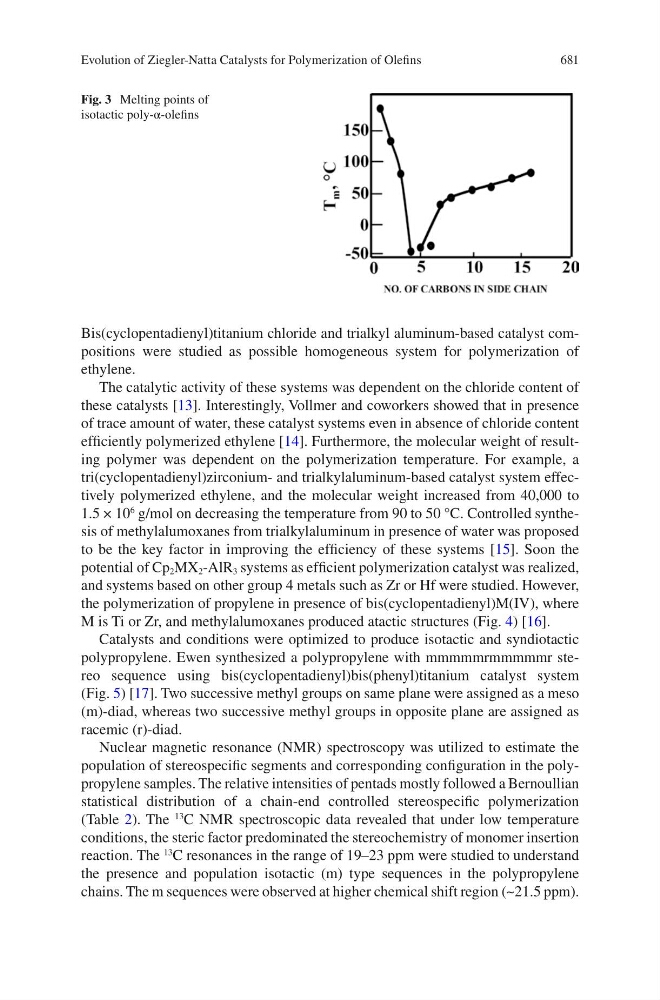
Fig. 3 Melting points of
isotactic poly-α-olefins
Evolution of Ziegler-Natta Catalysts for Polymerization of Olefins