

682
Similarly, the methylene (CH 2 ) carbons resonated in between 44 and 46 ppm [18].
The polymerization data revealed that the polypropylenes synthesized at low temperature (−45 °C) conditions possessed mmmm pentads with small amounts of
mmmr and mmrm pentads [17]. The stereoregularity of the polymer increased up to
85% on decreasing the polymerization temperature to −60 °C. Similarly, the VC1 4 -
Al(C 2 H 5 ) 2 Cl catalyst system produced syndiotactic polypropylene with similar stereoregularity [19]. Furthermore, the syndio-regulating ability is reinforced in
presence of cyclohexene, oxygen, or tert-butyl perbenzoate.
The bulkiness of R group in alkyl aluminum halide and the nature of halide
(when halide is chloride only) controlled the syndio-regularity of polymer. The
reaction conditions such as low temperature (−40 °C) and shorter polymerization
period favored the above stereospecificity of polypropylene. Addition of anisole as
donor with donor:V ratio as one under low conversion scenario and a non-polar
solvent like heptane complemented the yield of syndiotactic polypropylene. Boor
et al. proposed the mechanism to be coordination-anionic type with an alkylated
vanadium species acting as the active site. The initiation occurred with complexation of propylene to the V empty orbital (Scheme 4).
Subsequently, the CH 2 and CH of the monomer formed bond with V and R,
respectively, through a concerted four-membered ring pathway. During the course
m m
m
m
r
r
r
r
m
r
m
r
m
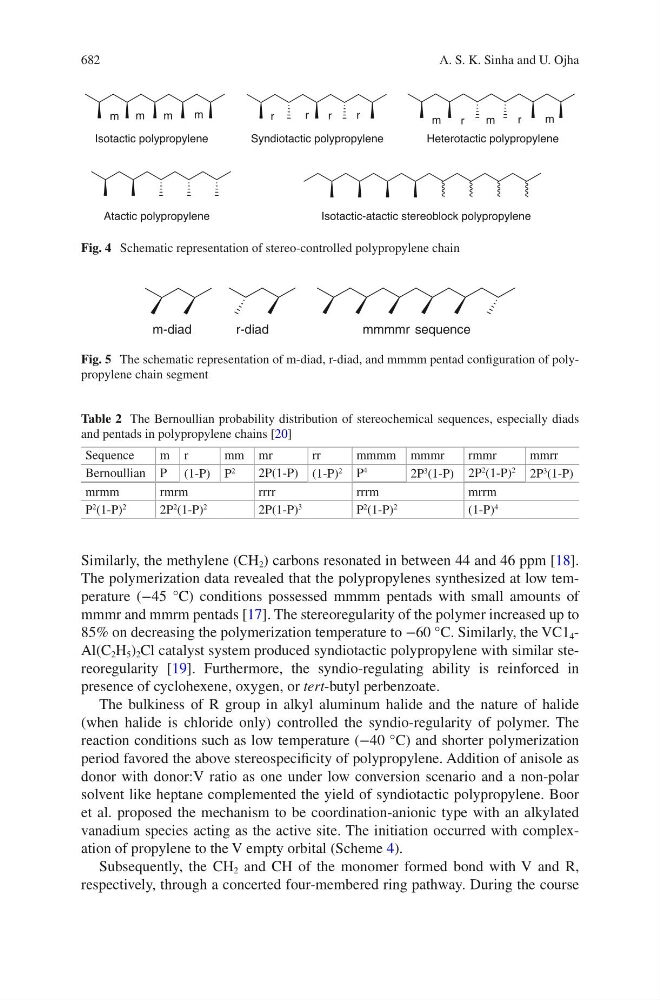
Isotactic-atactic stereoblock polypropylene
Atactic polypropylene
Isotactic polypropylene
Syndiotactic polypropylene
Heterotactic polypropylene
Fig. 4 Schematic representation of stereo-controlled polypropylene chain
m-diad
r-diad
mmmmr sequence
Fig. 5 The schematic representation of m-diad, r-diad, and mmmm pentad configuration of polypropylene chain segment
Table 2 The Bernoullian probability distribution of stereochemical sequences, especially diads
and pentads in polypropylene chains [20]
Sequence
m r
mm mr
rr
mmmm mmmr
rmmr
mmrr
Bernoullian P (1-P) P
2
2P(1-P) (1-P)
2
P
4
2P
3
(1-P) 2P
2
(1-P)
2
2P
3 (1-P)
mrmm
rmrm
rrrr
rrrm
mrrm
P
2
(1-P)
2
2P
2
(1-P)
2
2P(1-P)
3
P
2 (1-P)
2
(1-P)
4
A. S. K. Sinha and U. Ojha