

680
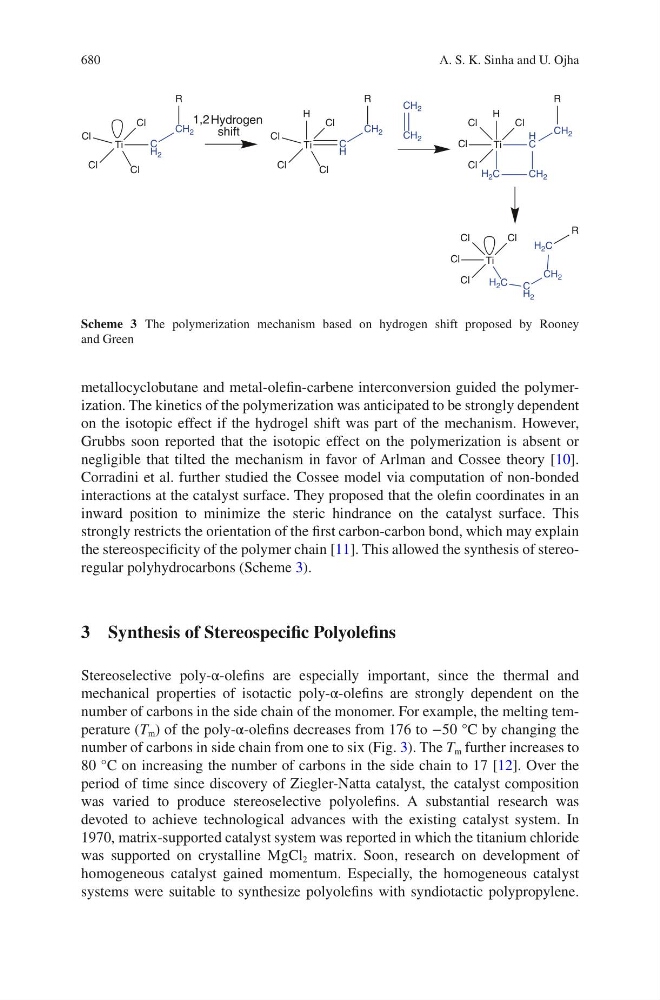
metallocyclobutane and metal-olefin-carbene interconversion guided the polymerization. The kinetics of the polymerization was anticipated to be strongly dependent
on the isotopic effect if the hydrogel shift was part of the mechanism. However,
Grubbs soon reported that the isotopic effect on the polymerization is absent or
negligible that tilted the mechanism in favor of Arlman and Cossee theory [10].
Corradini et al. further studied the Cossee model via computation of non-bonded
interactions at the catalyst surface. They proposed that the olefin coordinates in an
inward position to minimize the steric hindrance on the catalyst surface. This
strongly restricts the orientation of the first carbon-carbon bond, which may explain
the stereospecificity of the polymer chain [11]. This allowed the synthesis of stereoregular polyhydrocarbons (Scheme 3).
3 Synthesis of Stereospecific Polyolefins
Stereoselective poly-α-olefins are especially important, since the thermal and
mechanical properties of isotactic poly-α-olefins are strongly dependent on the
number of carbons in the side chain of the monomer. For example, the melting temperature (T m ) of the poly-α-olefins decreases from 176 to −50 °C by changing the
number of carbons in side chain from one to six (Fig. 3). The T m further increases to
80 °C on increasing the number of carbons in the side chain to 17 [12]. Over the
period of time since discovery of Ziegler-Natta catalyst, the catalyst composition
was varied to produce stereoselective polyolefins. A substantial research was
devoted to achieve technological advances with the existing catalyst system. In
1970, matrix-supported catalyst system was reported in which the titanium chloride
was supported on crystalline MgCl 2 matrix. Soon, research on development of
homogeneous catalyst gained momentum. Especially, the homogeneous catalyst
systems were suitable to synthesize polyolefins with syndiotactic polypropylene.
Cl
Ti
Cl
Cl
Cl
R
Cl
Ti
Cl
Cl
Cl
R
H
1,2 Hydrogen
shift
Cl
Ti
Cl
Cl
Cl
R
H
Cl
Ti
Cl
Cl
Cl
R
CH 2
C
H 2
CH 2
C
H
CH 2
CH 2
CH 2
H
C
CH 2
H 2 C
H 2 C
CH 2
C
H 2
H 2 C
Scheme 3 The polymerization mechanism based on hydrogen shift proposed by Rooney
and Green
A. S. K. Sinha and U. Ojha