

647
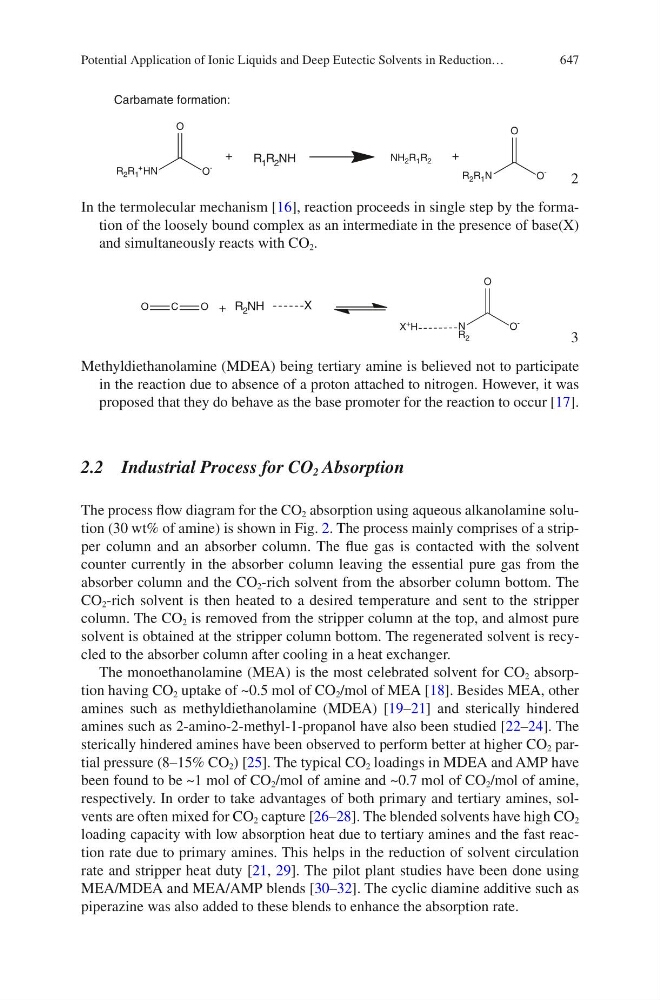
Carbamate formation:
R 1 R 2 NH
R 2 R 1 N
O
O
-
R 2 R 1
+ HN
O
O
-
NH 2 R 1 R 2
+
+
2
In the termolecular mechanism [16], reaction proceeds in single step by the formation of the loosely bound complex as an intermediate in the presence of base(X)
and simultaneously reacts with CO 2 .
R 2 NH
N
R 2
O
O
-
+
C
O
O
X
X
+
H
3
Methyldiethanolamine (MDEA) being tertiary amine is believed not to participate
in the reaction due to absence of a proton attached to nitrogen. However, it was
proposed that they do behave as the base promoter for the reaction to occur [17].
2.2 Industrial Process for CO 2 Absorption
The process flow diagram for the CO 2 absorption using aqueous alkanolamine solution (30 wt% of amine) is shown in Fig. 2. The process mainly comprises of a stripper column and an absorber column. The flue gas is contacted with the solvent
counter currently in the absorber column leaving the essential pure gas from the
absorber column and the CO 2 -rich solvent from the absorber column bottom. The
CO 2 -rich solvent is then heated to a desired temperature and sent to the stripper
column. The CO 2 is removed from the stripper column at the top, and almost pure
solvent is obtained at the stripper column bottom. The regenerated solvent is recycled to the absorber column after cooling in a heat exchanger.
The monoethanolamine (MEA) is the most celebrated solvent for CO 2 absorption having CO 2 uptake of ~0.5 mol of CO 2 /mol of MEA [18]. Besides MEA, other
amines such as methyldiethanolamine (MDEA) [19–21] and sterically hindered
amines such as 2-amino-2-methyl-1-propanol have also been studied [22–24]. The
sterically hindered amines have been observed to perform better at higher CO 2 partial pressure (8–15% CO 2 ) [25]. The typical CO 2 loadings in MDEA and AMP have
been found to be ~1 mol of CO 2 /mol of amine and ~0.7 mol of CO 2 /mol of amine,
respectively. In order to take advantages of both primary and tertiary amines, solvents are often mixed for CO 2 capture [26–28]. The blended solvents have high CO 2
loading capacity with low absorption heat due to tertiary amines and the fast reaction rate due to primary amines. This helps in the reduction of solvent circulation
rate and stripper heat duty [21, 29]. The pilot plant studies have been done using
MEA/MDEA and MEA/AMP blends [30–32]. The cyclic diamine additive such as
piperazine was also added to these blends to enhance the absorption rate.
Potential Application of Ionic Liquids and Deep Eutectic Solvents in Reduction…