

646
mainly concentrated CO 2 stream along with water which can be purified easily [11].
Oxy-fuel combustion does not require separate equipment for NOx elimination due
to the absence of NOx emissions. In addition, complete combustion of fuel occurs
in this process; therefore, almost pure CO 2 is formed which can be stored without
requiring a CO 2 separator. The boiler size is also reduced because combustion
occurs in the presence of pure oxygen [12]. The main drawback associated with
oxy-fuel technology is the high capital investment for air separation unit compared
to post-combustion technology [11].
Among all three technologies, post-combustion is commonly employed in the
industry because of flexibility in the operation. Pre-combustion processes are
restricted only to new industries. The energy requirement is less in the precombustion as compared to the post-combustion CO 2 capture, whereas high capital
required for oxy-fuel combustion limits its industrial application.
2 Amine-Based Solvents for CO 2 Capture
The amine-based solvents are most widely used in the industry. Amines have been
extensively used for the CO 2 absorption with the alkanolamines being the most
popular solvent. Depending on the degree of substitution of alkanol group to the
nitrogen, amines can be classified as primary, secondary, or tertiary. The CO 2 is
absorbed in alkanolamines by chemical absorption, and the product after absorption
largely depends on the nature of amine solvents [13]. For example, CO 2 rapidly
react with primary and secondary amines to form carbamate, but tertiary alkanolamines are devoid of hydrogen atom and therefore only facilitate the bicarbonate
formation through hydrolysis. Further, the tertiary amine can be easily regenerated
because the heat of formation of carbamate is higher than the heat of reaction to
form bicarbonate [14].
2.1 Reaction Mechanism
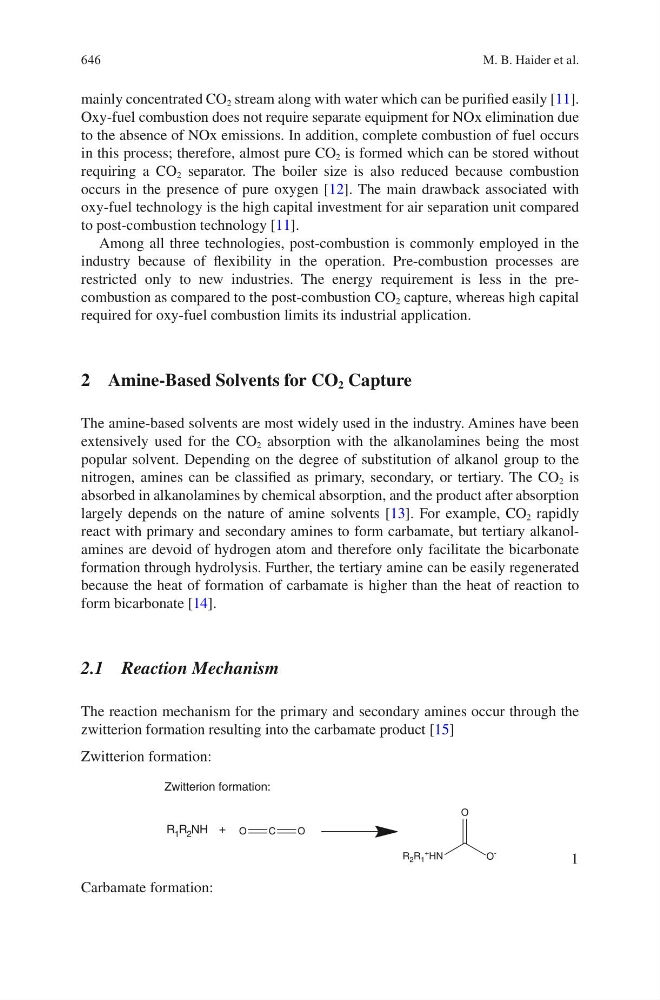
The reaction mechanism for the primary and secondary amines occur through the
zwitterion formation resulting into the carbamate product [15]
Zwitterion formation:
Zwitterion formation:
C
O
O
R 1 R 2 NH
R 2 R 1
+
HN
O
O
-
+
1
Carbamate formation:
M. B. Haider et al.