

645
contains significant amounts of NO 2 . Post-combustion offers flexibility in the operation of a power plant. That is, if CO 2 capture plant is shut down, the power plant can
still be operated [5]. This process can be retrofitted potentially to the existing industry; therefore, it is the most celebrated technology to reduce greenhouse gases [5, 8].
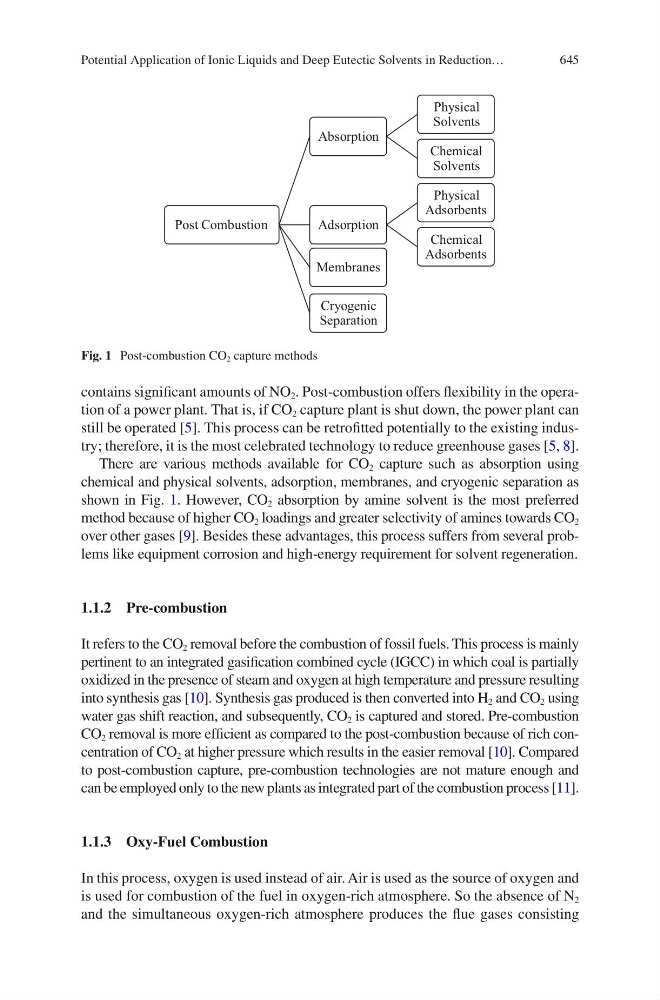
There are various methods available for CO 2 capture such as absorption using
chemical and physical solvents, adsorption, membranes, and cryogenic separation as
shown in Fig. 1. However, CO 2 absorption by amine solvent is the most preferred
method because of higher CO 2 loadings and greater selectivity of amines towards CO 2
over other gases [9]. Besides these advantages, this process suffers from several problems like equipment corrosion and high-energy requirement for solvent regeneration.
1.1.2 Pre-combustion
It refers to the CO 2 removal before the combustion of fossil fuels. This process is mainly
pertinent to an integrated gasification combined cycle (IGCC) in which coal is partially
oxidized in the presence of steam and oxygen at high temperature and pressure resulting
into synthesis gas [10]. Synthesis gas produced is then converted into H 2 and CO 2 using
water gas shift reaction, and subsequently, CO 2 is captured and stored. Pre-combustion
CO 2 removal is more efficient as compared to the post- combustion because of rich concentration of CO 2 at higher pressure which results in the easier removal [10]. Compared
to post-combustion capture, pre-combustion technologies are not mature enough and
can be employed only to the new plants as integrated part of the combustion process [11].
1.1.3 Oxy-Fuel Combustion
In this process, oxygen is used instead of air. Air is used as the source of oxygen and
is used for combustion of the fuel in oxygen-rich atmosphere. So the absence of N 2
and the simultaneous oxygen-rich atmosphere produces the flue gases consisting
Post Combustion
Absorption
Physical
Solvents
Chemical
Solvents
Adsorption
Physical
Adsorbents
Chemical
Adsorbents
Membranes
Cryogenic
Separation
Fig. 1 Post-combustion CO 2 capture methods
Potential Application of Ionic Liquids and Deep Eutectic Solvents in Reduction…