

633
4 Summary
Carbon dioxide conversion to fine chemicals, fuels, etc. is attractive and fascinating
in the area of catalysis with wide opportunities and enormous challenges. A reasonably significant number of technologies are already developed for the CO 2 capture,
transport, sequestration, and utilization. Several industrial methods have already
been developed and promoted to mitigate atmospheric CO 2 so that they need not
simply be stored. In addition, there are various commodity chemicals derived from
CO 2 , and many excellent catalysts are developed for the conversion of CO 2 in atmospheric condition.
The artificial photosynthesis process, i.e., synthesis of carbohydrates using CO 2
and water with efficient catalyst, is a challenging reaction and yet needs to be
addressed. However, there are few points to consider. (1) The process involves the
conversion of CO 2 to chemicals/fuels and requires huge energy which releases CO 2 .
(2) The industries that utilize the CO 2 would be very trace when compared to the
amount of CO 2 dumped into the atmosphere by fossil fuel combustion. (3) In addition, the molecules or fine chemicals obtained by CO 2 fixation will also emit CO 2
when disposed. Hence, the controlled emission of CO 2 into the atmosphere and the
effective utilization of CO 2 are great global challenges.
Acknowledgment CSMCRI Communication number-18/2020. R. A and E. C are thankful to
CSIR-SRF grants. Dr. P. S. acknowledges Indus Magic project no. CSC-0123 and DST-SERB New
Delhi (project no. SR/S1IC-23/2011) for financial support.
References
1. Monastersky R (2013) Global carbon dioxide levels near worrisome milestone. Nature 497:13
2. Aresta M (2010) Carbon dioxide: utilization options to reduce its accumulation in the atmosphere. Wiley-VCH, Weinheim
3. Kätelhön A, Meys R, Deutz S, Suh S, Bardow A (2019) Climate change mitigation potential of carbon capture and utilization in the chemical industry. Proc Natl Acad Sci U S A
116(23):11187–11194
4. Hansen J, Ruedy R, Sato M, Lo K (2010) Global surface temperature change. Rev Geophys
48:RG4004
C 6 F 5
Al
C 6 F 5
C 6 F 5
C 6 F 5
B
C 6 F 5
C 6 F 5
CO 2 activation
Si-H activation
Et 3 SiH
H COOSiEt 3
H 2C(OSiEt3)2
H 3C(OSiEt3)3
CH 4
Al
C 6 F 5
C 6 F 5
C 6 F 5
Si
H
Si
O
Al
C 6 F 5
C 6 F 5
C 6 F 5
H
O
+
CO 2
step-1
s tep-2
step-3
step-4
(69a)
(69b)
(69a)
(69b)
(69b)
(69b)
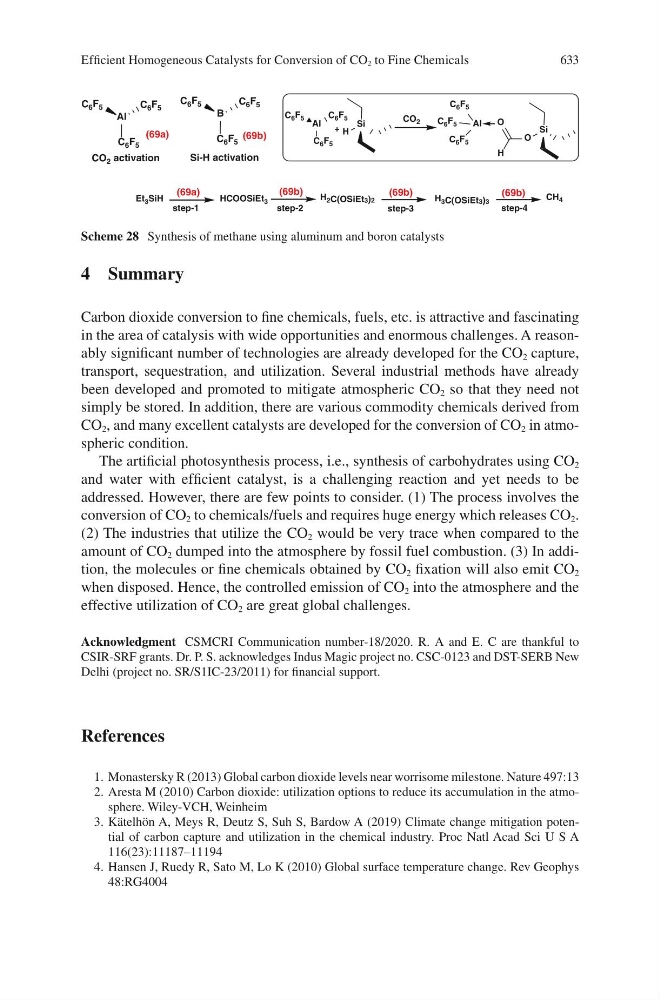
Scheme 28 Synthesis of methane using aluminum and boron catalysts
Efficient Homogeneous Catalysts for Conversion of CO 2 to Fine Chemicals