

632
(RWGS) reaction and (2) the hydrogenation of CO to hydrocarbons using molecular
hydrogen. The catalyst used should be active in both RWGS and FTS. The indirect
route for hydrocarbon synthesis is enrouted via methanol, i.e., the conversion of
CO 2 into methanol and subsequent transformation into hydrocarbons such as olefins, LPG, gasoline, aromatics, and so on [17].
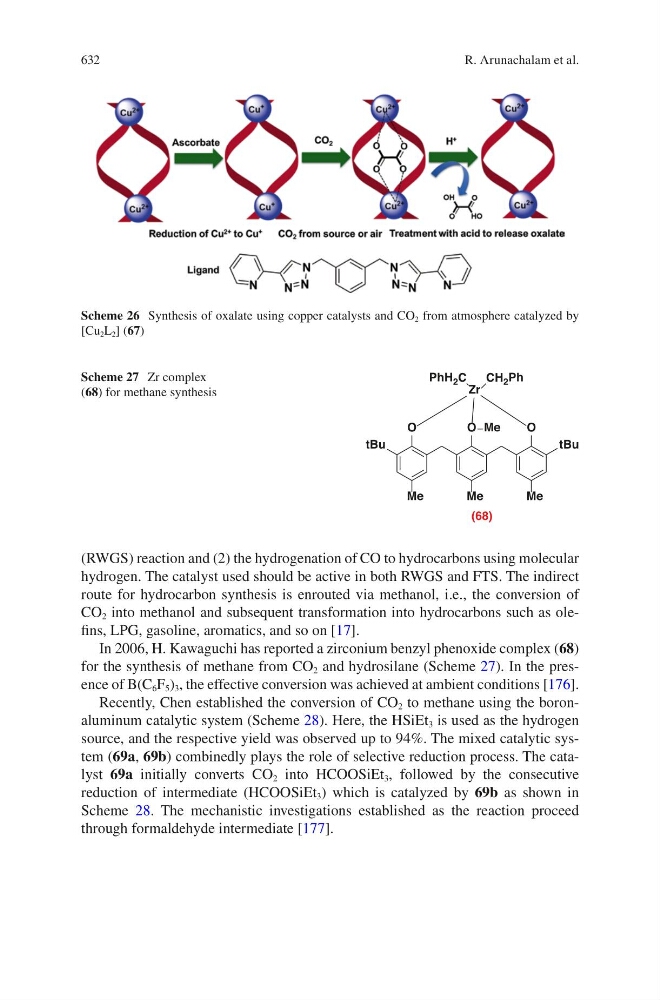
In 2006, H. Kawaguchi has reported a zirconium benzyl phenoxide complex (68)
for the synthesis of methane from CO 2 and hydrosilane (Scheme 27). In the presence of B(C 6 F 5 ) 3 , the effective conversion was achieved at ambient conditions [176].
Recently, Chen established the conversion of CO 2 to methane using the boronaluminum catalytic system (Scheme 28). Here, the HSiEt 3 is used as the hydrogen
source, and the respective yield was observed up to 94%. The mixed catalytic system (69a, 69b) combinedly plays the role of selective reduction process. The catalyst 69a initially converts CO 2 into HCOOSiEt 3 , followed by the consecutive
reduction of intermediate (HCOOSiEt 3 ) which is catalyzed by 69b as shown in
Scheme 28. The mechanistic investigations established as the reaction proceed
through formaldehyde intermediate [177].
Scheme 26 Synthesis of oxalate using copper catalysts and CO 2 from atmosphere catalyzed by
[Cu 2 L 2 ] (67)
Me
O
Me
Me
tBu
O
tBu
O
Zr
PhH 2 C
CH 2 Ph
Me
(68)
Scheme 27 Zr complex
(68) for methane synthesis
R. Arunachalam et al.