

631
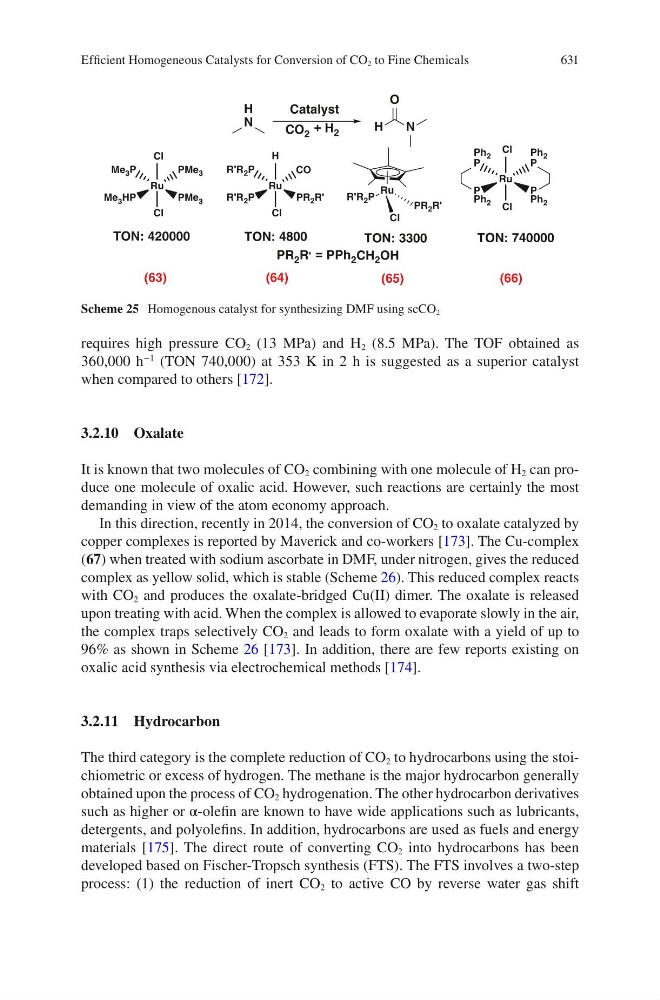
requires high pressure CO 2 (13 MPa) and H 2 (8.5 MPa). The TOF obtained as
360,000 h
−1
(TON 740,000) at 353 K in 2 h is suggested as a superior catalyst
when compared to others [172].
3.2.10 Oxalate
It is known that two molecules of CO 2 combining with one molecule of H 2 can produce one molecule of oxalic acid. However, such reactions are certainly the most
demanding in view of the atom economy approach.
In this direction, recently in 2014, the conversion of CO 2 to oxalate catalyzed by
copper complexes is reported by Maverick and co-workers [173]. The Cu-complex
(67) when treated with sodium ascorbate in DMF, under nitrogen, gives the reduced
complex as yellow solid, which is stable (Scheme 26). This reduced complex reacts
with CO 2 and produces the oxalate-bridged Cu(II) dimer. The oxalate is released
upon treating with acid. When the complex is allowed to evaporate slowly in the air,
the complex traps selectively CO 2 and leads to form oxalate with a yield of up to
96% as shown in Scheme 26 [173]. In addition, there are few reports existing on
oxalic acid synthesis via electrochemical methods [174].
3.2.11 Hydrocarbon
The third category is the complete reduction of CO 2 to hydrocarbons using the stoichiometric or excess of hydrogen. The methane is the major hydrocarbon generally
obtained upon the process of CO 2 hydrogenation. The other hydrocarbon derivatives
such as higher or α-olefin are known to have wide applications such as lubricants,
detergents, and polyolefins. In addition, hydrocarbons are used as fuels and energy
materials [175]. The direct route of converting CO 2 into hydrocarbons has been
developed based on Fischer-Tropsch synthesis (FTS). The FTS involves a two-step
process: (1) the reduction of inert CO 2 to active CO by reverse water gas shift
Ru
PMe 3
Me 3 P
Cl
Cl
PMe 3
Me 3 HP
Ru
CO
R'R 2 P
Cl
H
PR 2 R'
R'R 2 P
Ru
Ph 2
P
Ph 2
P
Cl
Cl
P
Ph 2
P
Ph 2
Ru
PR 2 R'
R'R 2 P
Cl
CO 2 H 2
N
H
O
H
N
Catalyst
+
TON: 420000
TON: 4800
TON: 3300
TON: 740000
PR 2 R' = PPh 2 CH 2 OH
(63)
(64)
(65)
(66)
Scheme 25 Homogenous catalyst for synthesizing DMF using scCO 2
Efficient Homogeneous Catalysts for Conversion of CO 2 to Fine Chemicals