

630
The methodology for the synthesis of R-methylene-γ-lactones by the addition of
aryl aldehydes and CO 2 to terminal allenes was achieved using Ni-(COD) 2 catalyst
(Scheme 23c). The R-methylene-γ-lactones are obtained with excellent regio- and
stereoselectivity [166]. The conversion of allenes and alkenes to the carboxylic acid
derivatives using carbon dioxide (Scheme 23d) was reported by N. Iwasawa group.
The Ni-COD in combination with 2,2′-(dibutylated methylene) bis(imidazoline)
ligand is suitable for carboxylation of aryl-substituted internal alkynes [167].
3.2.9 Dimethyl Formamide
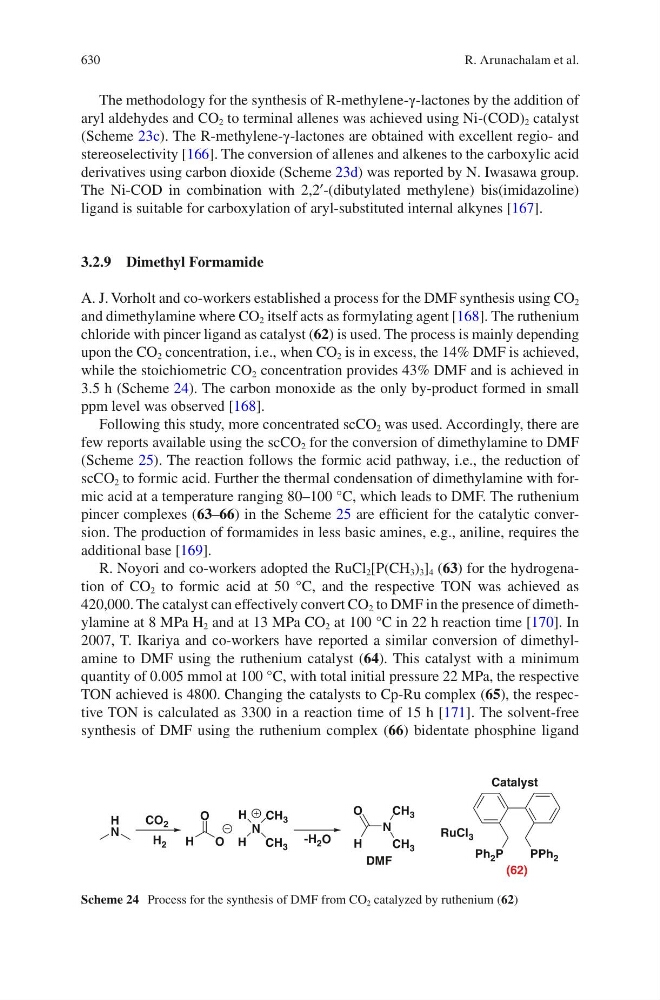
A. J. Vorholt and co-workers established a process for the DMF synthesis using CO 2
and dimethylamine where CO 2 itself acts as formylating agent [168]. The ruthenium
chloride with pincer ligand as catalyst (62) is used. The process is mainly depending
upon the CO 2 concentration, i.e., when CO 2 is in excess, the 14% DMF is achieved,
while the stoichiometric CO 2 concentration provides 43% DMF and is achieved in
3.5 h (Scheme 24). The carbon monoxide as the only by-product formed in small
ppm level was observed [168].
Following this study, more concentrated scCO 2 was used. Accordingly, there are
few reports available using the scCO 2 for the conversion of dimethylamine to DMF
(Scheme 25). The reaction follows the formic acid pathway, i.e., the reduction of
scCO 2 to formic acid. Further the thermal condensation of dimethylamine with formic acid at a temperature ranging 80–100 °C, which leads to DMF. The ruthenium
pincer complexes (63–66) in the Scheme 25 are efficient for the catalytic conversion. The production of formamides in less basic amines, e.g., aniline, requires the
additional base [169].
R. Noyori and co-workers adopted the RuCl 2 [P(CH 3 ) 3 ] 4 (63) for the hydrogenation of CO 2 to formic acid at 50 °C, and the respective TON was achieved as
420,000. The catalyst can effectively convert CO 2 to DMF in the presence of dimethylamine at 8 MPa H 2 and at 13 MPa CO 2 at 100 °C in 22 h reaction time [170]. In
2007, T. Ikariya and co-workers have reported a similar conversion of dimethylamine to DMF using the ruthenium catalyst (64). This catalyst with a minimum
quantity of 0.005 mmol at 100 °C, with total initial pressure 22 MPa, the respective
TON achieved is 4800. Changing the catalysts to Cp-Ru complex (65), the respective TON is calculated as 3300 in a reaction time of 15 h [171]. The solvent- free
synthesis of DMF using the ruthenium complex (66) bidentate phosphine ligand
Ph 2 P
PPh 2
RuCl 3
H
N
H 2
CO 2
N
CH 3
H
CH 3
H
H
O
O
N
CH 3
CH 3
O
H
DMF
-H 2 O
Catalyst
(62)
Scheme 24 Process for the synthesis of DMF from CO 2 catalyzed by ruthenium (62)
R. Arunachalam et al.