

627
3.2.7 Acetic Acid
Acetic acid, the commercially well-known fine chemical, is generally produced
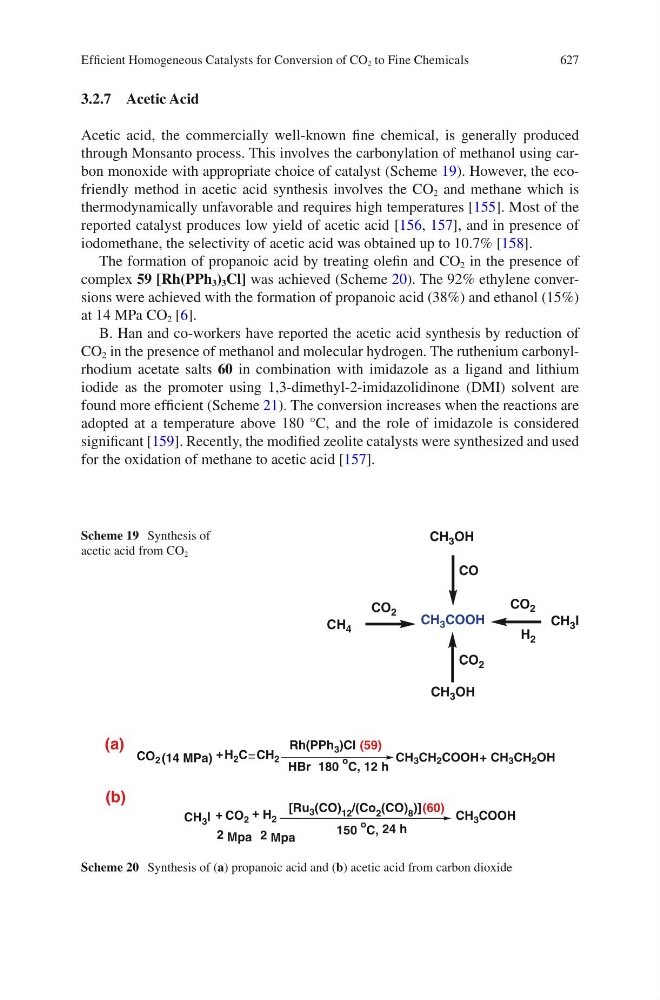
through Monsanto process. This involves the carbonylation of methanol using carbon monoxide with appropriate choice of catalyst (Scheme 19). However, the ecofriendly method in acetic acid synthesis involves the CO 2 and methane which is
thermodynamically unfavorable and requires high temperatures [155]. Most of the
reported catalyst produces low yield of acetic acid [156, 157], and in presence of
iodomethane, the selectivity of acetic acid was obtained up to 10.7% [158].
The formation of propanoic acid by treating olefin and CO 2 in the presence of
complex 59 [Rh(PPh 3 ) 3 Cl] was achieved (Scheme 20). The 92% ethylene conversions were achieved with the formation of propanoic acid (38%) and ethanol (15%)
at 14 MPa CO 2 [6].
B. Han and co-workers have reported the acetic acid synthesis by reduction of
CO 2 in the presence of methanol and molecular hydrogen. The ruthenium carbonylrhodium acetate salts 60 in combination with imidazole as a ligand and lithium
iodide as the promoter using 1,3-dimethyl-2-imidazolidinone (DMI) solvent are
found more efficient (Scheme 21). The conversion increases when the reactions are
adopted at a temperature above 180 °C, and the role of imidazole is considered
significant [159]. Recently, the modified zeolite catalysts were synthesized and used
for the oxidation of methane to acetic acid [157].
CO 2
CH 4
CH 3 I
H 2
CH 3 OH
CO
CH 3 OH
CO 2
CO 2
CH 3 COOH
Scheme 19 Synthesis of
acetic acid from CO 2
CH 3 I CO 2 H 2
CH 3 COOH
[Ru 3 (CO) 12 /(Co 2 (CO) 8 )]
2 Mpa
+
2 Mpa
+
150
o C, 24 h
H 2 C CH 2
CH 3 CH 2 COOH CH 3 CH 2 OH
+
Rh(PPh 3 )Cl
HBr 180
o C, 12 h
(14 MPa)
CO 2
+
(60)
(59)
(a)
(b)
Scheme 20 Synthesis of (a) propanoic acid and (b) acetic acid from carbon dioxide
Efficient Homogeneous Catalysts for Conversion of CO 2 to Fine Chemicals