

628
3.2.8 Acrylic Acid
In the catalytic reduction of olefin to carboxylic acid, the saturated carboxylic acid
is more preferred, when compared to unsaturated acids. In such attempt, the acrylic
acid is the most important and challenging conversion. Further, the acrylic acid
derivatives are important building blocks for synthesizing various industrial products, such as plastics, textiles, coatings, elastomers, adhesives, paints, etc. [160].
Generally, the acrylic acid derivatives are synthesized in a two-step process, i.e.,
oxidation of propene with O 2 via a transient acrolein intermediate over heterogeneous catalysts at high temperature. The alternate process includes carboxylation of
unsaturated hydrocarbon using C1 feedstock. The most popular processes utilize
CO and H 2 O as the C1 source with nickel or palladium complexes as active catalysts. The alternate and eco-friendly pathway includes the synthesis from CO 2 and
ethylene which is highly challenging [161].
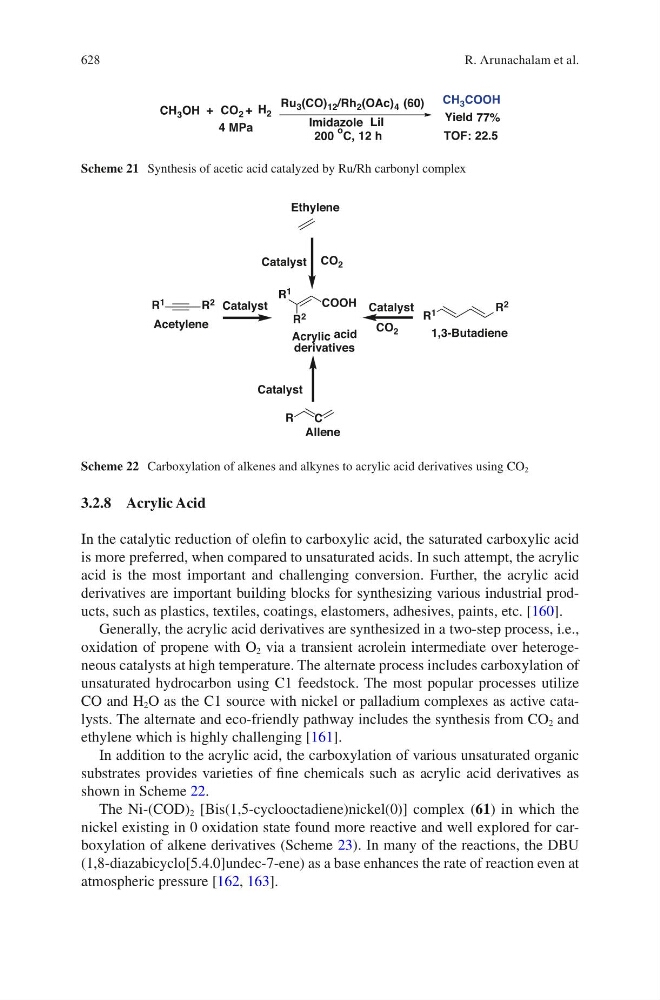
In addition to the acrylic acid, the carboxylation of various unsaturated organic
substrates provides varieties of fine chemicals such as acrylic acid derivatives as
shown in Scheme 22.
The Ni-(COD) 2 [Bis(1,5-cyclooctadiene)nickel(0)] complex (61) in which the
nickel existing in 0 oxidation state found more reactive and well explored for carboxylation of alkene derivatives (Scheme 23). In many of the reactions, the DBU
(1,8-diazabicyclo[5.4.0]undec-7-ene) as a base enhances the rate of reaction even at
atmospheric pressure [162, 163].
H 2
CH 3 OH
CO 2
+
+
Ru 3 (CO) 12 /Rh 2 (OAc) 4
Imidazole LiI
4 MPa
Yield 77%
200
o C, 12 h
TOF: 22.5
(60)
CH 3 COOH
Scheme 21 Synthesis of acetic acid catalyzed by Ru/Rh carbonyl complex
COOH
R 1
R 2
R 1
R 2
R
C
R 1
R 2
Ethylene
Acetylene
1,3-Butadiene
Allene
Acrylic acid
derivatives
CO 2
CO 2
Catalyst
Catalyst
Catalyst
Catalyst
Scheme 22 Carboxylation of alkenes and alkynes to acrylic acid derivatives using CO 2
R. Arunachalam et al.