

626
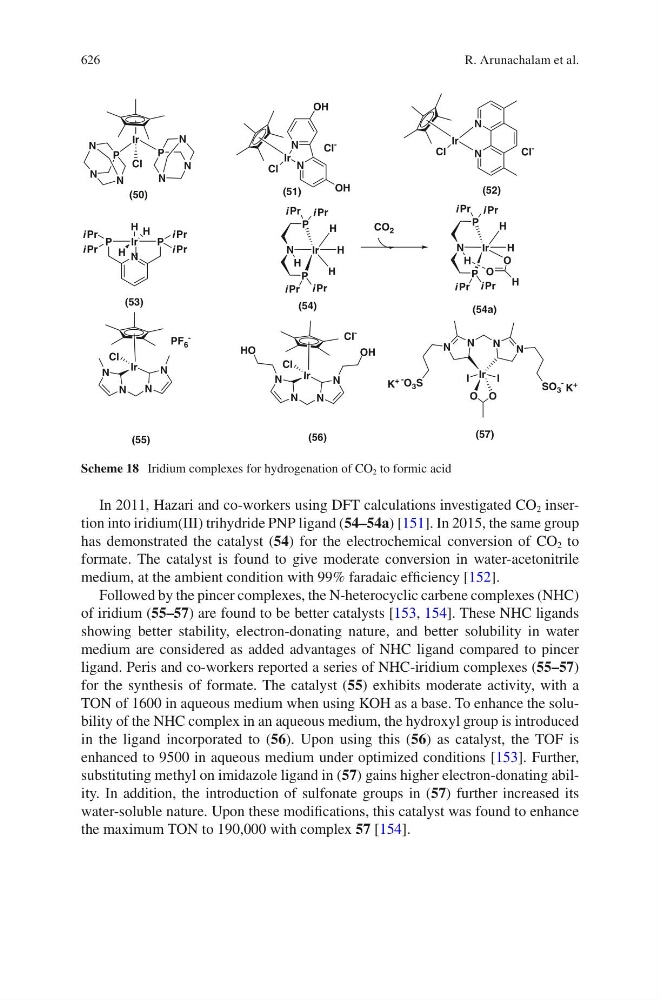
In 2011, Hazari and co-workers using DFT calculations investigated CO 2 insertion into iridium(III) trihydride PNP ligand (54–54a) [151]. In 2015, the same group
has demonstrated the catalyst (54) for the electrochemical conversion of CO 2 to
formate. The catalyst is found to give moderate conversion in water-acetonitrile
medium, at the ambient condition with 99% faradaic efficiency [152].
Followed by the pincer complexes, the N-heterocyclic carbene complexes (NHC)
of iridium (55–57) are found to be better catalysts [153, 154]. These NHC ligands
showing better stability, electron-donating nature, and better solubility in water
medium are considered as added advantages of NHC ligand compared to pincer
ligand. Peris and co-workers reported a series of NHC-iridium complexes (55–57)
for the synthesis of formate. The catalyst (55) exhibits moderate activity, with a
TON of 1600 in aqueous medium when using KOH as a base. To enhance the solubility of the NHC complex in an aqueous medium, the hydroxyl group is introduced
in the ligand incorporated to (56). Upon using this (56) as catalyst, the TOF is
enhanced to 9500 in aqueous medium under optimized conditions [153]. Further,
substituting methyl on imidazole ligand in (57) gains higher electron-donating ability. In addition, the introduction of sulfonate groups in (57) further increased its
water-soluble nature. Upon these modifications, this catalyst was found to enhance
the maximum TON to 190,000 with complex 57 [154].
Ir
Cl
N
P
N
N
N
P
N
N
Ir
N
Cl
N
OH
OH
Ir
Cl
N
N
Cl
-
Cl
-
N
P
P
Ir
i Pr
i Pr
i Pr
i Pr
H H
H
N
N
N
N
Ir
Cl
PF 6
-
N
P
P
Ir
H
H
H
i Pr
i Pr
i Pr
i Pr
N
P
P
Ir
H
H
O
i Pr
i Pr
i Pr
i Pr
H
H
H
O
N
N
N
N
Ir
Cl
Cl
-
HO
OH
N
N
N
N
-
O 3 S
SO 3
-
Ir
K
+
K
+
O O
I
I
(50)
(51)
(52)
(53)
(54)
(54a)
(55)
(56)
(57)
CO 2
Scheme 18 Iridium complexes for hydrogenation of CO 2 to formic acid
R. Arunachalam et al.