

621
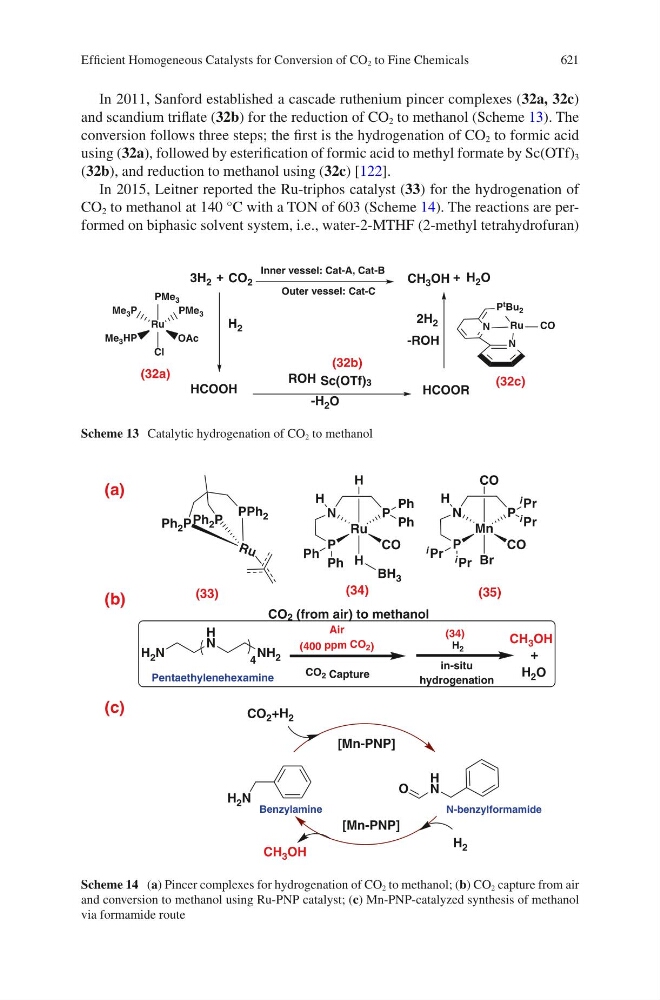
In 2011, Sanford established a cascade ruthenium pincer complexes (32a, 32c)
and scandium triflate (32b) for the reduction of CO 2 to methanol (Scheme 13). The
conversion follows three steps; the first is the hydrogenation of CO 2 to formic acid
using (32a), followed by esterification of formic acid to methyl formate by Sc(OTf) 3
(32b), and reduction to methanol using (32c) [122].
In 2015, Leitner reported the Ru-triphos catalyst (33) for the hydrogenation of
CO 2 to methanol at 140 °C with a TON of 603 (Scheme 14). The reactions are performed on biphasic solvent system, i.e., water-2-MTHF (2-methyl tetrahydrofuran)
3H 2 + CO 2
CH 3 OH H 2 O
+
HCOOH
HCOOR
Ru
PMe 3
Me 3 P
Cl
PMe 3
OAc
Me 3 HP
N
N
P t Bu 2
Ru
CO
Sc(OTf)3
2H 2
H 2
ROH
-H 2 O
-ROH
Inner vessel: Cat-A, Cat-B
Outer vessel: Cat-C
(32a)
(32b)
(32c)
Scheme 13 Catalytic hydrogenation of CO 2 to methanol
Mn
P
N
Br
CO
CO
P
i Pr
i Pr
i Pr
i Pr
H
Ru
P
N
H
H
CO
P
Ph
Ph
Ph
Ph
BH 3
H
H 2 N
H
N
NH 2
4
CO 2 Capture
H 2
in-situ
hydrogenation
+
H 2 O
CO 2 (from air) to methanol
Ph 2 P
PPh 2
Ph 2 P
R u
H 2 N
H
N
O
[Mn-PNP]
[Mn-PNP]
CO 2 +H 2
H 2
Pentaethylenehexamine
Air
(400 ppm CO 2)
(34)
CH 3 OH
(33)
(34)
(35)
CH 3 OH
N-benzylformamide
Benzylamine
(a)
(b)
(c)
Scheme 14 (a) Pincer complexes for hydrogenation of CO 2 to methanol; (b) CO 2 capture from air
and conversion to methanol using Ru-PNP catalyst; (c) Mn-PNP-catalyzed synthesis of methanol
via formamide route
Efficient Homogeneous Catalysts for Conversion of CO 2 to Fine Chemicals