

620
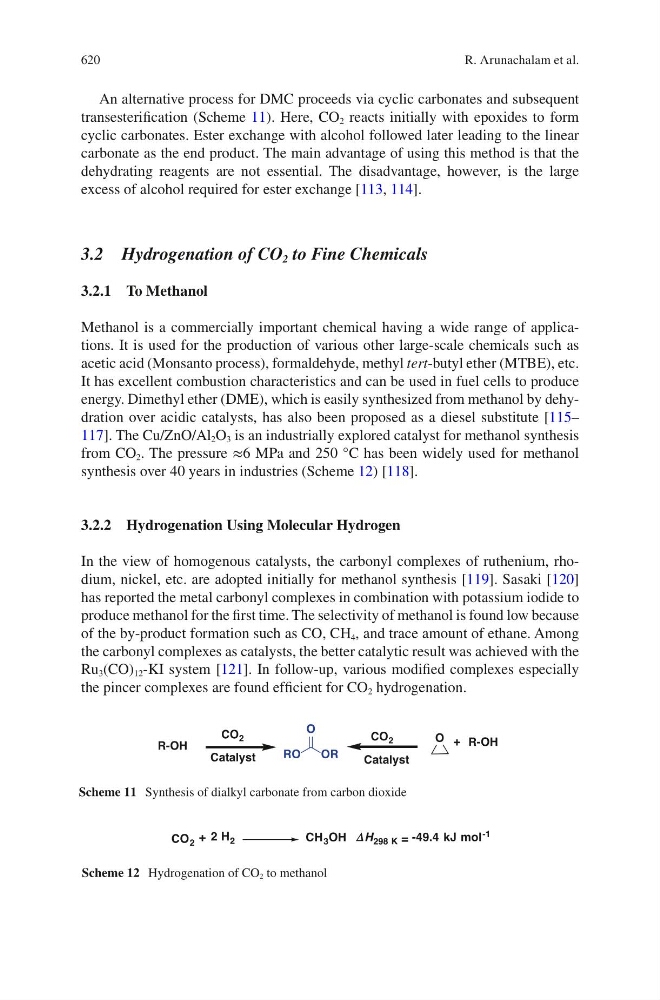
An alternative process for DMC proceeds via cyclic carbonates and subsequent
transesterification (Scheme 11). Here, CO 2 reacts initially with epoxides to form
cyclic carbonates. Ester exchange with alcohol followed later leading to the linear
carbonate as the end product. The main advantage of using this method is that the
dehydrating reagents are not essential. The disadvantage, however, is the large
excess of alcohol required for ester exchange [113, 114].
3.2 Hydrogenation of CO 2 to Fine Chemicals
3.2.1 To Methanol
Methanol is a commercially important chemical having a wide range of applications. It is used for the production of various other large-scale chemicals such as
acetic acid (Monsanto process), formaldehyde, methyl tert-butyl ether (MTBE), etc.
It has excellent combustion characteristics and can be used in fuel cells to produce
energy. Dimethyl ether (DME), which is easily synthesized from methanol by dehydration over acidic catalysts, has also been proposed as a diesel substitute [115–
117]. The Cu/ZnO/Al 2 O 3 is an industrially explored catalyst for methanol synthesis
from CO 2 . The pressure ≈6 MPa and 250 °C has been widely used for methanol
synthesis over 40 years in industries (Scheme 12) [118].
3.2.2 Hydrogenation Using Molecular Hydrogen
In the view of homogenous catalysts, the carbonyl complexes of ruthenium, rhodium, nickel, etc. are adopted initially for methanol synthesis [119]. Sasaki [120]
has reported the metal carbonyl complexes in combination with potassium iodide to
produce methanol for the first time. The selectivity of methanol is found low because
of the by-product formation such as CO, CH 4 , and trace amount of ethane. Among
the carbonyl complexes as catalysts, the better catalytic result was achieved with the
Ru 3 (CO) 12 -KI system [121]. In follow-up, various modified complexes especially
the pincer complexes are found efficient for CO 2 hydrogenation.
R-OH
CO 2
Catalyst
CO 2
Catalyst
O + R-OH
RO
OR
O
Scheme 11 Synthesis of dialkyl carbonate from carbon dioxide
CO 2 + 2 H 2
CH 3 OH ∆H 298 K = -49.4 kJ mol -1
Scheme 12 Hydrogenation of CO 2 to methanol
R. Arunachalam et al.