

619
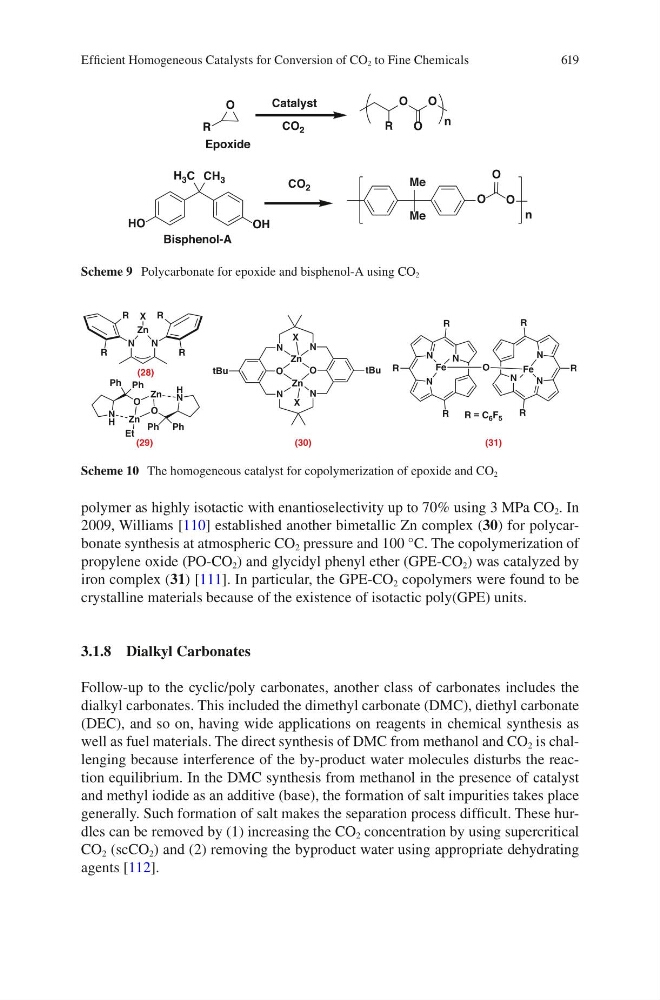
polymer as highly isotactic with enantioselectivity up to 70% using 3 MPa CO 2 . In
2009, Williams [110] established another bimetallic Zn complex (30) for polycarbonate synthesis at atmospheric CO 2 pressure and 100 °C. The copolymerization of
propylene oxide (PO-CO 2 ) and glycidyl phenyl ether (GPE-CO 2 ) was catalyzed by
iron complex (31) [111]. In particular, the GPE-CO 2 copolymers were found to be
crystalline materials because of the existence of isotactic poly(GPE) units.
3.1.8 Dialkyl Carbonates
Follow-up to the cyclic/poly carbonates, another class of carbonates includes the
dialkyl carbonates. This included the dimethyl carbonate (DMC), diethyl carbonate
(DEC), and so on, having wide applications on reagents in chemical synthesis as
well as fuel materials. The direct synthesis of DMC from methanol and CO 2 is challenging because interference of the by-product water molecules disturbs the reaction equilibrium. In the DMC synthesis from methanol in the presence of catalyst
and methyl iodide as an additive (base), the formation of salt impurities takes place
generally. Such formation of salt makes the separation process difficult. These hurdles can be removed by (1) increasing the CO 2 concentration by using supercritical
CO 2 (scCO 2 ) and (2) removing the byproduct water using appropriate dehydrating
agents [112].
CH 3
H 3 C
OH
HO
Me
Me
O
O
O
n
Bisphenol-A
O
R
O
O
n
O
R
Epoxide
Catalyst
CO 2
CO 2
Scheme 9 Polycarbonate for epoxide and bisphenol-A using CO 2
O
N
tBu
N
O
N
tBu
N
Zn
Zn
X
X
R
N
N
N
R
Fe
O
R
N
N
N
R
R
Fe
R
N
H
Ph
O
Ph
H
N
Ph
O
Ph
Zn
Zn
Et
N
N
Zn
R
R
R
R
X
R = C 6 F 5
(28)
(29)
(30)
(31)
Scheme 10 The homogeneous catalyst for copolymerization of epoxide and CO 2
Efficient Homogeneous Catalysts for Conversion of CO 2 to Fine Chemicals