

618
considered essential to promote the equilibrium towards the cyclic carbonate product. There are very few reports available on such reactions.
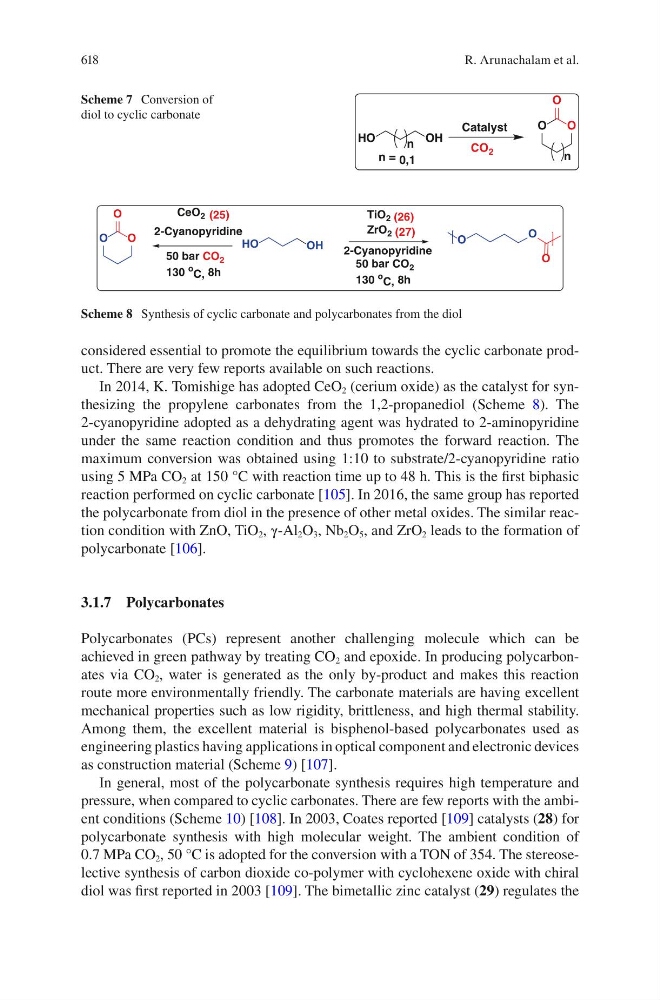
In 2014, K. Tomishige has adopted CeO 2 (cerium oxide) as the catalyst for synthesizing the propylene carbonates from the 1,2-propanediol (Scheme 8). The
2-cyanopyridine adopted as a dehydrating agent was hydrated to 2-aminopyridine
under the same reaction condition and thus promotes the forward reaction. The
maximum conversion was obtained using 1:10 to substrate/2-cyanopyridine ratio
using 5 MPa CO 2 at 150 °C with reaction time up to 48 h. This is the first biphasic
reaction performed on cyclic carbonate [105]. In 2016, the same group has reported
the polycarbonate from diol in the presence of other metal oxides. The similar reaction condition with ZnO, TiO 2 , γ-Al 2 O 3 , Nb 2 O 5 , and ZrO 2 leads to the formation of
polycarbonate [106].
3.1.7 Polycarbonates
Polycarbonates (PCs) represent another challenging molecule which can be
achieved in green pathway by treating CO 2 and epoxide. In producing polycarbonates via CO 2 , water is generated as the only by-product and makes this reaction
route more environmentally friendly. The carbonate materials are having excellent
mechanical properties such as low rigidity, brittleness, and high thermal stability.
Among them, the excellent material is bisphenol-based polycarbonates used as
engineering plastics having applications in optical component and electronic devices
as construction material (Scheme 9) [107].
In general, most of the polycarbonate synthesis requires high temperature and
pressure, when compared to cyclic carbonates. There are few reports with the ambient conditions (Scheme 10) [108]. In 2003, Coates reported [109] catalysts (28) for
polycarbonate synthesis with high molecular weight. The ambient condition of
0.7 MPa CO 2 , 50 °C is adopted for the conversion with a TON of 354. The stereoselective synthesis of carbon dioxide co-polymer with cyclohexene oxide with chiral
diol was first reported in 2003 [109]. The bimetallic zinc catalyst (29) regulates the
HO
OH
n
O
n
Catalyst
n = 0,1
O
O
CO 2
Scheme 7 Conversion of
diol to cyclic carbonate
HO
CeO 2
2-Cyanopyridine
2-Cyanopyridine
50 bar
130
o C, 8h
50 bar CO 2
130
o C, 8h
TiO 2
ZrO 2
OH
O
O
O
O
O
O
CO 2
(25)
(26)
(27)
Scheme 8 Synthesis of cyclic carbonate and polycarbonates from the diol
R. Arunachalam et al.