

617
3.1.5 Kinetic Resolution of Epoxide to Cyclic Carbonate
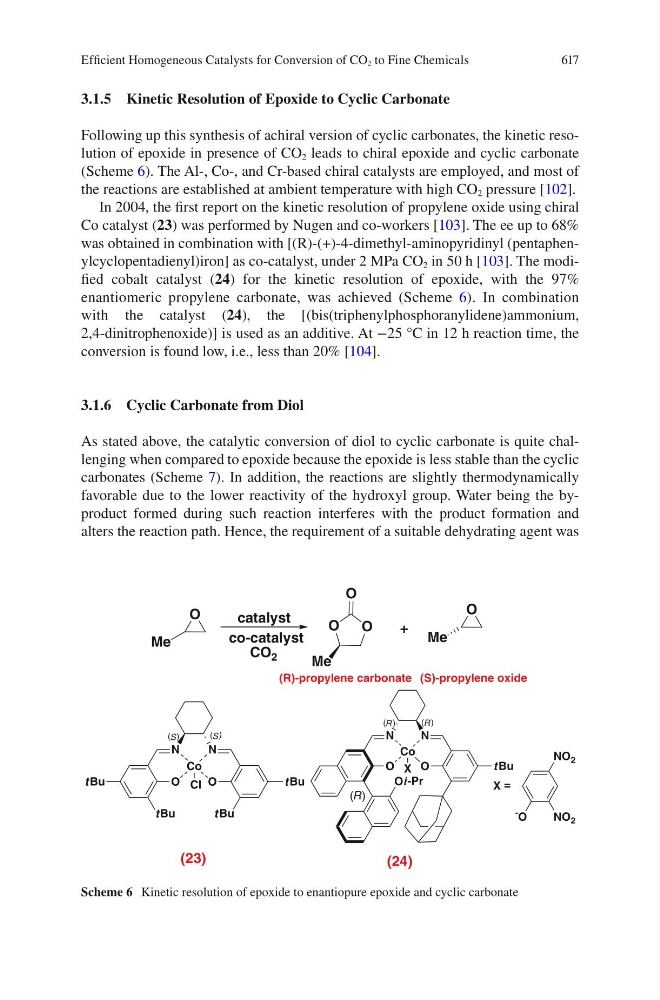
Following up this synthesis of achiral version of cyclic carbonates, the kinetic resolution of epoxide in presence of CO 2 leads to chiral epoxide and cyclic carbonate
(Scheme 6). The Al-, Co-, and Cr-based chiral catalysts are employed, and most of
the reactions are established at ambient temperature with high CO 2 pressure [102].
In 2004, the first report on the kinetic resolution of propylene oxide using chiral
Co catalyst (23) was performed by Nugen and co-workers [103]. The ee up to 68%
was obtained in combination with [(R)-(+)-4-dimethyl-aminopyridinyl (pentaphenylcyclopentadienyl)iron] as co-catalyst, under 2 MPa CO 2 in 50 h [103]. The modified cobalt catalyst (24) for the kinetic resolution of epoxide, with the 97%
enantiomeric propylene carbonate, was achieved (Scheme 6). In combination
with the catalyst (24), the [(bis(triphenylphosphoranylidene)ammonium,
2,4- dinitrophenoxide)] is used as an additive. At −25 °C in 12 h reaction time, the
conversion is found low, i.e., less than 20% [104].
3.1.6 Cyclic Carbonate from Diol
As stated above, the catalytic conversion of diol to cyclic carbonate is quite challenging when compared to epoxide because the epoxide is less stable than the cyclic
carbonates (Scheme 7). In addition, the reactions are slightly thermodynamically
favorable due to the lower reactivity of the hydroxyl group. Water being the byproduct formed during such reaction interferes with the product formation and
alters the reaction path. Hence, the requirement of a suitable dehydrating agent was
N
N
t Bu
Oi-Pr
O
Co
O
X
NO 2
NO 2
-
O
X =
N
N
t Bu
tBu
t Bu
O
t Bu
Co
O
Cl
(R )
(R )
(R)
(S)
(S)
O
Me
Me
O
Me
O
O
O
catalyst
co-catalyst
CO 2
+
(R)-propylene carbonate (S)-propylene oxide
(23)
(24)
Scheme 6 Kinetic resolution of epoxide to enantiopure epoxide and cyclic carbonate
Efficient Homogeneous Catalysts for Conversion of CO 2 to Fine Chemicals