

616
(Scheme 4) [98]. The alkyl-substituted terminal epoxides are giving better conversion when compared to internal epoxide. The path of the reaction is established with
kinetic experiments [98].
3.1.4 Porphyrin Complexes
Porphyrin is one of the important molecules; the respective complexes have been
extensively studied by Ema and workers. This group has developed a bifunctional
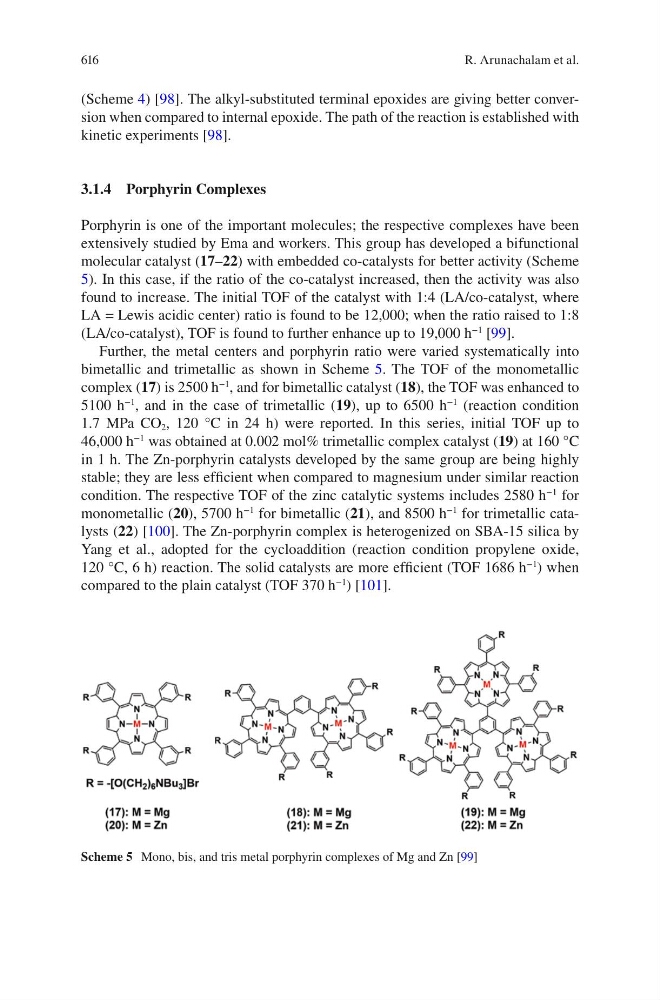
molecular catalyst (17–22) with embedded co-catalysts for better activity (Scheme
5). In this case, if the ratio of the co-catalyst increased, then the activity was also
found to increase. The initial TOF of the catalyst with 1:4 (LA/co-catalyst, where
LA = Lewis acidic center) ratio is found to be 12,000; when the ratio raised to 1:8
(LA/co-catalyst), TOF is found to further enhance up to 19,000 h
−1
[99].
Further, the metal centers and porphyrin ratio were varied systematically into
bimetallic and trimetallic as shown in Scheme 5. The TOF of the monometallic
complex (17) is 2500 h
−1
, and for bimetallic catalyst (18), the TOF was enhanced to
5100 h
−1
, and in the case of trimetallic (19), up to 6500 h
−1
(reaction condition
1.7 MPa CO 2 , 120 °C in 24 h) were reported. In this series, initial TOF up to
46,000 h
−1
was obtained at 0.002 mol% trimetallic complex catalyst (19) at 160 °C
in 1 h. The Zn-porphyrin catalysts developed by the same group are being highly
stable; they are less efficient when compared to magnesium under similar reaction
condition. The respective TOF of the zinc catalytic systems includes 2580 h
−1
for
monometallic (20), 5700 h
−1
for bimetallic (21), and 8500 h
−1
for trimetallic catalysts (22) [100]. The Zn-porphyrin complex is heterogenized on SBA-15 silica by
Yang et al., adopted for the cycloaddition (reaction condition propylene oxide,
120 °C, 6 h) reaction. The solid catalysts are more efficient (TOF 1686 h
−1
) when
compared to the plain catalyst (TOF 370 h
−1
) [101].
Scheme 5 Mono, bis, and tris metal porphyrin complexes of Mg and Zn [99]
R. Arunachalam et al.