

615
aluminum complex (9) as catalyst and TBAI as addictive gives better conversion at
atmospheric pressure, but with long reaction time (24 h) at 85 °C [92].
Yuan and Yao have reported the Nb amino triphenolate complex (10) and TBAB
for CO 2 fixation to cyclic carbonates [93]. In this case, the maximum TOF up to
4000 h
−1
was obtained. Similarly, the bimetallic amino triphenolate complex (11) is
found to give better conversion with terminal and internal epoxides (85 °C, 1 bar,
25 h) in the presence of TBAB [94]. The Cu, Zn, and Cd complexes of aminefunctionalized triphenolate ligand were also employed as a catalyst. Among them,
the Zn-triphenolate complex (12) was found catalytically active. Even though atmospheric pressure is sufficient, the temperature 100 °C is required to achieve a maximum of 79% conversion [95].
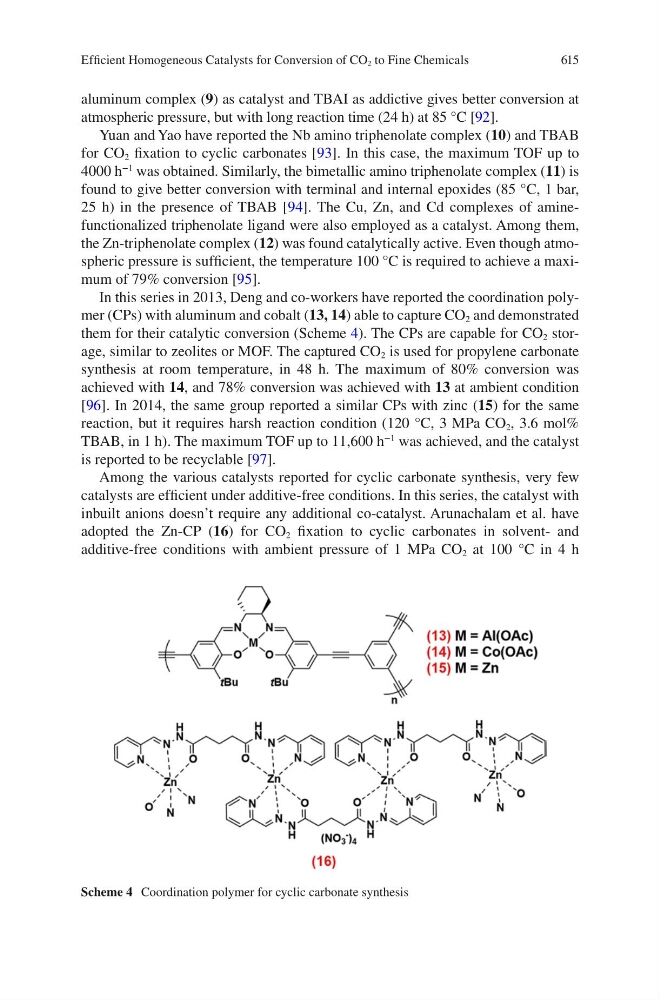
In this series in 2013, Deng and co-workers have reported the coordination polymer (CPs) with aluminum and cobalt (13, 14) able to capture CO 2 and demonstrated
them for their catalytic conversion (Scheme 4). The CPs are capable for CO 2 storage, similar to zeolites or MOF. The captured CO 2 is used for propylene carbonate
synthesis at room temperature, in 48 h. The maximum of 80% conversion was
achieved with 14, and 78% conversion was achieved with 13 at ambient condition
[96]. In 2014, the same group reported a similar CPs with zinc (15) for the same
reaction, but it requires harsh reaction condition (120 °C, 3 MPa CO 2 , 3.6 mol%
TBAB, in 1 h). The maximum TOF up to 11,600 h
−1
was achieved, and the catalyst
is reported to be recyclable [97].
Among the various catalysts reported for cyclic carbonate synthesis, very few
catalysts are efficient under additive-free conditions. In this series, the catalyst with
inbuilt anions doesn’t require any additional co-catalyst. Arunachalam et al. have
adopted the Zn-CP (16) for CO 2 fixation to cyclic carbonates in solvent- and
additive- free conditions with ambient pressure of 1 MPa CO 2 at 100 °C in 4 h
Scheme 4 Coordination polymer for cyclic carbonate synthesis
Efficient Homogeneous Catalysts for Conversion of CO 2 to Fine Chemicals