

614
3.1.3 Metal Catalysts with Maximum TOF for Cyclic
Carbonate Synthesis
Efficiency of the catalyst is described in terms of turnover frequency (TOF).
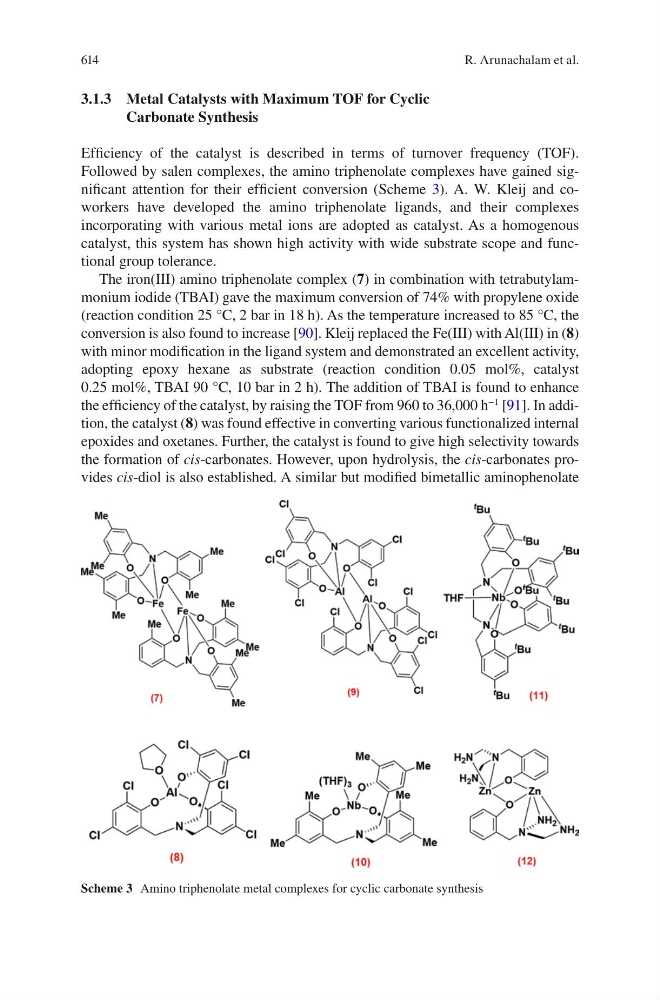
Followed by salen complexes, the amino triphenolate complexes have gained significant attention for their efficient conversion (Scheme 3). A. W. Kleij and coworkers have developed the amino triphenolate ligands, and their complexes
incorporating with various metal ions are adopted as catalyst. As a homogenous
catalyst, this system has shown high activity with wide substrate scope and functional group tolerance.
The iron(III) amino triphenolate complex (7) in combination with tetrabutylammonium iodide (TBAI) gave the maximum conversion of 74% with propylene oxide
(reaction condition 25 °C, 2 bar in 18 h). As the temperature increased to 85 °C, the
conversion is also found to increase [90]. Kleij replaced the Fe(III) with Al(III) in (8)
with minor modification in the ligand system and demonstrated an excellent activity,
adopting epoxy hexane as substrate (reaction condition 0.05 mol%, catalyst
0.25 mol%, TBAI 90 °C, 10 bar in 2 h). The addition of TBAI is found to enhance
the efficiency of the catalyst, by raising the TOF from 960 to 36,000 h
−1
[91]. In addition, the catalyst (8) was found effective in converting various functionalized internal
epoxides and oxetanes. Further, the catalyst is found to give high selectivity towards
the formation of cis-carbonates. However, upon hydrolysis, the cis- carbonates provides cis-diol is also established. A similar but modified bimetallic aminophenolate
Scheme 3 Amino triphenolate metal complexes for cyclic carbonate synthesis
R. Arunachalam et al.