

613
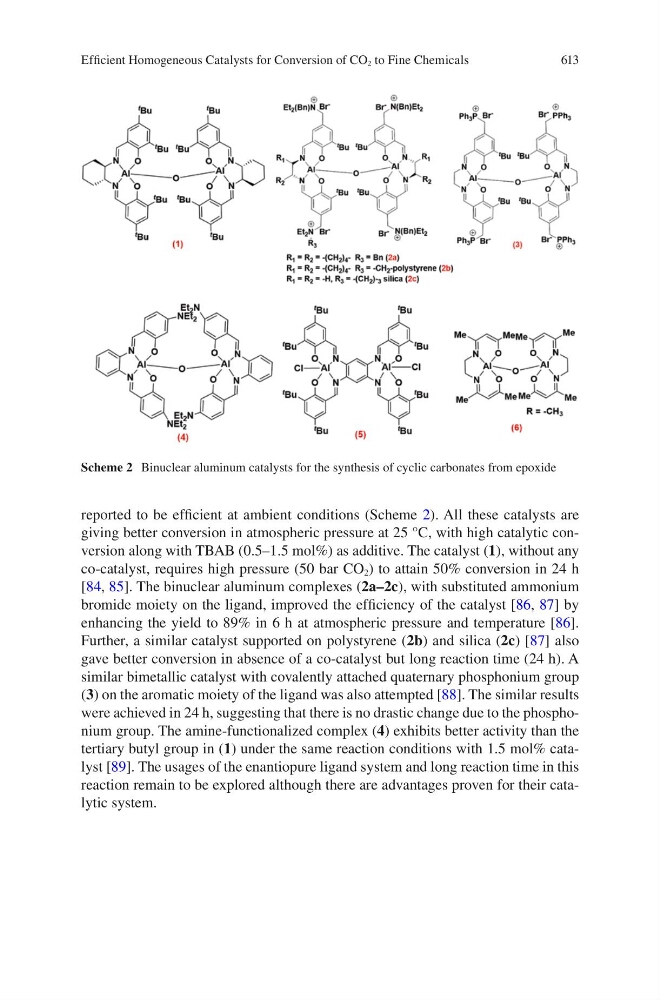
reported to be efficient at ambient conditions (Scheme 2). All these catalysts are
giving better conversion in atmospheric pressure at 25 °C, with high catalytic conversion along with TBAB (0.5–1.5 mol%) as additive. The catalyst (1), without any
co-catalyst, requires high pressure (50 bar CO 2 ) to attain 50% conversion in 24 h
[84, 85]. The binuclear aluminum complexes (2a–2c), with substituted ammonium
bromide moiety on the ligand, improved the efficiency of the catalyst [86, 87] by
enhancing the yield to 89% in 6 h at atmospheric pressure and temperature [86].
Further, a similar catalyst supported on polystyrene (2b) and silica (2c) [87] also
gave better conversion in absence of a co-catalyst but long reaction time (24 h). A
similar bimetallic catalyst with covalently attached quaternary phosphonium group
(3) on the aromatic moiety of the ligand was also attempted [88]. The similar results
were achieved in 24 h, suggesting that there is no drastic change due to the phosphonium group. The amine-functionalized complex (4) exhibits better activity than the
tertiary butyl group in (1) under the same reaction conditions with 1.5 mol% catalyst [89]. The usages of the enantiopure ligand system and long reaction time in this
reaction remain to be explored although there are advantages proven for their catalytic system.
Scheme 2 Binuclear aluminum catalysts for the synthesis of cyclic carbonates from epoxide
Efficient Homogeneous Catalysts for Conversion of CO 2 to Fine Chemicals