

622
in which the catalyst is separated on 2-MTHF layer and methanol residing in aqueous layer [123]. In 2016, Prakash and co-workers have reported the methanol synthesis using CO 2 captured from the air. Here the Ru-PNP complex (34) effectively
converts the CO 2 and H 2 to methanol, in the presence of polyamine at 125–165 °C
using an ethereal solvent. The methanol and water are separated by distillation, and
the catalyst is reused. The polyamine is replaced with pentaethylenehexamine having the capacity to capture CO 2 from the air, used for direct conversion to methanol
adapting a Ru-PNP complex (34). The maximum of 79% CO 2 captured from the air
was converted to CH 3 OH [124]. In 2017, a manganese PNP complex (35) was
adopted for the CO 2 hydrogenation in the presence of amines (such as benzylamine
and morpholine) for methanol synthesis. The catalytic mechanism follows the
formamide pathway, i.e., when benzylamine is treated with CO 2 /H 2 , the N-benzyl
formamide is formed initially. The formamide will undergo hydrogenation to produce
methanol in presence of catalyst. Eighty-four percent of methanol yield is obtained
with benzylamine, and 71% methanol was obtained when morpholine is used [125].
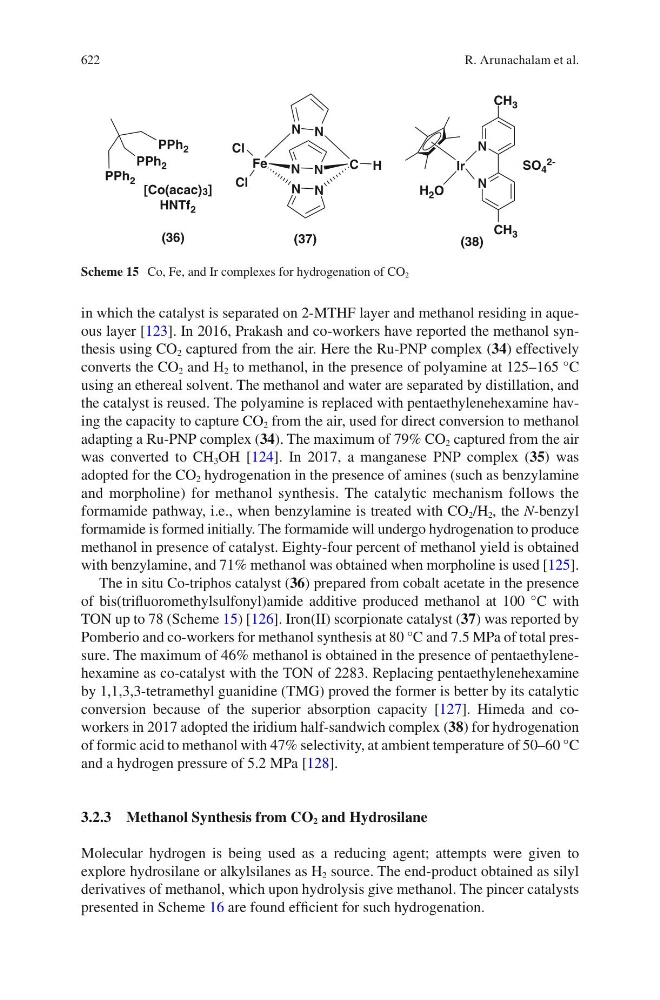
The in situ Co-triphos catalyst (36) prepared from cobalt acetate in the presence
of bis(trifluoromethylsulfonyl)amide additive produced methanol at 100 °C with
TON up to 78 (Scheme 15) [126]. Iron(II) scorpionate catalyst (37) was reported by
Pomberio and co-workers for methanol synthesis at 80 °C and 7.5 MPa of total pressure. The maximum of 46% methanol is obtained in the presence of pentaethylenehexamine as co-catalyst with the TON of 2283. Replacing pentaethylenehexamine
by 1,1,3,3-tetramethyl guanidine (TMG) proved the former is better by its catalytic
conversion because of the superior absorption capacity [127]. Himeda and coworkers in 2017 adopted the iridium half-sandwich complex (38) for hydrogenation
of formic acid to methanol with 47% selectivity, at ambient temperature of 50–60 °C
and a hydrogen pressure of 5.2 MPa [128].
3.2.3 Methanol Synthesis from CO 2 and Hydrosilane
Molecular hydrogen is being used as a reducing agent; attempts were given to
explore hydrosilane or alkylsilanes as H 2 source. The end-product obtained as silyl
derivatives of methanol, which upon hydrolysis give methanol. The pincer catalysts
presented in Scheme 16 are found efficient for such hydrogenation.
N N
N N
N N
C
Fe
Cl
Cl
H
[Co(acac)3]
PPh 2
PPh 2
PPh 2
HNTf 2
(36)
(37)
(38)
N
N
CH 3
CH 3
SO 4
2Ir
H 2 O
Scheme 15 Co, Fe, and Ir complexes for hydrogenation of CO 2
R. Arunachalam et al.