

583
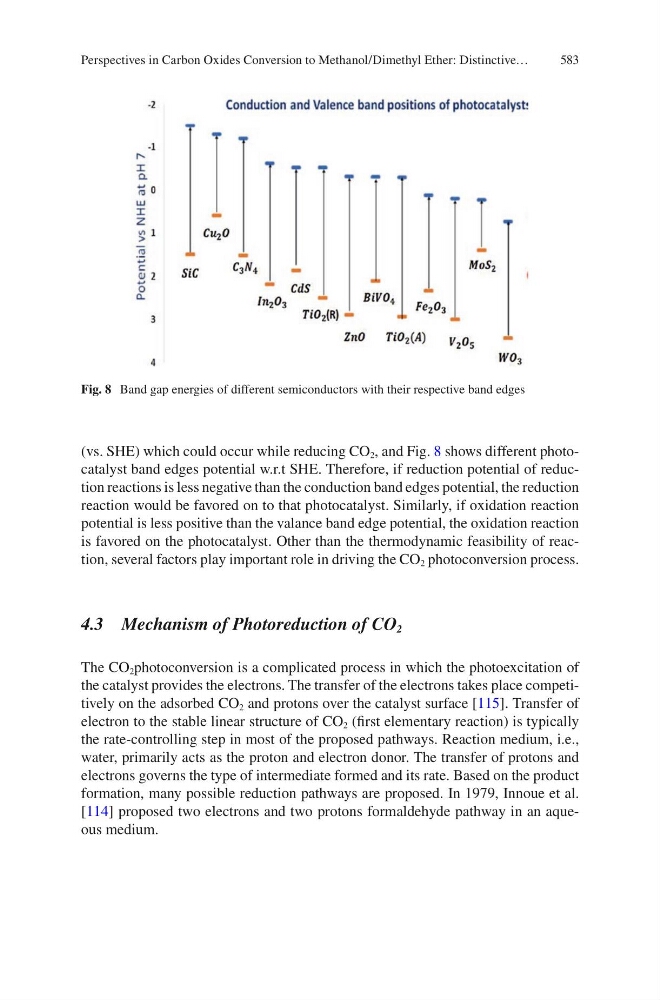
(vs. SHE) which could occur while reducing CO 2 , and Fig. 8 shows different photocatalyst band edges potential w.r.t SHE. Therefore, if reduction potential of reduction reactions is less negative than the conduction band edges potential, the reduction
reaction would be favored on to that photocatalyst. Similarly, if oxidation reaction
potential is less positive than the valance band edge potential, the oxidation reaction
is favored on the photocatalyst. Other than the thermodynamic feasibility of reaction, several factors play important role in driving the CO 2 photoconversion process.
4.3 Mechanism of Photoreduction of CO 2
The CO 2 photoconversion is a complicated process in which the photoexcitation of
the catalyst provides the electrons. The transfer of the electrons takes place competitively on the adsorbed CO 2 and protons over the catalyst surface [115]. Transfer of
electron to the stable linear structure of CO 2 (first elementary reaction) is typically
the rate-controlling step in most of the proposed pathways. Reaction medium, i.e.,
water, primarily acts as the proton and electron donor. The transfer of protons and
electrons governs the type of intermediate formed and its rate. Based on the product
formation, many possible reduction pathways are proposed. In 1979, Innoue et al.
[114] proposed two electrons and two protons formaldehyde pathway in an aqueous medium.
Fig. 8 Band gap energies of different semiconductors with their respective band edges
Perspectives in Carbon Oxides Conversion to Methanol/Dimethyl Ether: Distinctive…
(vs. SHE) which could occur while reducing CO 2 , and Fig. 8 shows different photocatalyst band edges potential w.r.t SHE. Therefore, if reduction potential of reduction reactions is less negative than the conduction band edges potential, the reduction
reaction would be favored on to that photocatalyst. Similarly, if oxidation reaction
potential is less positive than the valance band edge potential, the oxidation reaction
is favored on the photocatalyst. Other than the thermodynamic feasibility of reaction, several factors play important role in driving the CO 2 photoconversion process.
4.3 Mechanism of Photoreduction of CO 2
The CO 2 photoconversion is a complicated process in which the photoexcitation of
the catalyst provides the electrons. The transfer of the electrons takes place competitively on the adsorbed CO 2 and protons over the catalyst surface [115]. Transfer of
electron to the stable linear structure of CO 2 (first elementary reaction) is typically
the rate-controlling step in most of the proposed pathways. Reaction medium, i.e.,
water, primarily acts as the proton and electron donor. The transfer of protons and
electrons governs the type of intermediate formed and its rate. Based on the product
formation, many possible reduction pathways are proposed. In 1979, Innoue et al.
[114] proposed two electrons and two protons formaldehyde pathway in an aqueous medium.
Fig. 8 Band gap energies of different semiconductors with their respective band edges
Perspectives in Carbon Oxides Conversion to Methanol/Dimethyl Ether: Distinctive…