

584
catalyst
catalyst
cond
val
+
→
∗
+
(
)
−
+
h
e
p
ϑ
Oxidation reactions
H O
O
H
val
2
2
2
1
2
2
+
→
+
+
+
p
Reduction reactions
CO aq
H
H COOH
cond
2
2
2
( )+
+
→
+
−
e
HCOOH H
H CHO H O
cond
+
+
→
+
+
−
2
2
2
e
HCHO H
C H OH
cond
+
+
→
+
−
2
2
3
e
CH OH H
C H H O
cond
3
42
2
2
+
+
→
+
+
−
e
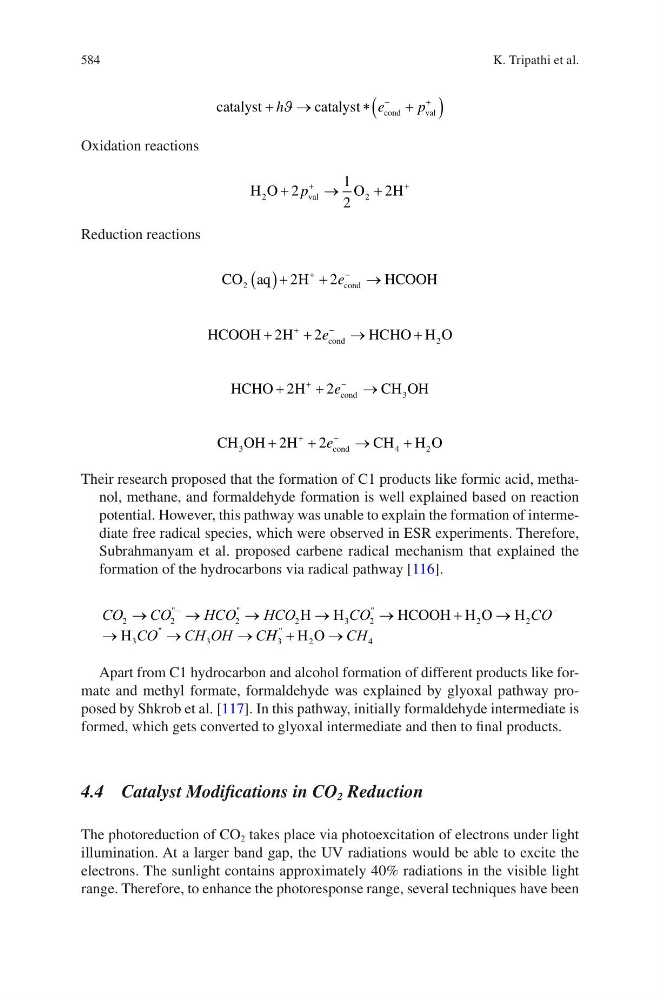
Their research proposed that the formation of C1 products like formic acid, methanol, methane, and formaldehyde formation is well explained based on reaction
potential. However, this pathway was unable to explain the formation of intermediate free radical species, which were observed in ESR experiments. Therefore,
Subrahmanyam et al. proposed carbene radical mechanism that explained the
formation of the hydrocarbons via radical pathway [116].
CO
CO
HCO
HCO
CO
CO
CO
CH OH
C
2
2
2
2
3
2
2
2
3
3
→
→
→
→
→
+
→
→
→
→
−
−
"
"
"
"
H H
HCOOH H O H
H
H H
C H
3
2
4
"
+
→
H O
Apart from C1 hydrocarbon and alcohol formation of different products like formate and methyl formate, formaldehyde was explained by glyoxal pathway proposed by Shkrob et al. [117]. In this pathway, initially formaldehyde intermediate is
formed, which gets converted to glyoxal intermediate and then to final products.
4.4 Catalyst Modifications in CO 2 Reduction
The photoreduction of CO 2 takes place via photoexcitation of electrons under light
illumination. At a larger band gap, the UV radiations would be able to excite the
electrons. The sunlight contains approximately 40% radiations in the visible light
range. Therefore, to enhance the photoresponse range, several techniques have been
K. Tripathi et al.
catalyst
catalyst
cond
val
+
→
∗
+
(
)
−
+
h
e
p
ϑ
Oxidation reactions
H O
O
H
val
2
2
2
1
2
2
+
→
+
+
+
p
Reduction reactions
CO aq
H
H COOH
cond
2
2
2
( )+
+
→
+
−
e
HCOOH H
H CHO H O
cond
+
+
→
+
+
−
2
2
2
e
HCHO H
C H OH
cond
+
+
→
+
−
2
2
3
e
CH OH H
C H H O
cond
3
42
2
2
+
+
→
+
+
−
e
Their research proposed that the formation of C1 products like formic acid, methanol, methane, and formaldehyde formation is well explained based on reaction
potential. However, this pathway was unable to explain the formation of intermediate free radical species, which were observed in ESR experiments. Therefore,
Subrahmanyam et al. proposed carbene radical mechanism that explained the
formation of the hydrocarbons via radical pathway [116].
CO
CO
HCO
HCO
CO
CO
CO
CH OH
C
2
2
2
2
3
2
2
2
3
3
→
→
→
→
→
+
→
→
→
→
−
−
"
"
"
"
H H
HCOOH H O H
H
H H
C H
3
2
4
"
+
→
H O
Apart from C1 hydrocarbon and alcohol formation of different products like formate and methyl formate, formaldehyde was explained by glyoxal pathway proposed by Shkrob et al. [117]. In this pathway, initially formaldehyde intermediate is
formed, which gets converted to glyoxal intermediate and then to final products.
4.4 Catalyst Modifications in CO 2 Reduction
The photoreduction of CO 2 takes place via photoexcitation of electrons under light
illumination. At a larger band gap, the UV radiations would be able to excite the
electrons. The sunlight contains approximately 40% radiations in the visible light
range. Therefore, to enhance the photoresponse range, several techniques have been
K. Tripathi et al.