

582
lution reaction (HER), whereas on the valance band, the oxidation of H 2 O takes
place to form O 2 , i.e., oxygen evolution reaction (OER).
4. Final step after the photocatalytic reaction is the desorption of products. It is
essential that the formed products are timely released from catalyst surface or
else the catalyst sites are blocked for further substrate adsorption, or further back
oxidation/reduction could take place.
4.2 Thermodynamics of Photocatalytic Reduction
of Carbon Dioxide
Due to the high stability of CO 2 , its reduction is thermodynamically not feasible
without external energy supply. In photocatalytic process, this extra energy is provided by high-energy electrons generated via photoexcitation. However, the reduction reaction feasibility is governed by thermodynamic driving force which is the
potential of the conduction band edge relative to the reaction reduction potential
[114]. Reactions with less negative reduction potential than the conduction band
edge potential are thermodynamically feasible, whereas reactions with more negative reduction potential are not favored. Similarly, for oxidation reactions which
occur via electron transfer to valence band holes, reaction with reduction potential
less positive than the valence band edge potential is thermodynamically feasible.
The substrate with more positive reduction potential is a better oxidant and tends to
reduce those with lower reduction potential values. Hence, if the reduction potential
of donor is less positive than valance band edge and reduction potential of acceptor
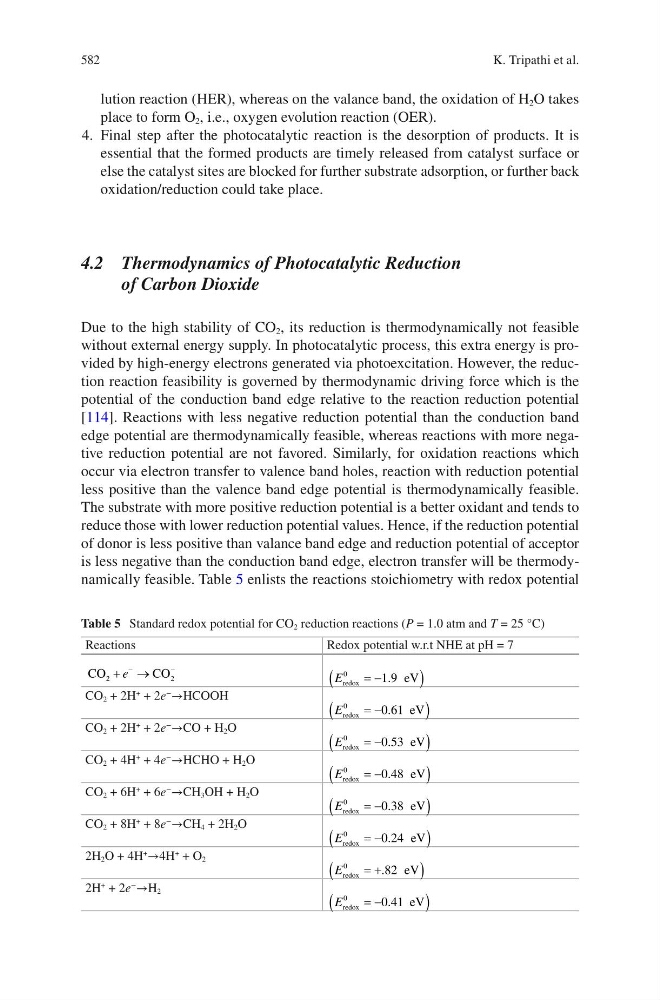
is less negative than the conduction band edge, electron transfer will be thermodynamically feasible. Table 5 enlists the reactions stoichiometry with redox potential
Table 5 Standard redox potential for CO 2 reduction reactions (P = 1.0 atm and T = 25 °C)
Reactions
Redox potential w.r.t NHE at pH = 7
CO
CO
2
2
+ →
−
−
e
E redox
eV
0
1 9
= −
(
)
.
CO 2 + 2H
+
+ 2e
−
→HCOOH
E redox
eV
0
0 61
= −
(
)
.
CO 2 + 2H
+
+ 2e
−
→CO + H 2 O
E redox
eV
0
0 53
= −
(
)
.
CO 2 + 4H
+
+ 4e
−
→HCHO + H 2 O
E redox
eV
0
0 48
= −
(
)
.
CO 2 + 6H
+
+ 6e
−
→CH 3 OH + H 2 O
E redox
eV
0
0 38
= −
(
)
.
CO 2 + 8H
+
+ 8e
−
→CH 4 + 2H 2 O
E redox
eV
0
0 24
= −
(
)
.
2H 2 O + 4H
+
→4H
+ + O 2
E redox
eV
0
82
= +
(
)
.
2H
+ + 2e
−
→H 2
E redox
eV
0
0 41
= −
(
)
.
K. Tripathi et al.
lution reaction (HER), whereas on the valance band, the oxidation of H 2 O takes
place to form O 2 , i.e., oxygen evolution reaction (OER).
4. Final step after the photocatalytic reaction is the desorption of products. It is
essential that the formed products are timely released from catalyst surface or
else the catalyst sites are blocked for further substrate adsorption, or further back
oxidation/reduction could take place.
4.2 Thermodynamics of Photocatalytic Reduction
of Carbon Dioxide
Due to the high stability of CO 2 , its reduction is thermodynamically not feasible
without external energy supply. In photocatalytic process, this extra energy is provided by high-energy electrons generated via photoexcitation. However, the reduction reaction feasibility is governed by thermodynamic driving force which is the
potential of the conduction band edge relative to the reaction reduction potential
[114]. Reactions with less negative reduction potential than the conduction band
edge potential are thermodynamically feasible, whereas reactions with more negative reduction potential are not favored. Similarly, for oxidation reactions which
occur via electron transfer to valence band holes, reaction with reduction potential
less positive than the valence band edge potential is thermodynamically feasible.
The substrate with more positive reduction potential is a better oxidant and tends to
reduce those with lower reduction potential values. Hence, if the reduction potential
of donor is less positive than valance band edge and reduction potential of acceptor
is less negative than the conduction band edge, electron transfer will be thermodynamically feasible. Table 5 enlists the reactions stoichiometry with redox potential
Table 5 Standard redox potential for CO 2 reduction reactions (P = 1.0 atm and T = 25 °C)
Reactions
Redox potential w.r.t NHE at pH = 7
CO
CO
2
2
+ →
−
−
e
E redox
eV
0
1 9
= −
(
)
.
CO 2 + 2H
+
+ 2e
−
→HCOOH
E redox
eV
0
0 61
= −
(
)
.
CO 2 + 2H
+
+ 2e
−
→CO + H 2 O
E redox
eV
0
0 53
= −
(
)
.
CO 2 + 4H
+
+ 4e
−
→HCHO + H 2 O
E redox
eV
0
0 48
= −
(
)
.
CO 2 + 6H
+
+ 6e
−
→CH 3 OH + H 2 O
E redox
eV
0
0 38
= −
(
)
.
CO 2 + 8H
+
+ 8e
−
→CH 4 + 2H 2 O
E redox
eV
0
0 24
= −
(
)
.
2H 2 O + 4H
+
→4H
+ + O 2
E redox
eV
0
82
= +
(
)
.
2H
+ + 2e
−
→H 2
E redox
eV
0
0 41
= −
(
)
.
K. Tripathi et al.