

581
band of the photocatalyst. The holes generated are present in the valance band of the
photocatalyst. These charge carriers contribute in the reduction of CO 2 reduction
process by different interaction mechanism with adsorbed species.
4.1 Photocatalytic Reduction
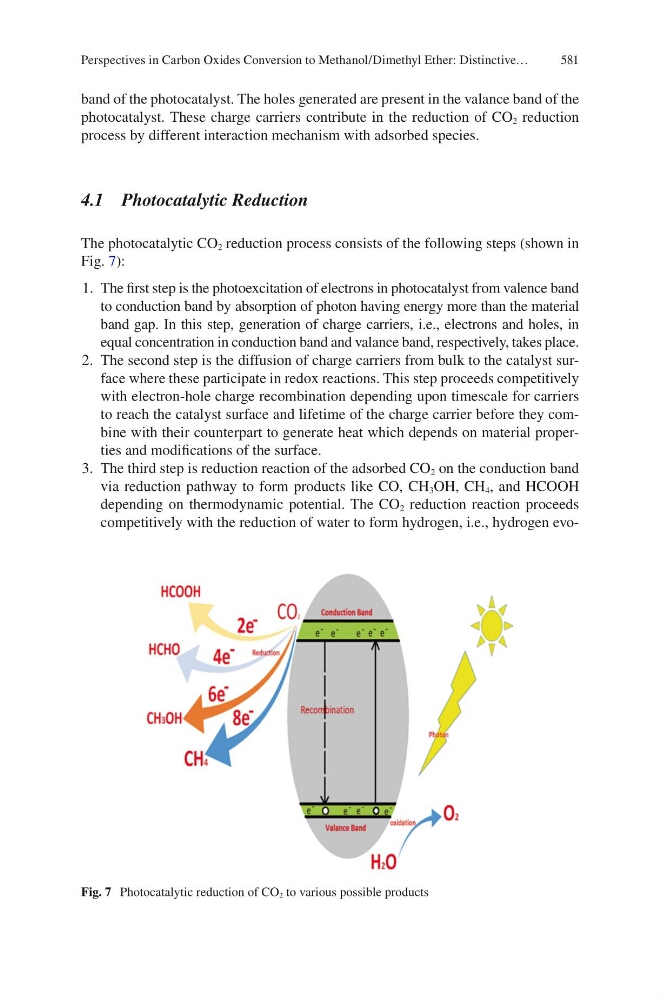
The photocatalytic CO 2 reduction process consists of the following steps (shown in
Fig. 7):
1. The first step is the photoexcitation of electrons in photocatalyst from valence band
to conduction band by absorption of photon having energy more than the material
band gap. In this step, generation of charge carriers, i.e., electrons and holes, in
equal concentration in conduction band and valance band, respectively, takes place.
2. The second step is the diffusion of charge carriers from bulk to the catalyst surface where these participate in redox reactions. This step proceeds competitively
with electron-hole charge recombination depending upon timescale for carriers
to reach the catalyst surface and lifetime of the charge carrier before they combine with their counterpart to generate heat which depends on material properties and modifications of the surface.
3. The third step is reduction reaction of the adsorbed CO 2 on the conduction band
via reduction pathway to form products like CO, CH 3 OH, CH 4 , and HCOOH
depending on thermodynamic potential. The CO 2 reduction reaction proceeds
competitively with the reduction of water to form hydrogen, i.e., hydrogen evoFig. 7 Photocatalytic reduction of CO 2 to various possible products
Perspectives in Carbon Oxides Conversion to Methanol/Dimethyl Ether: Distinctive…
band of the photocatalyst. The holes generated are present in the valance band of the
photocatalyst. These charge carriers contribute in the reduction of CO 2 reduction
process by different interaction mechanism with adsorbed species.
4.1 Photocatalytic Reduction
The photocatalytic CO 2 reduction process consists of the following steps (shown in
Fig. 7):
1. The first step is the photoexcitation of electrons in photocatalyst from valence band
to conduction band by absorption of photon having energy more than the material
band gap. In this step, generation of charge carriers, i.e., electrons and holes, in
equal concentration in conduction band and valance band, respectively, takes place.
2. The second step is the diffusion of charge carriers from bulk to the catalyst surface where these participate in redox reactions. This step proceeds competitively
with electron-hole charge recombination depending upon timescale for carriers
to reach the catalyst surface and lifetime of the charge carrier before they combine with their counterpart to generate heat which depends on material properties and modifications of the surface.
3. The third step is reduction reaction of the adsorbed CO 2 on the conduction band
via reduction pathway to form products like CO, CH 3 OH, CH 4 , and HCOOH
depending on thermodynamic potential. The CO 2 reduction reaction proceeds
competitively with the reduction of water to form hydrogen, i.e., hydrogen evoFig. 7 Photocatalytic reduction of CO 2 to various possible products
Perspectives in Carbon Oxides Conversion to Methanol/Dimethyl Ether: Distinctive…