

569
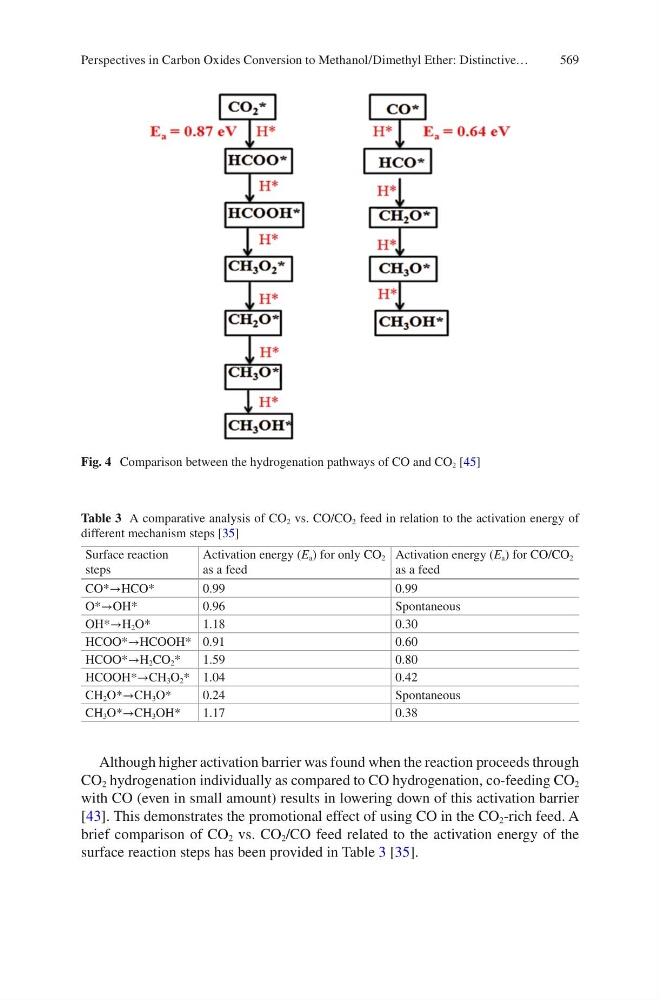
Although higher activation barrier was found when the reaction proceeds through
CO 2 hydrogenation individually as compared to CO hydrogenation, co-feeding CO 2
with CO (even in small amount) results in lowering down of this activation barrier
[43]. This demonstrates the promotional effect of using CO in the CO 2 -rich feed. A
brief comparison of CO 2 vs. CO 2 /CO feed related to the activation energy of the
surface reaction steps has been provided in Table 3 [35].
Fig. 4 Comparison between the hydrogenation pathways of CO and CO 2 [45]
Table 3 A comparative analysis of CO 2 vs. CO/CO 2 feed in relation to the activation energy of
different mechanism steps [35]
Surface reaction
steps
Activation energy (E a ) for only CO 2
as a feed
Activation energy (E a ) for CO/CO 2
as a feed
CO*→HCO*
0.99
0.99
O*→OH*
0.96
Spontaneous
OH*→H 2 O*
1.18
0.30
HCOO*→HCOOH* 0.91
0.60
HCOO*→H 2 CO 2 *
1.59
0.80
HCOOH*→CH 3 O 2 * 1.04
0.42
CH 2 O*→CH 3 O*
0.24
Spontaneous
CH 3 O*→CH 3 OH*
1.17
0.38
Perspectives in Carbon Oxides Conversion to Methanol/Dimethyl Ether: Distinctive…
Although higher activation barrier was found when the reaction proceeds through
CO 2 hydrogenation individually as compared to CO hydrogenation, co-feeding CO 2
with CO (even in small amount) results in lowering down of this activation barrier
[43]. This demonstrates the promotional effect of using CO in the CO 2 -rich feed. A
brief comparison of CO 2 vs. CO 2 /CO feed related to the activation energy of the
surface reaction steps has been provided in Table 3 [35].
Fig. 4 Comparison between the hydrogenation pathways of CO and CO 2 [45]
Table 3 A comparative analysis of CO 2 vs. CO/CO 2 feed in relation to the activation energy of
different mechanism steps [35]
Surface reaction
steps
Activation energy (E a ) for only CO 2
as a feed
Activation energy (E a ) for CO/CO 2
as a feed
CO*→HCO*
0.99
0.99
O*→OH*
0.96
Spontaneous
OH*→H 2 O*
1.18
0.30
HCOO*→HCOOH* 0.91
0.60
HCOO*→H 2 CO 2 *
1.59
0.80
HCOOH*→CH 3 O 2 * 1.04
0.42
CH 2 O*→CH 3 O*
0.24
Spontaneous
CH 3 O*→CH 3 OH*
1.17
0.38
Perspectives in Carbon Oxides Conversion to Methanol/Dimethyl Ether: Distinctive…