

570
Water Gas Shift Reaction
The description of mechanism for methanol synthesis is incomplete without mentioning the mechanism for inevitable water gas shift reaction. WGS is an essential
part of methanol synthesis process which involves consumption of water produced
during hydrogenation reaction. The combination of WGS and hydrogenation reaction provides a strong driving force, thereby increasing the syngas conversion dramatically. Water gas shift reaction proceeds through carboxylic path which can
undergo three main reactions as follows [45, 61–66].
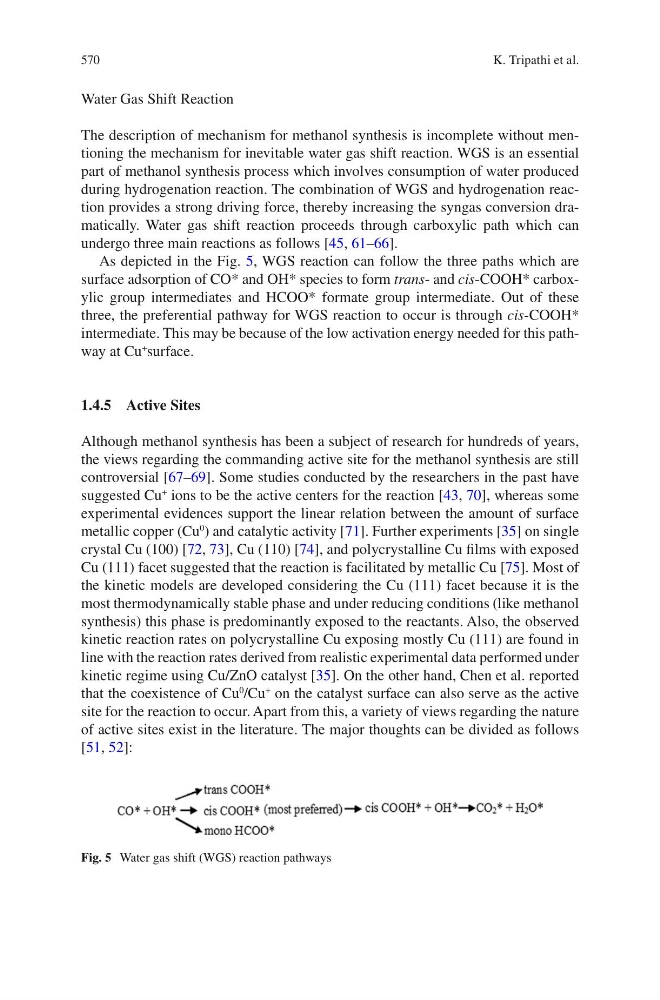
As depicted in the Fig. 5, WGS reaction can follow the three paths which are
surface adsorption of CO* and OH* species to form trans- and cis-COOH* carboxylic group intermediates and HCOO* formate group intermediate. Out of these
three, the preferential pathway for WGS reaction to occur is through cis-COOH*
intermediate. This may be because of the low activation energy needed for this pathway at Cu
+
surface.
1.4.5 Active Sites
Although methanol synthesis has been a subject of research for hundreds of years,
the views regarding the commanding active site for the methanol synthesis are still
controversial [67–69]. Some studies conducted by the researchers in the past have
suggested Cu
+
ions to be the active centers for the reaction [43, 70], whereas some
experimental evidences support the linear relation between the amount of surface
metallic copper (Cu
0
) and catalytic activity [71]. Further experiments [35] on single
crystal Cu (100) [72, 73], Cu (110) [74], and polycrystalline Cu films with exposed
Cu (111) facet suggested that the reaction is facilitated by metallic Cu [75]. Most of
the kinetic models are developed considering the Cu (111) facet because it is the
most thermodynamically stable phase and under reducing conditions (like methanol
synthesis) this phase is predominantly exposed to the reactants. Also, the observed
kinetic reaction rates on polycrystalline Cu exposing mostly Cu (111) are found in
line with the reaction rates derived from realistic experimental data performed under
kinetic regime using Cu/ZnO catalyst [35]. On the other hand, Chen et al. reported
that the coexistence of Cu
0
/Cu
+
on the catalyst surface can also serve as the active
site for the reaction to occur. Apart from this, a variety of views regarding the nature
of active sites exist in the literature. The major thoughts can be divided as follows
[51, 52]:
Fig. 5 Water gas shift (WGS) reaction pathways
K. Tripathi et al.
Water Gas Shift Reaction
The description of mechanism for methanol synthesis is incomplete without mentioning the mechanism for inevitable water gas shift reaction. WGS is an essential
part of methanol synthesis process which involves consumption of water produced
during hydrogenation reaction. The combination of WGS and hydrogenation reaction provides a strong driving force, thereby increasing the syngas conversion dramatically. Water gas shift reaction proceeds through carboxylic path which can
undergo three main reactions as follows [45, 61–66].
As depicted in the Fig. 5, WGS reaction can follow the three paths which are
surface adsorption of CO* and OH* species to form trans- and cis-COOH* carboxylic group intermediates and HCOO* formate group intermediate. Out of these
three, the preferential pathway for WGS reaction to occur is through cis-COOH*
intermediate. This may be because of the low activation energy needed for this pathway at Cu
+
surface.
1.4.5 Active Sites
Although methanol synthesis has been a subject of research for hundreds of years,
the views regarding the commanding active site for the methanol synthesis are still
controversial [67–69]. Some studies conducted by the researchers in the past have
suggested Cu
+
ions to be the active centers for the reaction [43, 70], whereas some
experimental evidences support the linear relation between the amount of surface
metallic copper (Cu
0
) and catalytic activity [71]. Further experiments [35] on single
crystal Cu (100) [72, 73], Cu (110) [74], and polycrystalline Cu films with exposed
Cu (111) facet suggested that the reaction is facilitated by metallic Cu [75]. Most of
the kinetic models are developed considering the Cu (111) facet because it is the
most thermodynamically stable phase and under reducing conditions (like methanol
synthesis) this phase is predominantly exposed to the reactants. Also, the observed
kinetic reaction rates on polycrystalline Cu exposing mostly Cu (111) are found in
line with the reaction rates derived from realistic experimental data performed under
kinetic regime using Cu/ZnO catalyst [35]. On the other hand, Chen et al. reported
that the coexistence of Cu
0
/Cu
+
on the catalyst surface can also serve as the active
site for the reaction to occur. Apart from this, a variety of views regarding the nature
of active sites exist in the literature. The major thoughts can be divided as follows
[51, 52]:
Fig. 5 Water gas shift (WGS) reaction pathways
K. Tripathi et al.