

568
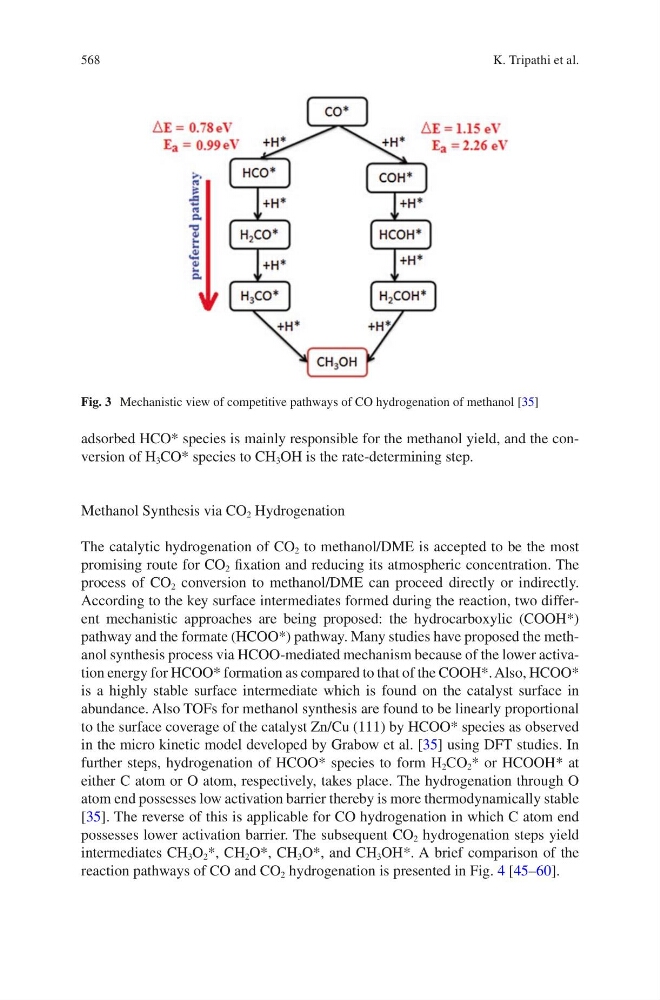
adsorbed HCO* species is mainly responsible for the methanol yield, and the conversion of H 3 CO* species to CH 3 OH is the rate-determining step.
Methanol Synthesis via CO 2 Hydrogenation
The catalytic hydrogenation of CO 2 to methanol/DME is accepted to be the most
promising route for CO 2 fixation and reducing its atmospheric concentration. The
process of CO 2 conversion to methanol/DME can proceed directly or indirectly.
According to the key surface intermediates formed during the reaction, two different mechanistic approaches are being proposed: the hydrocarboxylic (COOH*)
pathway and the formate (HCOO*) pathway. Many studies have proposed the methanol synthesis process via HCOO-mediated mechanism because of the lower activation energy for HCOO* formation as compared to that of the COOH*. Also, HCOO*
is a highly stable surface intermediate which is found on the catalyst surface in
abundance. Also TOFs for methanol synthesis are found to be linearly proportional
to the surface coverage of the catalyst Zn/Cu (111) by HCOO* species as observed
in the micro kinetic model developed by Grabow et al. [35] using DFT studies. In
further steps, hydrogenation of HCOO* species to form H 2 CO 2 * or HCOOH* at
either C atom or O atom, respectively, takes place. The hydrogenation through O
atom end possesses low activation barrier thereby is more thermodynamically stable
[35]. The reverse of this is applicable for CO hydrogenation in which C atom end
possesses lower activation barrier. The subsequent CO 2 hydrogenation steps yield
intermediates CH 3 O 2 *, CH 2 O*, CH 3 O*, and CH 3 OH*. A brief comparison of the
reaction pathways of CO and CO 2 hydrogenation is presented in Fig. 4 [45–60].
Fig. 3 Mechanistic view of competitive pathways of CO hydrogenation of methanol [35]
K. Tripathi et al.
adsorbed HCO* species is mainly responsible for the methanol yield, and the conversion of H 3 CO* species to CH 3 OH is the rate-determining step.
Methanol Synthesis via CO 2 Hydrogenation
The catalytic hydrogenation of CO 2 to methanol/DME is accepted to be the most
promising route for CO 2 fixation and reducing its atmospheric concentration. The
process of CO 2 conversion to methanol/DME can proceed directly or indirectly.
According to the key surface intermediates formed during the reaction, two different mechanistic approaches are being proposed: the hydrocarboxylic (COOH*)
pathway and the formate (HCOO*) pathway. Many studies have proposed the methanol synthesis process via HCOO-mediated mechanism because of the lower activation energy for HCOO* formation as compared to that of the COOH*. Also, HCOO*
is a highly stable surface intermediate which is found on the catalyst surface in
abundance. Also TOFs for methanol synthesis are found to be linearly proportional
to the surface coverage of the catalyst Zn/Cu (111) by HCOO* species as observed
in the micro kinetic model developed by Grabow et al. [35] using DFT studies. In
further steps, hydrogenation of HCOO* species to form H 2 CO 2 * or HCOOH* at
either C atom or O atom, respectively, takes place. The hydrogenation through O
atom end possesses low activation barrier thereby is more thermodynamically stable
[35]. The reverse of this is applicable for CO hydrogenation in which C atom end
possesses lower activation barrier. The subsequent CO 2 hydrogenation steps yield
intermediates CH 3 O 2 *, CH 2 O*, CH 3 O*, and CH 3 OH*. A brief comparison of the
reaction pathways of CO and CO 2 hydrogenation is presented in Fig. 4 [45–60].
Fig. 3 Mechanistic view of competitive pathways of CO hydrogenation of methanol [35]
K. Tripathi et al.