

567
assumed to be the main reaction pathway for methanol synthesis [42, 43], whereas
CO 2 modulates the surface composition, oxidation state of metal, and dispersion of
Cu as a passive reactant [43]. This was considered as the main mechanism until the
isotopic labelling experiments were performed first time by Chinchen et al. [44],
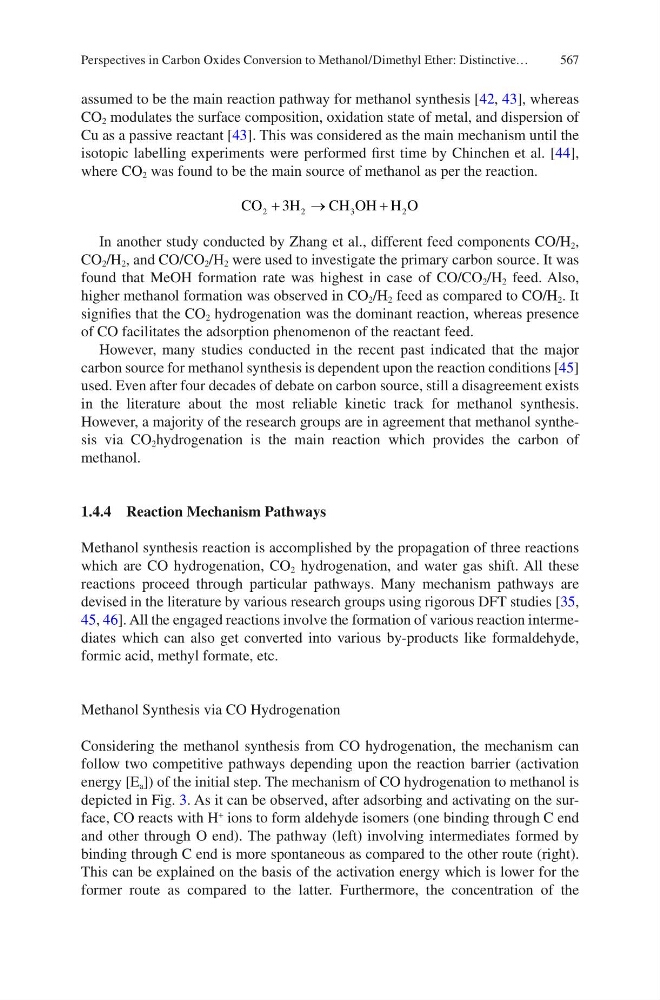
where CO 2 was found to be the main source of methanol as per the reaction.
CO
H
CH OH H O
2
2
3
2
3
+
→
+
In another study conducted by Zhang et al., different feed components CO/H 2 ,
CO 2 /H 2 , and CO/CO 2 /H 2 were used to investigate the primary carbon source. It was
found that MeOH formation rate was highest in case of CO/CO 2 /H 2 feed. Also,
higher methanol formation was observed in CO 2 /H 2 feed as compared to CO/H 2 . It
signifies that the CO 2 hydrogenation was the dominant reaction, whereas presence
of CO facilitates the adsorption phenomenon of the reactant feed.
However, many studies conducted in the recent past indicated that the major
carbon source for methanol synthesis is dependent upon the reaction conditions [45]
used. Even after four decades of debate on carbon source, still a disagreement exists
in the literature about the most reliable kinetic track for methanol synthesis.
However, a majority of the research groups are in agreement that methanol synthesis via CO 2 hydrogenation is the main reaction which provides the carbon of
methanol.
1.4.4 Reaction Mechanism Pathways
Methanol synthesis reaction is accomplished by the propagation of three reactions
which are CO hydrogenation, CO 2 hydrogenation, and water gas shift. All these
reactions proceed through particular pathways. Many mechanism pathways are
devised in the literature by various research groups using rigorous DFT studies [35,
45, 46]. All the engaged reactions involve the formation of various reaction intermediates which can also get converted into various by-products like formaldehyde,
formic acid, methyl formate, etc.
Methanol Synthesis via CO Hydrogenation
Considering the methanol synthesis from CO hydrogenation, the mechanism can
follow two competitive pathways depending upon the reaction barrier (activation
energy [E a ]) of the initial step. The mechanism of CO hydrogenation to methanol is
depicted in Fig. 3. As it can be observed, after adsorbing and activating on the surface, CO reacts with H
+
ions to form aldehyde isomers (one binding through C end
and other through O end). The pathway (left) involving intermediates formed by
binding through C end is more spontaneous as compared to the other route (right).
This can be explained on the basis of the activation energy which is lower for the
former route as compared to the latter. Furthermore, the concentration of the
Perspectives in Carbon Oxides Conversion to Methanol/Dimethyl Ether: Distinctive…
assumed to be the main reaction pathway for methanol synthesis [42, 43], whereas
CO 2 modulates the surface composition, oxidation state of metal, and dispersion of
Cu as a passive reactant [43]. This was considered as the main mechanism until the
isotopic labelling experiments were performed first time by Chinchen et al. [44],
where CO 2 was found to be the main source of methanol as per the reaction.
CO
H
CH OH H O
2
2
3
2
3
+
→
+
In another study conducted by Zhang et al., different feed components CO/H 2 ,
CO 2 /H 2 , and CO/CO 2 /H 2 were used to investigate the primary carbon source. It was
found that MeOH formation rate was highest in case of CO/CO 2 /H 2 feed. Also,
higher methanol formation was observed in CO 2 /H 2 feed as compared to CO/H 2 . It
signifies that the CO 2 hydrogenation was the dominant reaction, whereas presence
of CO facilitates the adsorption phenomenon of the reactant feed.
However, many studies conducted in the recent past indicated that the major
carbon source for methanol synthesis is dependent upon the reaction conditions [45]
used. Even after four decades of debate on carbon source, still a disagreement exists
in the literature about the most reliable kinetic track for methanol synthesis.
However, a majority of the research groups are in agreement that methanol synthesis via CO 2 hydrogenation is the main reaction which provides the carbon of
methanol.
1.4.4 Reaction Mechanism Pathways
Methanol synthesis reaction is accomplished by the propagation of three reactions
which are CO hydrogenation, CO 2 hydrogenation, and water gas shift. All these
reactions proceed through particular pathways. Many mechanism pathways are
devised in the literature by various research groups using rigorous DFT studies [35,
45, 46]. All the engaged reactions involve the formation of various reaction intermediates which can also get converted into various by-products like formaldehyde,
formic acid, methyl formate, etc.
Methanol Synthesis via CO Hydrogenation
Considering the methanol synthesis from CO hydrogenation, the mechanism can
follow two competitive pathways depending upon the reaction barrier (activation
energy [E a ]) of the initial step. The mechanism of CO hydrogenation to methanol is
depicted in Fig. 3. As it can be observed, after adsorbing and activating on the surface, CO reacts with H
+
ions to form aldehyde isomers (one binding through C end
and other through O end). The pathway (left) involving intermediates formed by
binding through C end is more spontaneous as compared to the other route (right).
This can be explained on the basis of the activation energy which is lower for the
former route as compared to the latter. Furthermore, the concentration of the
Perspectives in Carbon Oxides Conversion to Methanol/Dimethyl Ether: Distinctive…