

563
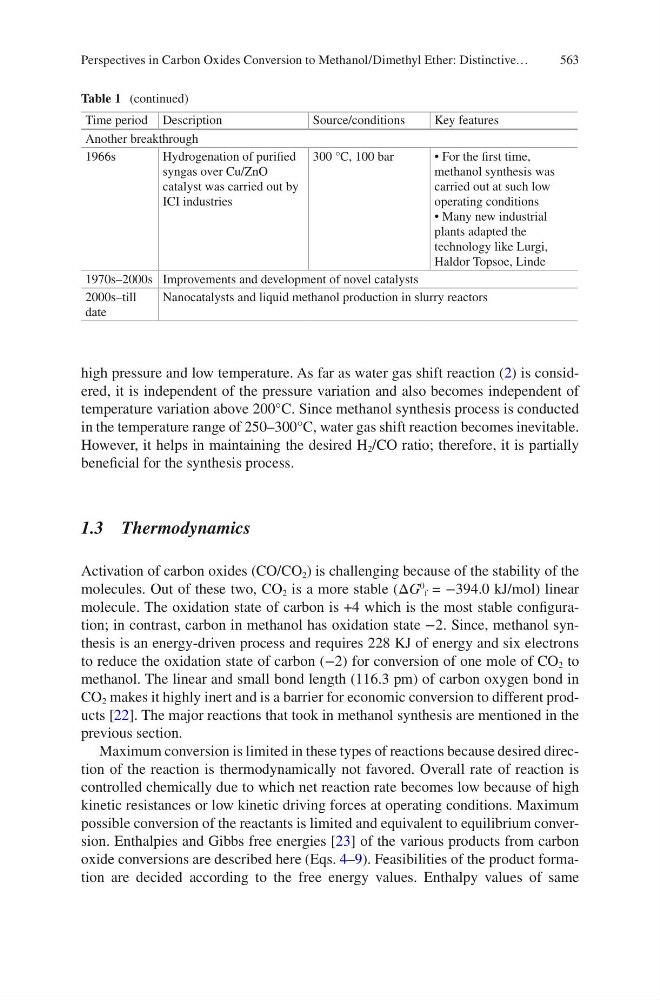
Table 1 (continued)
Time period Description
Source/conditions
Key features
Another breakthrough
1966s
Hydrogenation of purified
syngas over Cu/ZnO
catalyst was carried out by
ICI industries
300 °C, 100 bar
• For the first time,
methanol synthesis was
carried out at such low
operating conditions
• Many new industrial
plants adapted the
technology like Lurgi,
Haldor Topsoe, Linde
1970s–2000s Improvements and development of novel catalysts
2000s–till
date
Nanocatalysts and liquid methanol production in slurry reactors
high pressure and low temperature. As far as water gas shift reaction (2) is considered, it is independent of the pressure variation and also becomes independent of
temperature variation above 200°C. Since methanol synthesis process is conducted
in the temperature range of 250–300°C, water gas shift reaction becomes inevitable.
However, it helps in maintaining the desired H 2 /CO ratio; therefore, it is partially
beneficial for the synthesis process.
1.3 Thermodynamics
Activation of carbon oxides (CO/CO 2 ) is challenging because of the stability of the
molecules. Out of these two, CO 2 is a more stable (ΔG
0 f = −394.0 kJ/mol) linear
molecule. The oxidation state of carbon is +4 which is the most stable configuration; in contrast, carbon in methanol has oxidation state −2. Since, methanol synthesis is an energy-driven process and requires 228 KJ of energy and six electrons
to reduce the oxidation state of carbon (−2) for conversion of one mole of CO 2 to
methanol. The linear and small bond length (116.3 pm) of carbon oxygen bond in
CO 2 makes it highly inert and is a barrier for economic conversion to different products [22]. The major reactions that took in methanol synthesis are mentioned in the
previous section.
Maximum conversion is limited in these types of reactions because desired direction of the reaction is thermodynamically not favored. Overall rate of reaction is
controlled chemically due to which net reaction rate becomes low because of high
kinetic resistances or low kinetic driving forces at operating conditions. Maximum
possible conversion of the reactants is limited and equivalent to equilibrium conversion. Enthalpies and Gibbs free energies [23] of the various products from carbon
oxide conversions are described here (Eqs. 4–9). Feasibilities of the product formation are decided according to the free energy values. Enthalpy values of same
Perspectives in Carbon Oxides Conversion to Methanol/Dimethyl Ether: Distinctive…
Table 1 (continued)
Time period Description
Source/conditions
Key features
Another breakthrough
1966s
Hydrogenation of purified
syngas over Cu/ZnO
catalyst was carried out by
ICI industries
300 °C, 100 bar
• For the first time,
methanol synthesis was
carried out at such low
operating conditions
• Many new industrial
plants adapted the
technology like Lurgi,
Haldor Topsoe, Linde
1970s–2000s Improvements and development of novel catalysts
2000s–till
date
Nanocatalysts and liquid methanol production in slurry reactors
high pressure and low temperature. As far as water gas shift reaction (2) is considered, it is independent of the pressure variation and also becomes independent of
temperature variation above 200°C. Since methanol synthesis process is conducted
in the temperature range of 250–300°C, water gas shift reaction becomes inevitable.
However, it helps in maintaining the desired H 2 /CO ratio; therefore, it is partially
beneficial for the synthesis process.
1.3 Thermodynamics
Activation of carbon oxides (CO/CO 2 ) is challenging because of the stability of the
molecules. Out of these two, CO 2 is a more stable (ΔG
0 f = −394.0 kJ/mol) linear
molecule. The oxidation state of carbon is +4 which is the most stable configuration; in contrast, carbon in methanol has oxidation state −2. Since, methanol synthesis is an energy-driven process and requires 228 KJ of energy and six electrons
to reduce the oxidation state of carbon (−2) for conversion of one mole of CO 2 to
methanol. The linear and small bond length (116.3 pm) of carbon oxygen bond in
CO 2 makes it highly inert and is a barrier for economic conversion to different products [22]. The major reactions that took in methanol synthesis are mentioned in the
previous section.
Maximum conversion is limited in these types of reactions because desired direction of the reaction is thermodynamically not favored. Overall rate of reaction is
controlled chemically due to which net reaction rate becomes low because of high
kinetic resistances or low kinetic driving forces at operating conditions. Maximum
possible conversion of the reactants is limited and equivalent to equilibrium conversion. Enthalpies and Gibbs free energies [23] of the various products from carbon
oxide conversions are described here (Eqs. 4–9). Feasibilities of the product formation are decided according to the free energy values. Enthalpy values of same
Perspectives in Carbon Oxides Conversion to Methanol/Dimethyl Ether: Distinctive…