

562
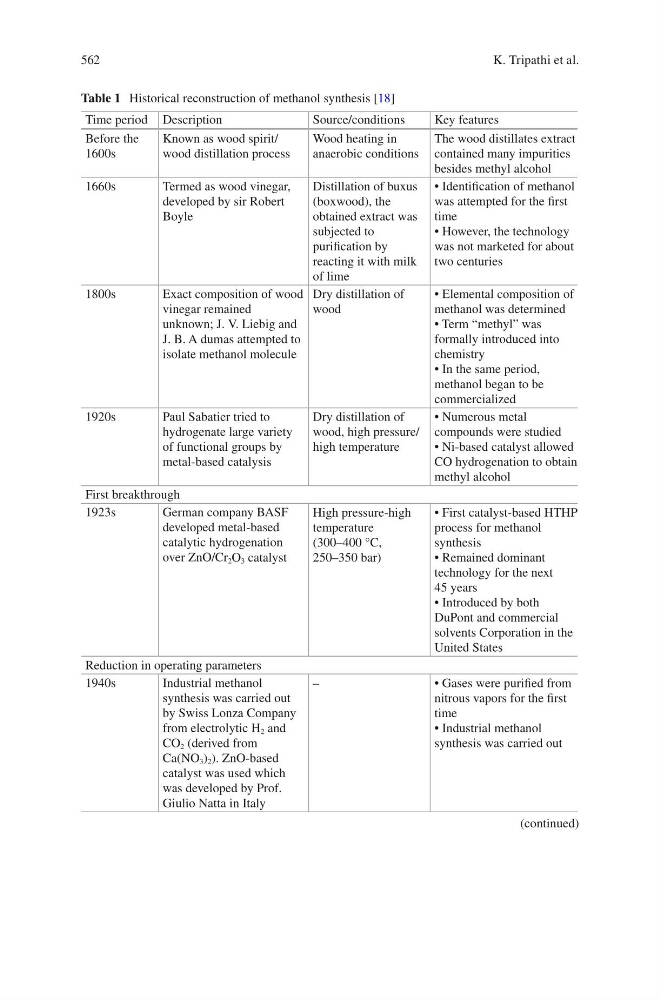
Table 1 Historical reconstruction of methanol synthesis [18]
Time period Description
Source/conditions
Key features
Before the
1600s
Known as wood spirit/
wood distillation process
Wood heating in
anaerobic conditions
The wood distillates extract
contained many impurities
besides methyl alcohol
1660s
Termed as wood vinegar,
developed by sir Robert
Boyle
Distillation of buxus
(boxwood), the
obtained extract was
subjected to
purification by
reacting it with milk
of lime
• Identification of methanol
was attempted for the first
time
• However, the technology
was not marketed for about
two centuries
1800s
Exact composition of wood
vinegar remained
unknown; J. V. Liebig and
J. B. A dumas attempted to
isolate methanol molecule
Dry distillation of
wood
• Elemental composition of
methanol was determined
• Term “methyl” was
formally introduced into
chemistry
• In the same period,
methanol began to be
commercialized
1920s
Paul Sabatier tried to
hydrogenate large variety
of functional groups by
metal-based catalysis
Dry distillation of
wood, high pressure/
high temperature
• Numerous metal
compounds were studied
• Ni-based catalyst allowed
CO hydrogenation to obtain
methyl alcohol
First breakthrough
1923s
German company BASF
developed metal-based
catalytic hydrogenation
over ZnO/Cr 2 O 3 catalyst
High pressure-high
temperature
(300–400 °C,
250–350 bar)
• First catalyst-based HTHP
process for methanol
synthesis
• Remained dominant
technology for the next
45 years
• Introduced by both
DuPont and commercial
solvents Corporation in the
United States
Reduction in operating parameters
1940s
Industrial methanol
synthesis was carried out
by Swiss Lonza Company
from electrolytic H 2 and
CO 2 (derived from
Ca(NO 3 ) 2 ). ZnO-based
catalyst was used which
was developed by Prof.
Giulio Natta in Italy
–
• Gases were purified from
nitrous vapors for the first
time
• Industrial methanol
synthesis was carried out
(continued)
K. Tripathi et al.
Table 1 Historical reconstruction of methanol synthesis [18]
Time period Description
Source/conditions
Key features
Before the
1600s
Known as wood spirit/
wood distillation process
Wood heating in
anaerobic conditions
The wood distillates extract
contained many impurities
besides methyl alcohol
1660s
Termed as wood vinegar,
developed by sir Robert
Boyle
Distillation of buxus
(boxwood), the
obtained extract was
subjected to
purification by
reacting it with milk
of lime
• Identification of methanol
was attempted for the first
time
• However, the technology
was not marketed for about
two centuries
1800s
Exact composition of wood
vinegar remained
unknown; J. V. Liebig and
J. B. A dumas attempted to
isolate methanol molecule
Dry distillation of
wood
• Elemental composition of
methanol was determined
• Term “methyl” was
formally introduced into
chemistry
• In the same period,
methanol began to be
commercialized
1920s
Paul Sabatier tried to
hydrogenate large variety
of functional groups by
metal-based catalysis
Dry distillation of
wood, high pressure/
high temperature
• Numerous metal
compounds were studied
• Ni-based catalyst allowed
CO hydrogenation to obtain
methyl alcohol
First breakthrough
1923s
German company BASF
developed metal-based
catalytic hydrogenation
over ZnO/Cr 2 O 3 catalyst
High pressure-high
temperature
(300–400 °C,
250–350 bar)
• First catalyst-based HTHP
process for methanol
synthesis
• Remained dominant
technology for the next
45 years
• Introduced by both
DuPont and commercial
solvents Corporation in the
United States
Reduction in operating parameters
1940s
Industrial methanol
synthesis was carried out
by Swiss Lonza Company
from electrolytic H 2 and
CO 2 (derived from
Ca(NO 3 ) 2 ). ZnO-based
catalyst was used which
was developed by Prof.
Giulio Natta in Italy
–
• Gases were purified from
nitrous vapors for the first
time
• Industrial methanol
synthesis was carried out
(continued)
K. Tripathi et al.