

561
blender in gasoline, methanol-based fuel cells, and many household purposes.
Methanol synthesis reaction is an exothermic and equilibrium-restricted reaction
[20, 21]. To circumvent the accumulation of large amount of reaction heat, per pass
conversion of the reactant is limited to 15–25%. The following reactions occur in
overall methanol synthesis process:
CO H
CH OH
k J mol
+
↔
= −
°
2
9 1
2
3
∆H
/
(1)
CO H O
CO H
k J mol
+
↔
+
=−
°
2
2
2
41
∆H
/
(2)
CO
H
CH OH H O
k J mol
2
2
3
2
3
4 9
+
↔
+
=−
°
∆H
/
(3)
Reaction (3) of methanol synthesis from CO 2 hydrogenation takes place with the
combination of the above two reactions, which are methanol synthesis reaction (1)
from CO hydrogenation and water gas shift reaction (2). In the instance when water
gas shift reaction does not occur, reactions (1) and (3) propagate independently
when both CO and CO 2 are in the same feed stream. Both of the reactions (1) and
(3) involve compression in moles of the products as compared to that of the reactants, increasing the process pressure and decrease in the overall entropy of the
reaction. This leads to higher conversion, thereby making the reaction favorable at
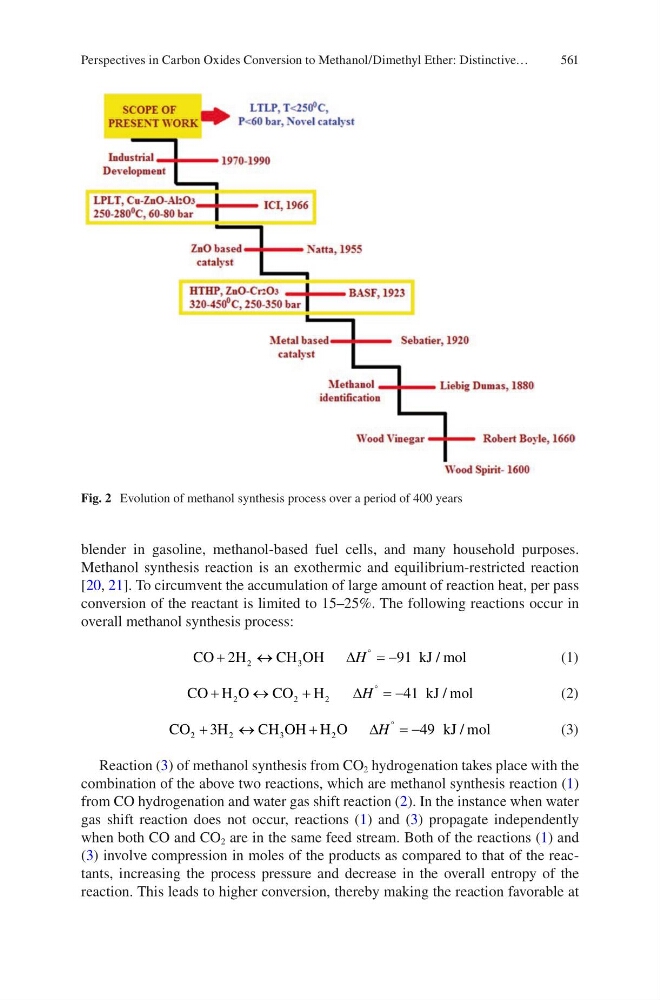
Fig. 2 Evolution of methanol synthesis process over a period of 400 years
Perspectives in Carbon Oxides Conversion to Methanol/Dimethyl Ether: Distinctive…
blender in gasoline, methanol-based fuel cells, and many household purposes.
Methanol synthesis reaction is an exothermic and equilibrium-restricted reaction
[20, 21]. To circumvent the accumulation of large amount of reaction heat, per pass
conversion of the reactant is limited to 15–25%. The following reactions occur in
overall methanol synthesis process:
CO H
CH OH
k J mol
+
↔
= −
°
2
9 1
2
3
∆H
/
(1)
CO H O
CO H
k J mol
+
↔
+
=−
°
2
2
2
41
∆H
/
(2)
CO
H
CH OH H O
k J mol
2
2
3
2
3
4 9
+
↔
+
=−
°
∆H
/
(3)
Reaction (3) of methanol synthesis from CO 2 hydrogenation takes place with the
combination of the above two reactions, which are methanol synthesis reaction (1)
from CO hydrogenation and water gas shift reaction (2). In the instance when water
gas shift reaction does not occur, reactions (1) and (3) propagate independently
when both CO and CO 2 are in the same feed stream. Both of the reactions (1) and
(3) involve compression in moles of the products as compared to that of the reactants, increasing the process pressure and decrease in the overall entropy of the
reaction. This leads to higher conversion, thereby making the reaction favorable at
Fig. 2 Evolution of methanol synthesis process over a period of 400 years
Perspectives in Carbon Oxides Conversion to Methanol/Dimethyl Ether: Distinctive…