

564
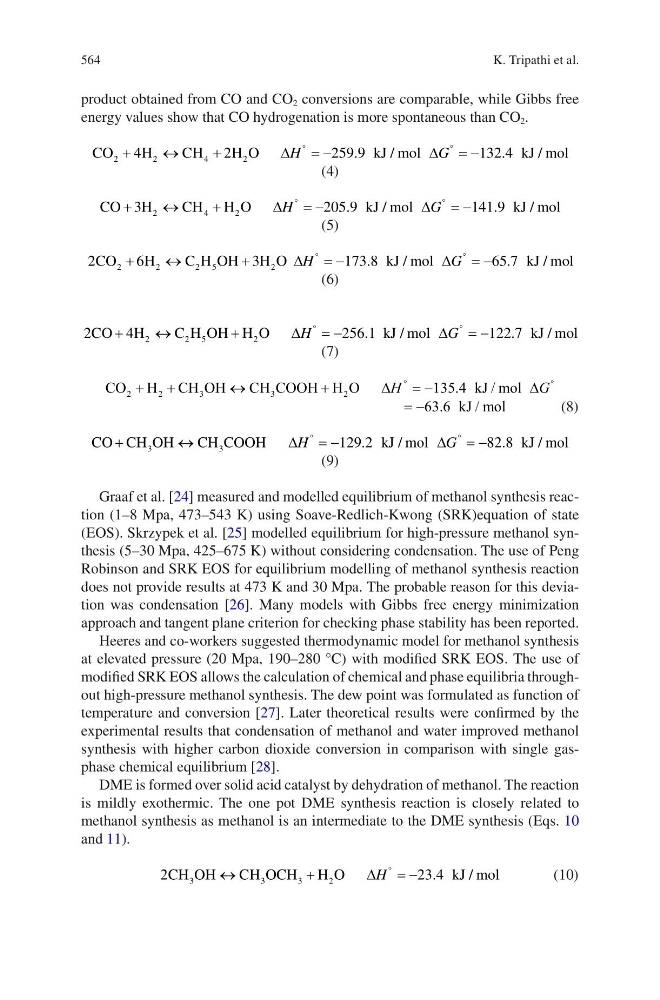
product obtained from CO and CO 2 conversions are comparable, while Gibbs free
energy values show that CO hydrogenation is more spontaneous than CO 2 .
CO
H
CH
H O
k J mol
kJ mol
2
2
4
2
4
2
259 9
132 4
+
↔
+
= −
= −
°
°
∆
∆
H
G
.
/
.
/
(4)
CO H
CH H O
k J mol
kJ mol
+
↔
+
=−
= −
°
°
3
205 9
141 9
2
4
2
∆
∆
H
G
.
/
.
/
(5)
2
6
3
173 8
6 5 7
2
2
2 5
2
CO
H
C H OH H O
k J mol
kJ mol
+
↔
+
=−
= −
°
°
∆
∆
H
G
.
/
.
/
(6)
2
4
256 1
122 7
2
2 5
2
CO H
C H OH H O
k J mol
kJ mol
+
↔
+
=−
= −
°
°
∆
∆
H
G
.
/
.
/
(7)
CO H CH OH
CH COOH H O
kJ mol
kJ mol
2
2
3
3
2
135 4
63 6
+
+
↔
+
= −
= −
°
°
∆
∆
H
G
.
/
.
/
(8)
CO CH OH
CH COOH
kJ mol
k J mol
+
↔
= −
= −
°
°
3
3
129 2
8 2 8
∆
∆
H
G
.
/
.
/
(9)
Graaf et al. [24] measured and modelled equilibrium of methanol synthesis reaction (1–8 Mpa, 473–543 K) using Soave-Redlich-Kwong (SRK)equation of state
(EOS). Skrzypek et al. [25] modelled equilibrium for high-pressure methanol synthesis (5–30 Mpa, 425–675 K) without considering condensation. The use of Peng
Robinson and SRK EOS for equilibrium modelling of methanol synthesis reaction
does not provide results at 473 K and 30 Mpa. The probable reason for this deviation was condensation [26]. Many models with Gibbs free energy minimization
approach and tangent plane criterion for checking phase stability has been reported.
Heeres and co-workers suggested thermodynamic model for methanol synthesis
at elevated pressure (20 Mpa, 190–280 °C) with modified SRK EOS. The use of
modified SRK EOS allows the calculation of chemical and phase equilibria throughout high-pressure methanol synthesis. The dew point was formulated as function of
temperature and conversion [27]. Later theoretical results were confirmed by the
experimental results that condensation of methanol and water improved methanol
synthesis with higher carbon dioxide conversion in comparison with single gasphase chemical equilibrium [28].
DME is formed over solid acid catalyst by dehydration of methanol. The reaction
is mildly exothermic. The one pot DME synthesis reaction is closely related to
methanol synthesis as methanol is an intermediate to the DME synthesis (Eqs. 10
and 11).
2
2 3 4
3
3
3
2
CH OH
CH OCH H O
k J mol
↔
+
= −
°
∆H
.
/
(10)
K. Tripathi et al.
product obtained from CO and CO 2 conversions are comparable, while Gibbs free
energy values show that CO hydrogenation is more spontaneous than CO 2 .
CO
H
CH
H O
k J mol
kJ mol
2
2
4
2
4
2
259 9
132 4
+
↔
+
= −
= −
°
°
∆
∆
H
G
.
/
.
/
(4)
CO H
CH H O
k J mol
kJ mol
+
↔
+
=−
= −
°
°
3
205 9
141 9
2
4
2
∆
∆
H
G
.
/
.
/
(5)
2
6
3
173 8
6 5 7
2
2
2 5
2
CO
H
C H OH H O
k J mol
kJ mol
+
↔
+
=−
= −
°
°
∆
∆
H
G
.
/
.
/
(6)
2
4
256 1
122 7
2
2 5
2
CO H
C H OH H O
k J mol
kJ mol
+
↔
+
=−
= −
°
°
∆
∆
H
G
.
/
.
/
(7)
CO H CH OH
CH COOH H O
kJ mol
kJ mol
2
2
3
3
2
135 4
63 6
+
+
↔
+
= −
= −
°
°
∆
∆
H
G
.
/
.
/
(8)
CO CH OH
CH COOH
kJ mol
k J mol
+
↔
= −
= −
°
°
3
3
129 2
8 2 8
∆
∆
H
G
.
/
.
/
(9)
Graaf et al. [24] measured and modelled equilibrium of methanol synthesis reaction (1–8 Mpa, 473–543 K) using Soave-Redlich-Kwong (SRK)equation of state
(EOS). Skrzypek et al. [25] modelled equilibrium for high-pressure methanol synthesis (5–30 Mpa, 425–675 K) without considering condensation. The use of Peng
Robinson and SRK EOS for equilibrium modelling of methanol synthesis reaction
does not provide results at 473 K and 30 Mpa. The probable reason for this deviation was condensation [26]. Many models with Gibbs free energy minimization
approach and tangent plane criterion for checking phase stability has been reported.
Heeres and co-workers suggested thermodynamic model for methanol synthesis
at elevated pressure (20 Mpa, 190–280 °C) with modified SRK EOS. The use of
modified SRK EOS allows the calculation of chemical and phase equilibria throughout high-pressure methanol synthesis. The dew point was formulated as function of
temperature and conversion [27]. Later theoretical results were confirmed by the
experimental results that condensation of methanol and water improved methanol
synthesis with higher carbon dioxide conversion in comparison with single gasphase chemical equilibrium [28].
DME is formed over solid acid catalyst by dehydration of methanol. The reaction
is mildly exothermic. The one pot DME synthesis reaction is closely related to
methanol synthesis as methanol is an intermediate to the DME synthesis (Eqs. 10
and 11).
2
2 3 4
3
3
3
2
CH OH
CH OCH H O
k J mol
↔
+
= −
°
∆H
.
/
(10)
K. Tripathi et al.