

546
though more expensive, have been shown to have high activity and resist deactivation in steam reforming [85, 86], dry reforming [87] and partial oxidation [88]
which are the main reforming reactions.
The three main descriptors for the performance of a catalyst are activity, selectivity and stability. Activity refers to the ability of the catalyst to convert feedstock into
products usually measured in terms of conversion and turn over number or frequency. Selectivity is the ability of the catalyst to give a desired product out of all
possible product, and stability refers to the ability of the catalyst to maintain the
sufficient level of activity and selectivity at the reaction conditions with time [73].
For high activity and selectivity, reforming catalysts should absorb and activate
CO 2 , CH 4 , H 2 O and O 2 efficiently [74]. Surface acidic and basic sites are essential
for CO 2 absorption and activation [74]. Supports for reforming catalyst should have
high hydrothermal stability and surface area [74]. Studies have shown that high
metal dispersion, stronger metal support interaction, smaller particle size improve
catalytic activity [37, 74, 87].
Deactivation mechanisms for reforming catalysts include coking, sintering,
metal re-oxidation or irreversible reactions with support [74, 87, 89]. The nature of
the catalyst support has been shown to strongly influence catalyst deactivation [74,
89, 90] and hence the stability of the catalyst. Redox, oxygen storage and oxophillic
properties of supports have been shown to promote coke gasification and minimize
metal oxidation while strong metal support interaction limits sintering [74]. The
design of reforming catalysts to ensure stable operation is still an active area of
research [91].
Tri-reforming reaction is a complex reaction system which is a combination of
several reactions occurring simultaneously. While the kinetics of the individual
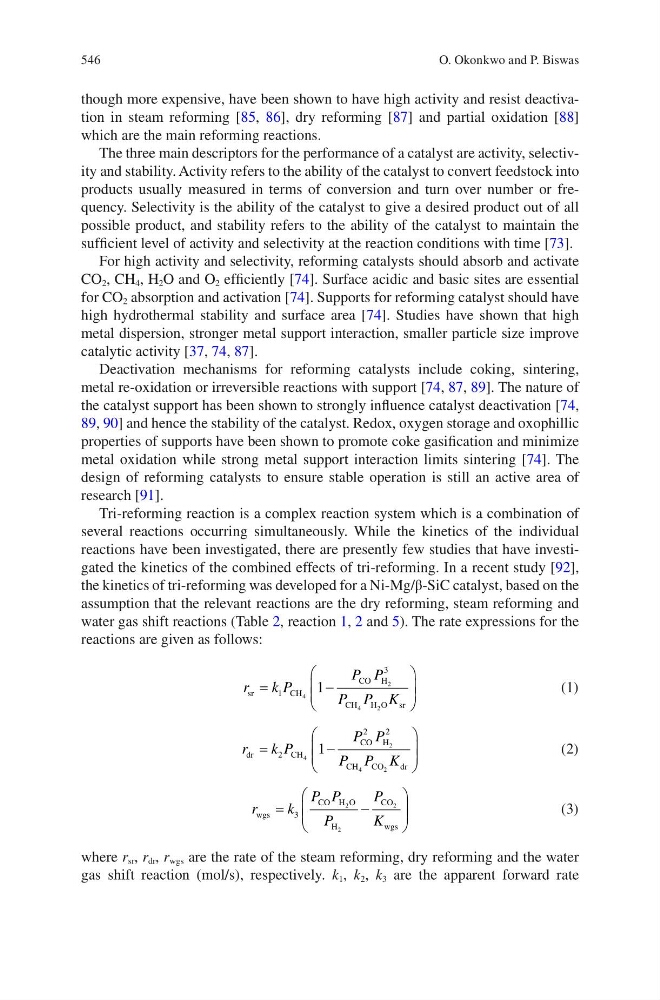
reactions have been investigated, there are presently few studies that have investigated the kinetics of the combined effects of tri-reforming. In a recent study [92],
the kinetics of tri-reforming was developed for a Ni-Mg/β-SiC catalyst, based on the
assumption that the relevant reactions are the dry reforming, steam reforming and
water gas shift reactions (Table 2, reaction 1, 2 and 5). The rate expressions for the
reactions are given as follows:
r
k P
P P
P P K
sr
CH
CO H
CH
H O sr
=
-
æ
è
ç
ç
ö
ø
÷
÷
1
3
4
2
4
2
1
(1)
r
k P
P P
P P K
dr
CH
CO H
CH
CO
dr
=
-
æ
è
ç
ç
ö
ø
÷
÷
2
2
2
4
2
4
2
1
(2)
r
k
P P
P
P
K
wgs
CO H O
H
CO
wgs
=
-
æ
è
ç
ç
ö
ø
÷
÷
3
2
2
2
(3)
where r sr , r dr , r wgs are the rate of the steam reforming, dry reforming and the water
gas shift reaction (mol/s), respectively. k 1 , k 2 , k 3 are the apparent forward rate
O. Okonkwo and P. Biswas
though more expensive, have been shown to have high activity and resist deactivation in steam reforming [85, 86], dry reforming [87] and partial oxidation [88]
which are the main reforming reactions.
The three main descriptors for the performance of a catalyst are activity, selectivity and stability. Activity refers to the ability of the catalyst to convert feedstock into
products usually measured in terms of conversion and turn over number or frequency. Selectivity is the ability of the catalyst to give a desired product out of all
possible product, and stability refers to the ability of the catalyst to maintain the
sufficient level of activity and selectivity at the reaction conditions with time [73].
For high activity and selectivity, reforming catalysts should absorb and activate
CO 2 , CH 4 , H 2 O and O 2 efficiently [74]. Surface acidic and basic sites are essential
for CO 2 absorption and activation [74]. Supports for reforming catalyst should have
high hydrothermal stability and surface area [74]. Studies have shown that high
metal dispersion, stronger metal support interaction, smaller particle size improve
catalytic activity [37, 74, 87].
Deactivation mechanisms for reforming catalysts include coking, sintering,
metal re-oxidation or irreversible reactions with support [74, 87, 89]. The nature of
the catalyst support has been shown to strongly influence catalyst deactivation [74,
89, 90] and hence the stability of the catalyst. Redox, oxygen storage and oxophillic
properties of supports have been shown to promote coke gasification and minimize
metal oxidation while strong metal support interaction limits sintering [74]. The
design of reforming catalysts to ensure stable operation is still an active area of
research [91].
Tri-reforming reaction is a complex reaction system which is a combination of
several reactions occurring simultaneously. While the kinetics of the individual
reactions have been investigated, there are presently few studies that have investigated the kinetics of the combined effects of tri-reforming. In a recent study [92],
the kinetics of tri-reforming was developed for a Ni-Mg/β-SiC catalyst, based on the
assumption that the relevant reactions are the dry reforming, steam reforming and
water gas shift reactions (Table 2, reaction 1, 2 and 5). The rate expressions for the
reactions are given as follows:
r
k P
P P
P P K
sr
CH
CO H
CH
H O sr
=
-
æ
è
ç
ç
ö
ø
÷
÷
1
3
4
2
4
2
1
(1)
r
k P
P P
P P K
dr
CH
CO H
CH
CO
dr
=
-
æ
è
ç
ç
ö
ø
÷
÷
2
2
2
4
2
4
2
1
(2)
r
k
P P
P
P
K
wgs
CO H O
H
CO
wgs
=
-
æ
è
ç
ç
ö
ø
÷
÷
3
2
2
2
(3)
where r sr , r dr , r wgs are the rate of the steam reforming, dry reforming and the water
gas shift reaction (mol/s), respectively. k 1 , k 2 , k 3 are the apparent forward rate
O. Okonkwo and P. Biswas