

545
interaction. Depending on the reaction, concentration of acid sites and basic sites on
the catalyst surface can influence the activity of the catalyst as it impacts adsorption
and activation of reactant species and coke formation [74]. Concentration of acid
and basic sites is characterized using NH 3 and CO 2 temperature-programmed
desorption (TPD).
The morphology of synthesized catalyst can be characterized using electron
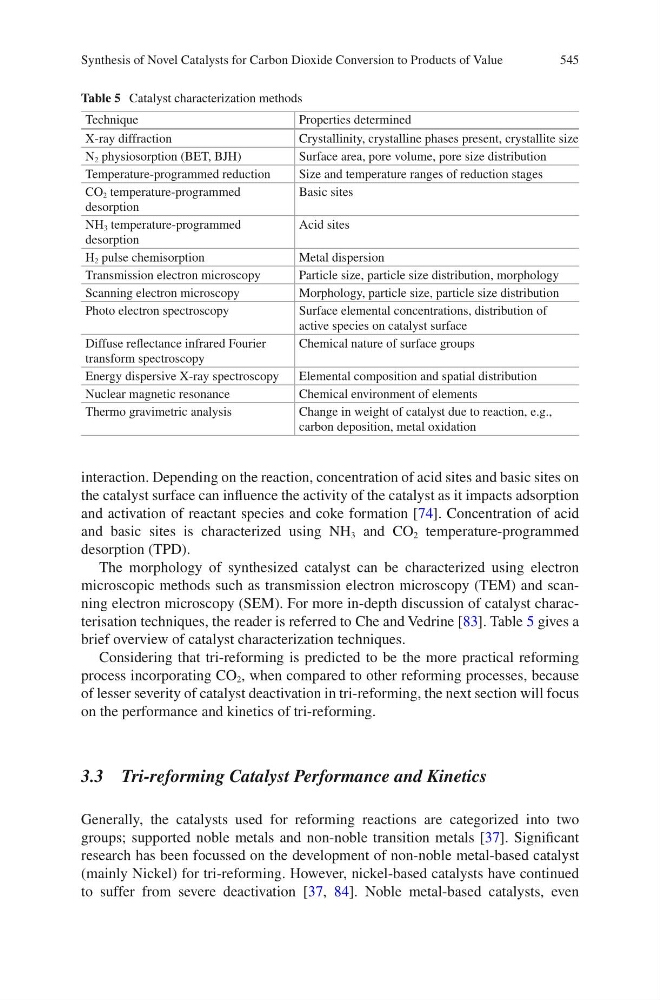
microscopic methods such as transmission electron microscopy (TEM) and scanning electron microscopy (SEM). For more in-depth discussion of catalyst characterisation techniques, the reader is referred to Che and Vedrine [83]. Table 5 gives a
brief overview of catalyst characterization techniques.
Considering that tri-reforming is predicted to be the more practical reforming
process incorporating CO 2 , when compared to other reforming processes, because
of lesser severity of catalyst deactivation in tri-reforming, the next section will focus
on the performance and kinetics of tri-reforming.
3.3 Tri-reforming Catalyst Performance and Kinetics
Generally, the catalysts used for reforming reactions are categorized into two
groups; supported noble metals and non-noble transition metals [37]. Significant
research has been focussed on the development of non-noble metal-based catalyst
(mainly Nickel) for tri-reforming. However, nickel-based catalysts have continued
to suffer from severe deactivation [37, 84]. Noble metal-based catalysts, even
Table 5 Catalyst characterization methods
Technique
Properties determined
X-ray diffraction
Crystallinity, crystalline phases present, crystallite size
N 2 physiosorption (BET, BJH)
Surface area, pore volume, pore size distribution
Temperature-programmed reduction
Size and temperature ranges of reduction stages
CO 2 temperature-programmed
desorption
Basic sites
NH 3 temperature-programmed
desorption
Acid sites
H 2 pulse chemisorption
Metal dispersion
Transmission electron microscopy
Particle size, particle size distribution, morphology
Scanning electron microscopy
Morphology, particle size, particle size distribution
Photo electron spectroscopy
Surface elemental concentrations, distribution of
active species on catalyst surface
Diffuse reflectance infrared Fourier
transform spectroscopy
Chemical nature of surface groups
Energy dispersive X-ray spectroscopy
Elemental composition and spatial distribution
Nuclear magnetic resonance
Chemical environment of elements
Thermo gravimetric analysis
Change in weight of catalyst due to reaction, e.g.,
carbon deposition, metal oxidation
Synthesis of Novel Catalysts for Carbon Dioxide Conversion to Products of Value
interaction. Depending on the reaction, concentration of acid sites and basic sites on
the catalyst surface can influence the activity of the catalyst as it impacts adsorption
and activation of reactant species and coke formation [74]. Concentration of acid
and basic sites is characterized using NH 3 and CO 2 temperature-programmed
desorption (TPD).
The morphology of synthesized catalyst can be characterized using electron
microscopic methods such as transmission electron microscopy (TEM) and scanning electron microscopy (SEM). For more in-depth discussion of catalyst characterisation techniques, the reader is referred to Che and Vedrine [83]. Table 5 gives a
brief overview of catalyst characterization techniques.
Considering that tri-reforming is predicted to be the more practical reforming
process incorporating CO 2 , when compared to other reforming processes, because
of lesser severity of catalyst deactivation in tri-reforming, the next section will focus
on the performance and kinetics of tri-reforming.
3.3 Tri-reforming Catalyst Performance and Kinetics
Generally, the catalysts used for reforming reactions are categorized into two
groups; supported noble metals and non-noble transition metals [37]. Significant
research has been focussed on the development of non-noble metal-based catalyst
(mainly Nickel) for tri-reforming. However, nickel-based catalysts have continued
to suffer from severe deactivation [37, 84]. Noble metal-based catalysts, even
Table 5 Catalyst characterization methods
Technique
Properties determined
X-ray diffraction
Crystallinity, crystalline phases present, crystallite size
N 2 physiosorption (BET, BJH)
Surface area, pore volume, pore size distribution
Temperature-programmed reduction
Size and temperature ranges of reduction stages
CO 2 temperature-programmed
desorption
Basic sites
NH 3 temperature-programmed
desorption
Acid sites
H 2 pulse chemisorption
Metal dispersion
Transmission electron microscopy
Particle size, particle size distribution, morphology
Scanning electron microscopy
Morphology, particle size, particle size distribution
Photo electron spectroscopy
Surface elemental concentrations, distribution of
active species on catalyst surface
Diffuse reflectance infrared Fourier
transform spectroscopy
Chemical nature of surface groups
Energy dispersive X-ray spectroscopy
Elemental composition and spatial distribution
Nuclear magnetic resonance
Chemical environment of elements
Thermo gravimetric analysis
Change in weight of catalyst due to reaction, e.g.,
carbon deposition, metal oxidation
Synthesis of Novel Catalysts for Carbon Dioxide Conversion to Products of Value